
Replacing the heating element in a dishwasher
 The design of a dishwasher and a washing machine is similar, but a detailed comparison reveals that a dishwasher is simpler. Despite this, it requires repairs just like other household appliances. It's a matter of luck: it might work for ten years without breaking down, or it might work for a year and then start acting up. In this article, we'll discuss replacing a dishwasher's heating element, what's needed for the job, how to access the faulty part, and how to determine whether it needs replacing.
How do you know when it's time to change the heating element?
Modern dishwashers are equipped with an electronic self-diagnostic system. If a malfunction occurs with any component, the system will display an error code with a specific alphanumeric character. In some cases, problems with water heating occur, but the system doesn't display any errors. This is where you need to use your brain, not let the problem slide, and begin to determine the cause. Let's take preventative measures.
- Let's turn the dishwasher upside down.
- Remove the back panel (if the machine is not built-in) or the bottom panel (if the machine is built-in). To remove the bottom panel, disconnect the drain hose from the heating unit, then pull the entire panel toward you.
Important! You don't need to pull the panel all the way out, and you won't be able to do so without unscrewing the fasteners inside the machine's body. Our goal is to access the temperature sensor, which will be located just above the heating block.
- We inspect the sensor visually and with a multimeter. Pay particular attention to the wiring and contacts. There should be no signs of burning or melting.
- If the sensor is working properly and there are no traces of burning, you will have to disassemble the Bosch, Electrolux or Indesit dishwasher further and consider replacing the heating element at the same time.
What will be required to produce a replacement?
Each component, including the heating element, in Bosch, Electrolux, or Indesit dishwashers is completely replaceable. Repairing them is extremely difficult, if not impossible, especially without the help of a specialist. Therefore, the most practical solution is to remove and discard the broken part and install a new one. If you follow this procedure, you won't need any special tools; however, be sure to have the following items ready:
- two screwdrivers - flat and Phillips;
- multimeter;
- pliers;
- awl.
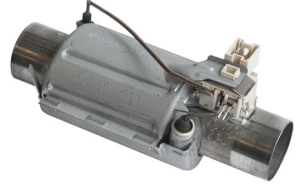 We'll need the heating element assembly and possibly a separate temperature sensor. Bosch, Electrolux, and Indesit dishwashers have removable temperature sensors. Don't rush into buying replacement parts. Experts recommend first making sure the heating element is faulty and only then replacing it. The thing is that in dishwashers Bosch, Electrolux or Indesit heating elements cannot be replaced separately from the heating unit. The exceptions are certain models, which we'll discuss in more detail.
The heating unit consists of a plastic housing with outlets for pipes and sensor ports. If the plastic housing doesn't have fasteners indicating it's detachable, the heating element itself can't be removed and replaced. If the heating unit is detachable, you can disassemble it, remove the burned-out heating element, and install a new one in its place.
Important! A non-removable heating unit with a heating element for a Bosch dishwasher can cost $30–$100, depending on the model. An Electrolux heating element costs $35–$40, and an Indesit heating element costs $25–$35.
Changing the heating element: step-by-step instructions
If you're certain that the heating element has burned out and that's why your Bosch, Electrolux, or Indesit dishwasher isn't heating up, you should purchase a genuine spare part and begin the replacement. It's a good idea to consider the cost-effectiveness of the repair while you're at it. If, for example, a dishwasher is already old and its “red price” is $7,000, then what’s the point of buying a flow-through heating element for the same money? But of course, you know better. Let's get started replacing the heating element on the dishwasher.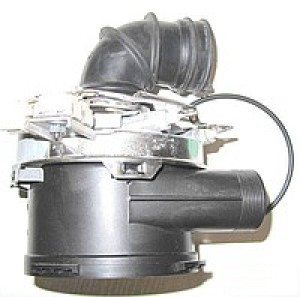
- To replace the dishwasher's flow-through heating element, first open the dishwasher door and remove the dish trays so they are out of the way.
- Disconnect the dishwasher from the power supply and unscrew all the hoses.
- Inside the dishwasher, at the very bottom, there is a plastic spray arm; remove it by pulling it up.
- Next, we unscrew the peculiar plastic cup located nearby – this is the filter.
- We lift and put aside the stainless steel mesh.
- We unscrew the five screws holding the pipe and the flow-through heating block.
- Now let's turn the dishwasher upside down.
- Unscrew the back panel or remove the bottom panel (this was discussed above).
- The flow-through heating element is connected to the pump on the side. Grasp it with your hands and turn it half a turn clockwise, then pull it to the side. The pump will be in your hands. Disconnect the sensor and set the pump aside.
- The flow-through heating element is held in place by a rubber fastener at the bottom. Reach under the plastic housing and remove this fastener.
- Disconnect the sensor plugs and hoses, then remove the burned-out heating element and install a new one in its place. Reassemble the dishwasher in reverse order.
As you can see, replacing a heating element isn't difficult. Even if you encounter a few nuances along the way, you'll figure it out easily. Sometimes you'll need to pry up a plastic clamp with an awl (if you damage it, you'll need to replace it). Sometimes you'll need to grab a stubborn hose with pliers—these are minor details, but be careful not to damage the fragile plastic parts, as they're currently prohibitively expensive. We hope your DIY dishwasher heating element replacement goes well, and we wish you the best of luck!
Interesting:

Readers' comments
Headings
Washing machine repair




For buyers




For users


Dishwasher




Add a comment