
Types of drying in dishwashers
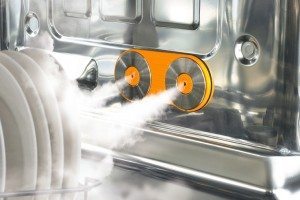 The final stage of the dishwasher's drying process is drying. There are several drying methods, each with its own operating principle and, consequently, duration. We've decided to describe each drying method in detail, identifying the best option and highlighting their pros and cons.
Condensation type drying
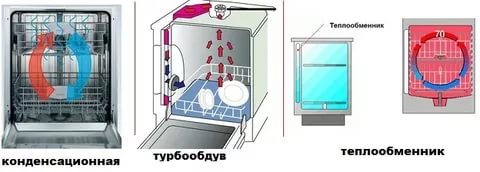
The most common method is condensation drying, which can be called natural drying. It occurs through the gradual cooling of dishes after rinsing them in hot water. Steam emitted by the dishes hits the cool walls of the dishwasher tank and condenses. The resulting droplets are collected in a special container. Condensation drying has an advantage: it is the most economical drying option. Cons: You'll have to wait a long time for the dishes to dry, which is why many people run the machine in the evening, letting the dishes dry until the morning.
Convection drying
Convection drying, also known as turbo drying, uses hot air blown in by a fan. This technology allows for much faster drying, which is its advantage. However, to supply this air to the dish chamber, it must be heated by a special heating element, which increases energy costs. Many people report that they don't always use the fan-assisted drying feature, turning off the dishwasher after the final rinse cycle.
Turbo drying is found in both expensive and inexpensive dishwashers, for example:
- Electrolux ESF 9420 LOW – 21 thousand rubles;
- Korting KDI 4530 – 23 thousand rubles;
- Smeg ST2FABNE2 – 93 thousand rubles;
- Miele G 4263 Vi Active – 57 thousand rubles.
Conclusion! The presence of a turbo dryer does not affect the price of a dishwasher.
Intensive drying
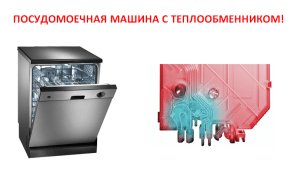
This type of drying involves a heat exchanger in the dishwasher. The air inside the washing chamber is moved during the drying process not by a fan, but by a pressure difference. The heat exchanger is located around the machine body, containing cold water, while the inside of the machine is hot, which creates this pressure difference. Furthermore, near heat exchanger There is also an air collector, which creates air flows.
Intensive drying is much better than condensation drying, but it is slower than convection drying.
Zeolite drying
This new technology uses a mineral as a heat source. A reservoir containing a mineral (zeolite) is installed under the dishwasher's drum, where moisture evaporates. The moisture heats the zeolite, releasing heat. This heat is then transferred to the dishwasher's drum, ensuring that dishes dry well. Once the drying process is complete, there will be no steam when the door is opened, which is another advantage of this drying system.
During the operation of the dishwasher, the zeolite will not lose its properties. Zeolite drying technology is currently only available in premium dishwashers, such as:
- NEFF S 51T65 X2EU;
- NEFF S 41T65 N2EU;
- Bosch SMV 69 T 70 RU.
Intelligent drying
 Another modern drying technology is Sensor Dry. It was first used in Miele dishwashers (MIELE G4263VI ACTIVE, Miele G4263Vi). The essence of this drying is that a special sensor is installed in the machine, which measures the temperature outside the dishwasher (in the room).
If the room temperature is high, the dishwasher's chamber is fan-assisted. If the temperature is low, the final rinse water is heated to a higher temperature.
Drying class
The dishwasher's drying class determines its quality. Class A is the highest—dishes come out dry, while class B means some water may remain on the dishes. Modern dishwashers have a drying class of A; we haven't encountered any others, and this is completely independent of the drying type.
However, in practice, users note that condensation drying machines don't always dry dishes well, even though they have a Class A rating. Hot air drying is better, and intensive drying is optimal.
So, it's up to you to decide which drying method is best for you. If time is a priority, then choose a model with a turbo dryer. If results are important but you still want to save on energy, choose a dishwasher with a zeolite or intensive drying system. No matter how long it takes for your dishes to dry, there are plenty of dishwashers with condensation drying, so choose any one you like.
Interesting:

Readers' comments
Headings
Washing machine repair




For buyers




For users


Dishwasher




Add a comment