
Water hardness levels for dishwashers in St. Petersburg
 To ensure proper operation of a dishwasher, users must be aware of the quality of their water supply. It's especially important to know the water hardness level so they can set the appropriate parameters on the dishwasher itself. Today, we've decided to discuss the water hardness level in St. Petersburg. What parameters should dishwasher users set for different areas of the city? Is the water there soft or hard? We'll find out.
Average annual indicators
If we take popular opinion into account, it boils down to one thing: the water in St. Petersburg has always been soft. We, of course, won't base our conclusions on rumors and gossip, but will instead turn to the data published by the State Unitary Enterprise "Vodokanal of St. Petersburg." First, let's determine the average annual fluctuations in water hardness. These fluctuations, as it turns out, are insignificant, so we won't take them into account.
- Main water supply station. The water has a hardness of less than 1.1. 0Zh – very soft water. It has no odor or taste. Color is no more than 6 degrees, with the standard being 20. Turbidity is less than 0.15 mg/dm3, with the standard being no more than 1.5. pH is 6.6, with the standard being no more than 9.
- Southern Waterworks. Water hardness less than 1.2. 0G. There is no odor or taste. Color is 5 degrees, while the standard is 20. Turbidity is 0.24 mg/dm3, while the standard is no more than 1.5. pH is 6.5, while the standard is no more than 9.
- Volkovskaya Waterworks. Water hardness less than 1.0. 0G. No odor or taste. Color: 7 degrees. Turbidity: 0.18 mg/dm3. pH: 6.6.
- Northern Waterworks. Water hardness is less than 0.9. 0G. No odor or taste. Color: 7 degrees. Turbidity: 0.34 mg/dm3. pH: 6.5.
- Kolpino Waterworks. Water hardness less than 1.0. 0F. Odorless and tasteless. Color: 6 degrees. Turbidity: 0.38 mg/dm3. pH: 6.5.
Official data tells us that the water throughout the city is soft, meaning the dishwasher's water hardness setting should be set to the lowest possible level. However, residents of southwest St. Petersburg claim their water is hard. This is because some of their water is taken not from the Neva River, but from artesian wells.
In some wells, the water is hard and is supplied specifically to the homes of residents in the southwestern part of the city.
If you live in the southwest, it's a good idea to call the State Unitary Enterprise "Vodokanal of St. Petersburg" or visit their official website and ask: what sources supply your water? If they tell you your street is supplied by an artesian well, you likely have medium-hard or hard water. The State Unitary Enterprise "Vodokanal of St. Petersburg" has information on water hardness levels by district.
Is this water suitable for dishwasher?
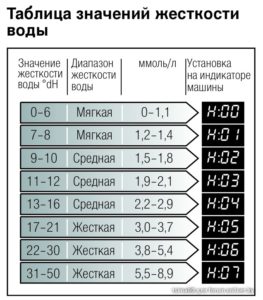
In most areas of St. Petersburg, the water is indeed very soft. This is good for the dishwasher. Firstly, less salt is needed to regenerate the ion exchange resins. Secondly, the ion exchanger itself lasts much longer. And thirdly, there's no need to spend money on additional filters and softeners, since the water is already of high quality.
If you live in an area supplied with well water, pay attention to how quickly scale builds up on your kettle. If your electric kettle requires frequent cleaning, it means your water is hard, which is bad for your dishwasher. You need to take additional measures to soften the water, including installing expensive instant-through softeners.
How is water prepared in St. Petersburg?
Knowing the water hardness level for dishwashers is crucial. This applies not only to dishwashers but also to washing machines. Ultimately, it's also important for human health, as many people drink this water (albeit filtered).
There's a common misconception that the quality of tap water in large cities, particularly St. Petersburg, leaves much to be desired. Is this true? As always, people are likely exaggerating. Water treatment is top-notch.
- The water is treated with sodium hypochlorite, which reduces the chlorine ion content of the water at the outlet to a minimum.
- Next, treatment is carried out with environmentally friendly ammonium sulfate.
- Finally, the water is exposed to powerful ultraviolet lamps, which effectively kill bacteria and viruses.
The purity of water supplied to the homes of residents of St. Petersburg is monitored not only by equipment and laboratory specialists. Recently, water quality control has also been assigned to crustaceans, or more precisely, crayfish. The crayfish's body is sensitive to the presence of various chemicals in water, so as long as these little creatures guard clean water, people have nothing to fear.
So, we've established that in St. Petersburg, at least in most of the city, the water is soft. If you're interested, water hardness levels in Moscow, read the article of the same name published on our website. We bid you farewell and wish you good luck!
Interesting:



Readers' comments
Headings
Washing machine repair




For buyers




For users


Dishwasher




Add a comment