
Installing a washing machine without running water
 An automatic washing machine for rural areas without running water is no longer a dream. It turns out that even in the complete absence of such a blessing as water, you can count on a connection and efficient operation of the machine. However, it will require a little effort and a wealth of expert advice.
Preparing to install a washing machine without running water
Preparing for the installation of a washing machine is a crucial step. Without proper preparation, it's impossible to answer the question of how to install a washing machine without a water supply. First of all, you need to carefully select the location for the machine. Since there are no water or sewer lines, the machine must be positioned so that there is room for the water tank, water supply, and drainage lines.
The room in which the machine will be located must be heated. Additionally, it's important to remember that the inlet and outlet hoses must also be routed through a heated area or located underground. The flooring on which the machine will be installed must be well-supported to prevent unnecessary vibration.
Once you've determined a location for the washing machine in your home, you need to stock up on tools. It's impossible to provide a complete list of tools, as everything will depend on the materials you choose and the installation method. Here are a few examples of tools you might need: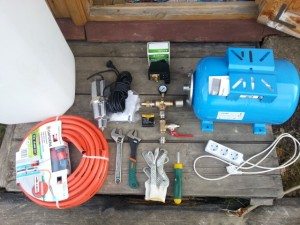
- bolts, nuts, clamps, etc.;
- pliers and adjustable wrench;
- regular roulette;
- household level;
- sealing tape;
- indicator screwdriver;
- knife.
Once you've gathered the necessary tools, you need to consider the components for installing the machine. Regardless of the model of your machine, you'll likely encounter problems finding these components. Their final list is formed only after the completion of installation works., usually it is:
- water supply hoses and filters of suitable diameter;
- compression couplings or tee;
- special shut-off valve;
- electromagnetic valves;
- centrifugal pump.
Please note! The diameters of hoses, valves, and tees are selected depending on the washing machine model and its connection diagram.
Installation process
A washing machine for a summer house without running water should be fully automatic—that's the main goal. To achieve this, the most important task is to ensure a water supply to the machine. This can be accomplished in several ways:
- Fill the machine directly from the bucket, if your machine model allows it. This method precludes automated washing, so it's not suitable for us.
- Pour water into a special reservoir from which water will be supplied to the machine. This method is only possible if the machine manufacturer provides a reservoir or if a pressure booster is installed between the machine's valve and the water tank.
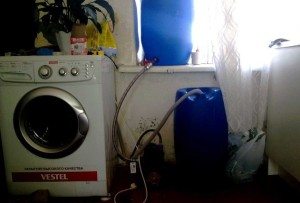 Solve the plumbing issue, then connect the machine as usual. If this option is available, great, the problem is solved. If not, there's no point in even considering it.
- Drilling a well and pumping water directly from the ground using an electric pumping station is a rather expensive method of connecting a machine to the water supply, and it's not always feasible, as the aquifer can be tens of meters below solid rock.
To summarize, most of the above methods are either completely unacceptable or acceptable only if you have a fair amount of cash. The only solution is to connect the machine to a special water tank and a pressure washer. We'll describe the entire process.
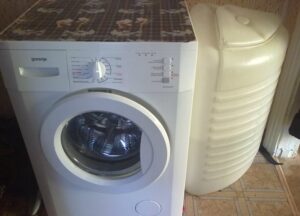
- First, prepare and install a 40-50 liter water tank next to the machine. The top of the tank should be open for easy filling. The tank should be placed on legs 50 cm above the floor.
- We make a hole in the bottom of the tank (slightly wider in diameter than the water intake hose) and install a threaded adapter into it. The adapter will connect to the hose.
- Now we'll need a compact, low-power electric water pump; it will act as a pressure booster. We'll run a hose from the water tank to the pump. For convenience, we'll place the pump under the tank.
- Now let's do some work on the washing machine; the connection can wait. First, we need to improve the flow rate of the machine's valves. To do this, we need to access these valves and remove the rubber seals. They are located where the water inlet hose connects to the machine.
- Next, we connect the water intake hose from the pump to the machine, pour water into the tank and connect the pump to the electrical network.
Thus, our water intake hoses run from the water tank to the pump and from the pump to the machine – simply and reliably. This type of machine connection has two disadvantages: firstly, you need to buy a water pump, and secondly, you need to manually fill the tank with water periodically. However, there are no simpler and cheaper solutions for connecting a machine without a water supply.
After connecting the machine, you can check its operation even if there is no water. How do I check the operation of a washing machine?
- Connect the machine to the power supply and press the power button.
- Turn the control switch and see how the electrical panel reacts to changing washing modes.
- Set the spin mode (if the temperature sensor is on, you need to turn it off).
- The drum should start rotating in reverse mode, which allows you to check the operation of the motor and drives.
Important! When testing the machine without water, do not set any wash cycles, as this could cause overheating and damage to the heating elements.
The following video will supplement the installation process described.
Organizing the drainage of soapy water
Once you've connected the water to the machine, you definitely need to consider how to drain the soapy water. It's important to remember that dirty water containing the detergent is toxic and can contaminate the soil, so you need to dig a drainage pit, fill it with concrete, insulate the walls with concrete rings, and install a sewer drain.
Lay a plastic pipe of a suitable diameter from the pit to the washing machine. This will serve as the drain pipe. Make sure the pipe doesn't freeze in the winter; to prevent this, you may need to bury the outdoor section deeper. Insert the washing machine's drain hose into the pipe, seal the connection with sealant, and enjoy – drainage is now complete.
Cars that don't need running water
There are washing machines that don't require running water at all; water is filled manually. This category includes older Soviet washing machines like the "Malyutka" or "Sibir" and other models. These machines also include modern automatic washing machines with reservoirs, which are installed in trailers and mobile homes in the US and Europe.
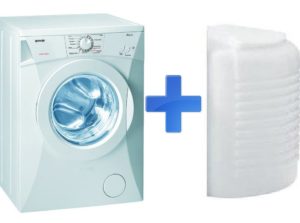
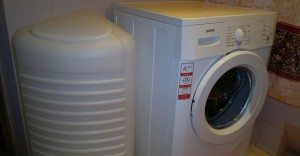 One of the most famous modern models of washing machines with tanks is the machine produced under the Gorenje brand.The machine's 80-liter tank is sufficient for two washes, ensuring it operates completely independently from the water supply. The tank can be refilled manually at any time. The Gorenje series machine is fully functional and offers the same wash cycles as standard automatic machines. You can read more about these washing machines here. Here.
To summarize, an automatic washing machine can operate without any problems without a water supply connection, as long as it's properly connected. The question of how to connect such a machine isn't immediately clear; everything will depend on the machine model, the chosen connection scheme, the owner's budget, and preferences. However, there are relatively simple, straightforward methods that don't require significant financial or time investment.
Interesting:
Readers' comments
Headings
Washing machine repair




For buyers




For users


Dishwasher




Add a comment