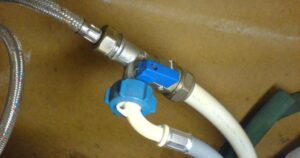
Connecting a washing machine requires careful consideration. The "simpler, better" approach won't work in this situation. Avoid powering the washing machine through an extension cord, attaching the drain hose to the edge of the bathtub, or using a standard tee for the water supply. How do you do it right? First, the appliance should have a dedicated outlet. Second, to drain the water, connect the drain hose to the trap. Third, it's important to install a faucet for the washing machine that will isolate the inlet hose from the water supply.
Why can't you do without a crane?
The valve used to connect the automatic machine to the water supply performs a special function. Using a shut-off valve, you can instantly shut off the water supply to the machine in unforeseen situations. For example, it will come in very handy if your washing machine starts to leak.
Don't forget about the risk of water hammer. This can damage the inlet hose, leading to a major flood. This could damage not only your home but also your neighbors' property. This is why it's so important to connect your washing machine through a faucet. The valve should be located in a visible location so that it can be easily accessed in an emergency. In extreme conditions, every second counts, and proper placement can make a difference.
What do you need for installation?
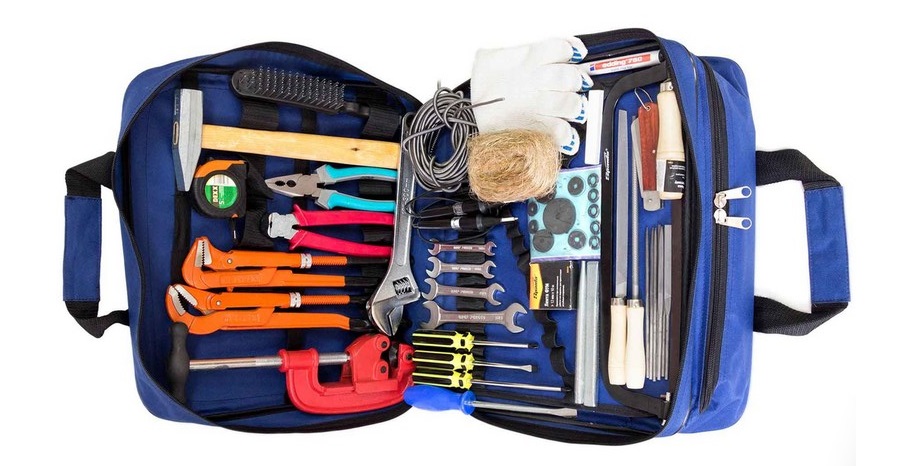
When installing a faucet, you'll need to have a whole set of tools on hand. Having everything ready in advance will ensure you don't have to worry about interrupting your work. So, when connecting, you'll need:
Adjustable wrench. This tool is necessary for installation, namely, securing pipes and tightening nuts;
Calibrator. This will be needed to "match" the dimensions of the faucet and pipe;
die (commonly known as lerka). Necessary for cutting out threads;
screwdriver, Phillips and slotted;
drill and file;
scissors for cutting polymers;
Angle grinder. This is needed if the shut-off device is cut into the pipe.
In addition to these tools, you'll need a double hose. It's sometimes included with the washing machine, or it can be purchased separately. It's best to have it slightly longer than necessary. This will allow for a little extra length, which can be useful when moving the appliance.
It's best to install a filter element before the shutoff valve. A small mesh screen can improve water quality and soften it. This minimizes the risk of scale buildup on the machine's internal components.
It is permissible to install several filters in front of the shut-off valve, for example, separately for water purification and softening.
Additionally, it's important to remember to prepare sealing rings, tape, a couple of spare bolts, and FUM tape. Without these tools, it's impossible to secure the faucet and ensure a tight connection. Before starting work, consider the optimal connection option, taking into account the room's configuration and the placement of the plumbing fixtures.
Best connection options
There are actually several ways to install a shut-off valve. Let's look at the most popular options and explain the procedure for each.
Option 1. Assembling a flow-through device. Before starting work, be sure to turn off the valve that supplies water to the apartment. Afterwards, it is necessary to drain the remaining liquid from the pipe so that moisture does not interfere with the process.
It is advisable to install a flow-through tap on a stationary branch of the pipe.
Typically, in this case, the pipe already has a special threaded bushing at the required height. All that's left to do is screw a faucet with two outlets onto it. Next, connect it to the inlet hose. Once you're done, be sure to check the connection for leaks. Inspect the joints to ensure there are no leaks. If you notice any water drips, install additional rubber gaskets and wrap the affected areas with flax fibers.
Option 2. Installing a termination valve. When a separate water supply branch is connected to the automatic washing machine connection point, the termination valve can be installed through a tee. The cut-in clamp is screwed to the riser so that the guide nipple faces outward.
Next, holes are made in the pipe using a drill, and through these holes, a connection is made to the section of pipe where the faucet is planned to be installed. A die is used to cut a thread on the end of the pipe, identical in size to the grooves on the tee. The threads are then wrapped with sealing tape, and the faucet is pressed into place.
The washing machine's inlet hose is attached to the free end of the valve. The other end of the tube is attached to the washing machine. It's important to remember to remove the transport valve. The assembled unit should be tested for leaks. If there are no leaks, you can safely use the appliance.
Option 3. Installing a shut-off valve with a tap. This method is considered the most difficult, especially if the apartment has metal piping. In this case, you'll need a grinder.
If the pipes are plastic, the cutting can be done using special scissors for polymers.
To determine how many centimeters of pipe need to be cut, simply add the length of the valve and the filter being installed. Then, a cut is made. Then, threads are cut on the ends to match the grooves on the faucet. Next, a deep-cleaning filter is installed—it will trap impurities in the water. Then, the faucet is installed. If the pipes are made of polymer, they must first be expanded using a calibrator.
The joints are secured with special sealing rings. Next, the end of the inlet hose is connected to the faucet. Finally, all the nuts are tightened with an adjustable wrench. For added security, the joints can be wrapped with sealing tape or sanitary flax fibers.
It is important to consider the fixing force - a bolt that is not tightened enough or, on the contrary, is overtightened can cause a leak.
Interesting solutions
I'd also like to discuss non-standard shutoff valve connection options. These are used when conventional methods are unavailable for some reason. These include the following installation methods:
installing a valve on a mixer;
on old pipes;
with double connection of the automatic machine (in addition to hot water supply).
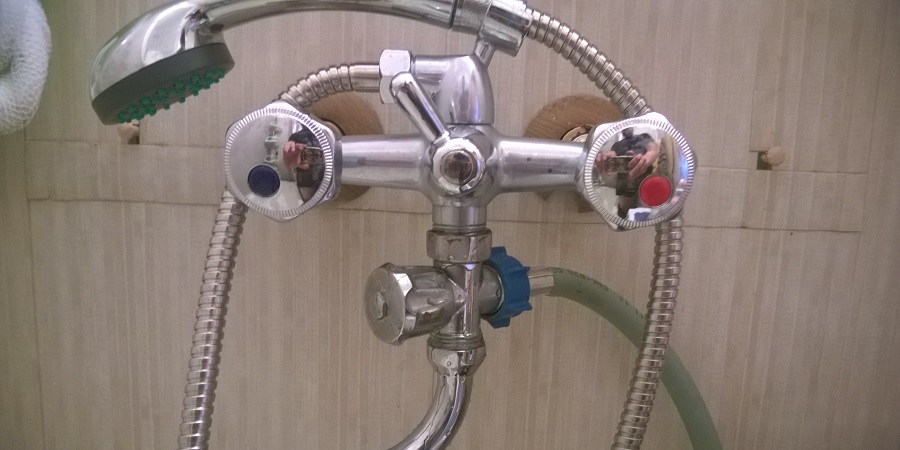
The first option is becoming more common these days. It's the simplest and most accessible. However, installing a valve on a faucet has several drawbacks. First, it damages the faucet itself. Due to increased loads, its service life is significantly reduced. Second, this "combination" complicates the use of both devices. Therefore, experts only recommend this installation option as a temporary measure.
This method won't work if you have an older faucet. Connecting the faucet will require a complex procedure, which will require significant investment in time, money, and labor. If your apartment still has old cast-iron pipes, installing the valve may be difficult. These pipes typically have corroded surfaces. To make installing the faucet easier, follow these steps:
File the ends of the pipes. This will allow you to align the edges of the elements and route the hose as close to the pipe as possible;
Install an extension. This will hide the corroded ends. A hose with a rubber seal is connected to the other end of the part.
The main goal is to ensure the integrity of the structure and prevent further deterioration of the pipes. Alternatively, coat the cast iron with a special anti-corrosion compound. Ideally, of course, immediately replace the pipes with more modern ones to avoid similar problems in the future.
Today, you can find washing machines (most often from Japanese and American manufacturers) that can be connected to both cold and hot water supplies. This can reduce energy consumption. In this case, you'll need to install two shut-off valves.
Which faucet should I choose?
On store shelves you can find many types of devices designed to be installed in front of the washing machine's inlet hose. Multi-turn and ball valves are very popular. In the first case, the water is shut off by a moving plate, while in the second, it's shut off by a small ball located inside the valve. Ball valves offer several advantages:
high tightness;
instant "response", due to which the water can be shut off in a second;
The simplicity of the design. Therefore, the service life of such taps is longer;
Their small size makes them suitable for installation even in the most confined spaces.
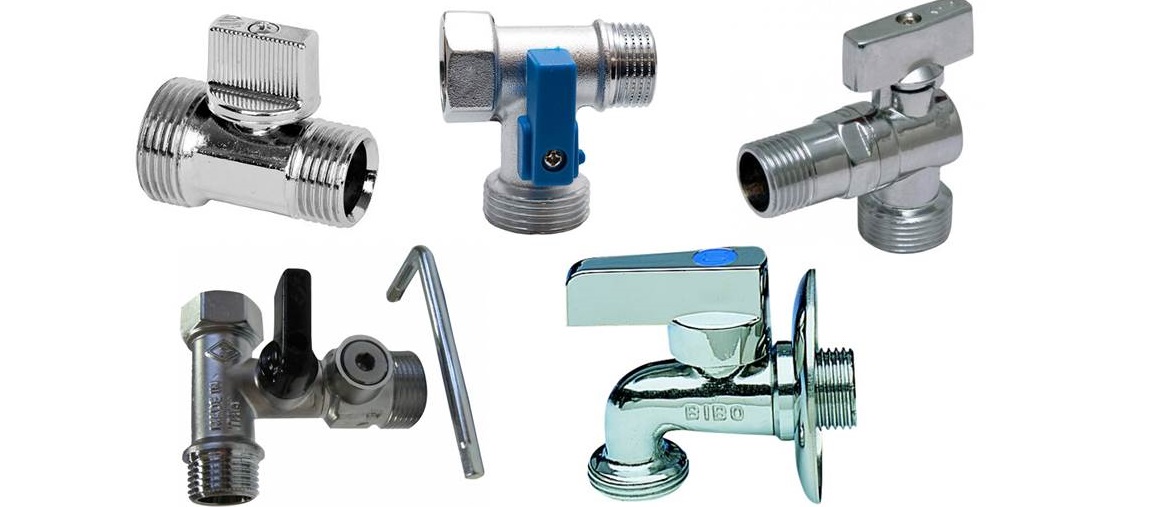
Ball valves also come in different types:
walk-through;
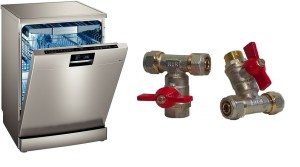
tees (three-way);
angular.
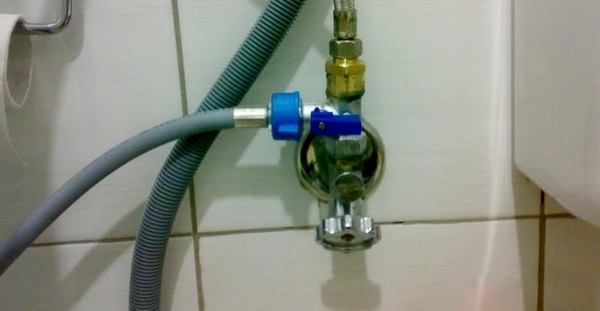
A straight-through valve can be installed either on a branch from a central riser or embedded into a pipe. This device has outlets on both ends. It is used not only for connecting automatic machines but also for plumbing fixtures.
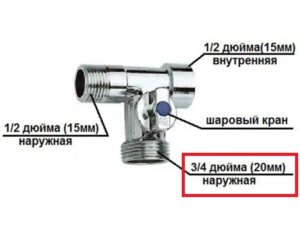
A three-way valve has three outlets. One opening is responsible for interrupting the water flow, while the other two connect all the outlets into a single system. These devices are most often used for connecting to a pipeline, where they are connected to other fittings, such as a faucet. Using an angle valve, it's easy to divide the outlet into two independent branches. These devices are commonly used to connect toilets and unusually positioned automatic washing machines.
Each ball valve comes complete with sealing rings, nuts and rotary handles.
When deciding which faucet to buy, consider the connection point. In small spaces, corner units are best. They'll help reduce the space needed for the outlet.
If you need to connect several plumbing fixtures, a tee is preferable. If you have a separate outlet for the automatic washing machine, you can install a standard straight-through ball valve. The diameter of the purchased tap must correspond to the size of the pipeline. It's also worth paying attention to the thread characteristics. It's also important to consider which direction the faucet will turn. The handle shouldn't rest against the wall, otherwise it won't be possible to completely shut off the water flow. To choose the right shut-off valve, you need to consider all these details.

 Connecting a washing machine requires careful consideration. The "simpler, better" approach won't work in this situation. Avoid powering the washing machine through an extension cord, attaching the drain hose to the edge of the bathtub, or using a standard tee for the water supply. How do you do it right? First, the appliance should have a dedicated outlet. Second, to drain the water, connect the drain hose to the trap. Third, it's important to install a faucet for the washing machine that will isolate the inlet hose from the water supply.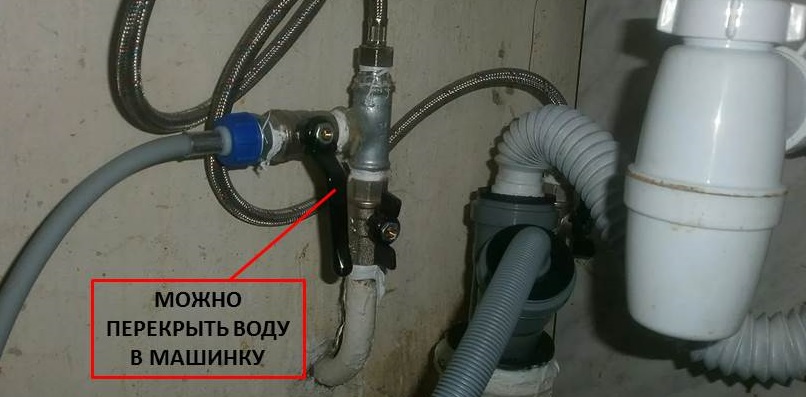














Add a comment