Modern household appliances are quite compact, allowing for creative placement to save space. Sometimes, in small apartments, it's not possible to install a washing machine in the bathroom, hallway, or kitchen, leaving only one option: installing the washing machine in the toilet. This option is no longer uncommon and has its advantages. We'll explore the pros and cons of placing a washing machine next to the toilet. We'll also cover the installation and utility connections to the washing machine.
How to place a machine in the toilet?
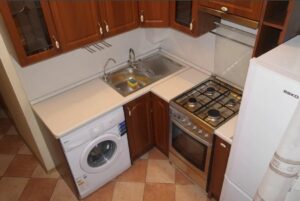
Washing machines are rarely installed in bathrooms; people often prefer the bathroom or kitchen. This option is considered safer: it avoids high humidity, which can be harmful to washing machines. Furthermore, the walls and floor in the bathroom are tiled to prevent leaks, and household chemicals stored nearby will not come into contact with food.
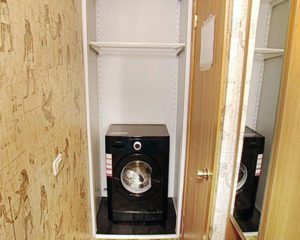
Despite the toilet's modest size, there are several ways to install a washing machine. The simplest is to place the appliance next to the toilet. If there is not enough space, then the “porcelain friend” can be moved closer to the wall, and the machine can be turned sideways.
When spinning, the washing machine places a load of 150-200 kg on the support, which must be taken into account when planning a niche for it.
The second option is to combine the bathroom and toilet by removing the wall entirely or cutting a hole for the toilet. However, this requires legalizing the remodeling and making unscheduled repairs.
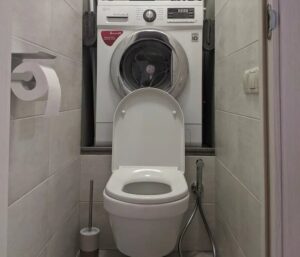
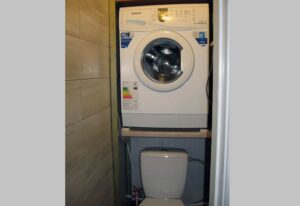
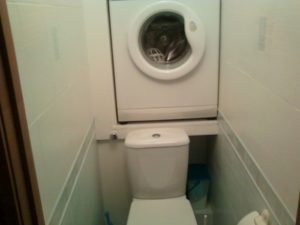
If your bathroom is too narrow, you can place the washing machine above the toilet. This is more difficult, but it saves significant space. However, it's better to choose compact machines with a narrow frame. It's also important to decide on the installation option: in a niche, in a cabinet, or on a shelf. A false panel concealing the washing machine is an excellent solution.
Before installing a vending machine in a toilet, it is necessary to pay attention to a number of recommendations:
choose a durable base that can withstand a load of 200 kg (it is better to use metal instead of wood);
Place a piece of rubber under the machine to reduce slipping and dampen vibrations coming from the machine;
Give preference to collapsible designs (there should be free access to the back wall of the washing machine).
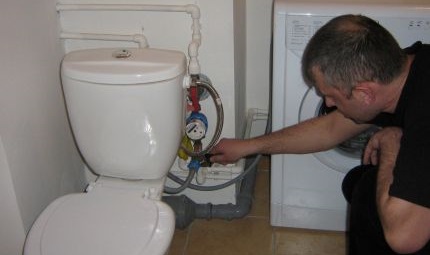
Finding a suitable location for the washing machine is only the first step in installing it. The second step is connecting the appliance to utilities: power, sewer, and water.
Organization of power supply
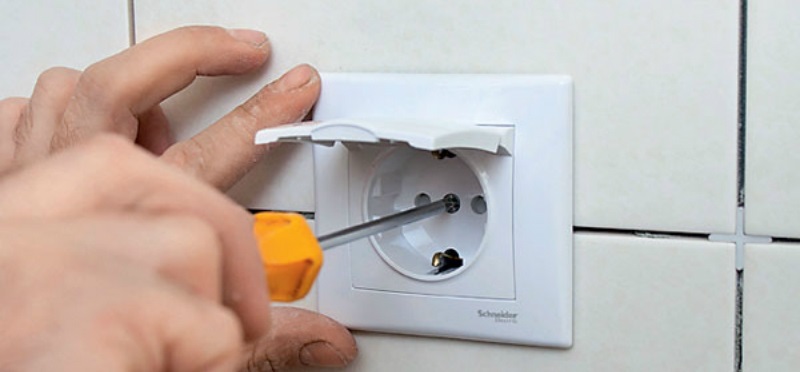
To connect the washing machine to the power grid, a separate outlet must be installed in the toilet. It's best to use a device with a moisture-resistant housing to ensure adequate protection against possible flooding. The location for the future electrical outlet should be chosen in accordance with regulations: 50-70 cm from the floor and 60-90 cm from the risers.
In bathrooms, it is permitted to use only moisture-proof sockets raised 50-70 cm from the floor.
For safety reasons, a separate circuit breaker is allocated for the new power line. Grounding is also provided. Otherwise, a short circuit in the machine will cause current leakage to the housing, which can lead to electric shock.
What will the drain be like?
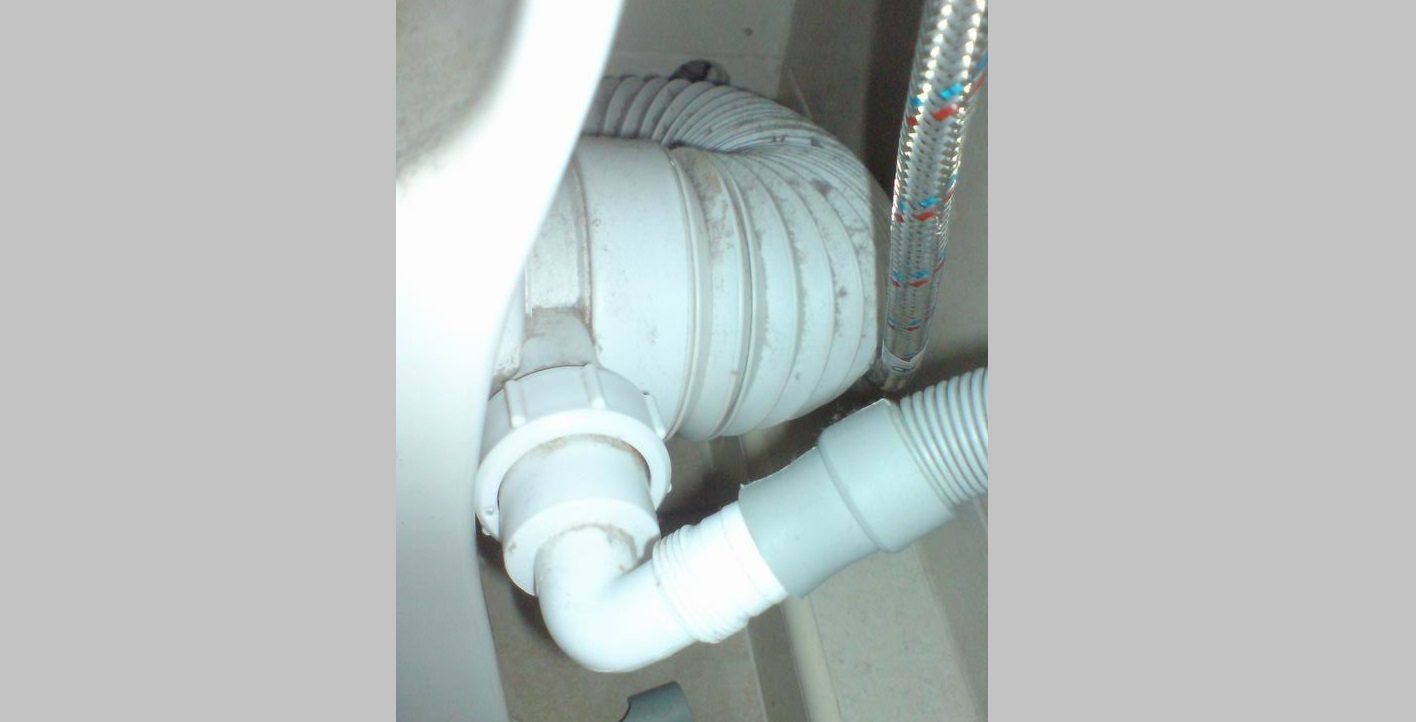
Connecting the sewer pipe won't be a problem—the toilet is already equipped with a drain. The key is to connect it correctly to avoid gravity drainage and unpleasant odors. First, choose one of four options for connecting the washing machine's drain hose to the central sewer system:
installation of a separate plastic pipe with a diameter of 5 cm;
lowering the drain hose directly into the toilet;
installation in the gap of the comb tee with dimensions of 5x5x5 cm;
using a siphon with a drain under the sink (you will have to extend the drainage hose and run it to the bathtub).
When connecting, it is important to raise the washing machine drain hose 50-70 cm from the floor. If the corrugated pipe is lowered below the bottom of the tank, the pressure in the pipe will be disrupted and water will spontaneously flow into the sewer. The second point concerns watertightness: the connection to the main riser must be secured with a clamp and sealed with sealant. Otherwise, leaks and an unpleasant odor may develop.
We supply the machine with water
Each toilet has a water supply pipe running through it, so connecting the washing machine to the central drain won't be a problem. Simply connect a standard inlet hose with a union nut and a straight pipe thread to the cold water riser. A ¾-inch thread is typically suitable.
Next, a crane is selected. Two options are possible:
ball valve – more reliable, operates when the handle is turned 90 degrees;
screw - here the water is shut off by several turns of the "lamb" screw.
In addition to the faucet type, consider the length of its handle. It's recommended to choose designs with long handles: they're easier to open and close. Short handles are harder to catch, which can be inconvenient if the joint rusts and the valve jams.
Techniques for moving a toilet machine
Installing a washing machine is only half the job. Afterward, the user may have trouble moving the appliance around the room. For example, if the room is being renovated or the machine itself is being serviced. To avoid damaging the machine and make the task easier, consider a few tips:
First of all, the washing machine is disconnected from the communications;
the equipment is brought into the toilet and lifted into the niche sideways, and then turned with the hatch forward;
After repair, the unit is re-aligned.
A washing machine above the toilet saves significant space, but this installation option has more disadvantages than advantages. It's better to install the machine next to the toilet or choose more traditional alternatives—the kitchen, bathroom, or hallway.

 Modern household appliances are quite compact, allowing for creative placement to save space. Sometimes, in small apartments, it's not possible to install a washing machine in the bathroom, hallway, or kitchen, leaving only one option: installing the washing machine in the toilet. This option is no longer uncommon and has its advantages. We'll explore the pros and cons of placing a washing machine next to the toilet. We'll also cover the installation and utility connections to the washing machine.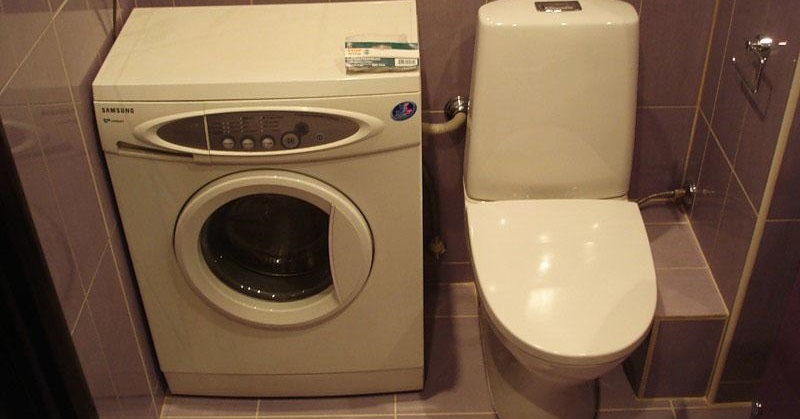















Add a comment