
Installing a washing machine on a wooden floor
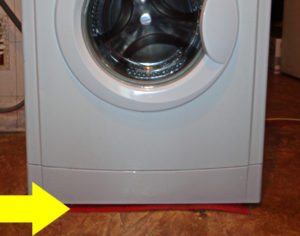 If the room where you plan to install the washing machine has a level concrete floor, there won't be any problems. Simply check the machine's alignment with a level, adjust the feet, and you can connect the appliance to the utilities with a clear conscience. But how do you install a washing machine on a wooden floor, especially one that's been through a lot?
This requires some thought. You can't just let things slide, as vibration not only damages your flooring and frays your nerves, it can also gradually damage your washing machine, which is a real problem. We'll discuss the specifics of installing a washing machine on a wooden floor in this article.
Errors when installing a washing machine
Vibration is a destructive force that impacts a front-loading washing machine, gradually causing wear and tear on its vital components and eventually failure. If vibration is partially dampened by leveling the machine on a solid, solid surface, its lifespan will be approximately doubled. If you place a washing machine in a house with a shaky wooden floor, and place it just the wrong way, it will not only vibrate and swing, but will also start jumping around on the floor.
When attempting to dampen the vibration of a washing machine installed on a wooden floor, users make mistakes that later lead to premature failure. Let's look at these common mistakes so our readers never make them again.
- Before installing the washing machine on a wooden plank floor, some users put a thick layer of anti-vibration matThis measure will not dampen the vibration, but it will be less transmitted to surrounding objects and the sound it produces will also partially disappear.
The problem is that the rubber mat doesn't protect the washing machine from the damaging effects of vibration, and it will still quickly break down. Although, of course, it will seem like the problem is solved.

- The second mistake involves attempting to reinforce the floor with angle brackets or metal pipes. To avoid too much fuss, users mark the spot on the floor where the washing machine will stand. Then, at the intended locations of the washing machine's feet, they drill four holes directly into the floorboards. Metal pipes or angle brackets are driven through these holes into the ground beneath the floor, and a piece of thick chipboard is placed on top of these. The washing machine is then placed on top of this. As a result, the supports quickly become loose and after 2-3 months the problem returns.
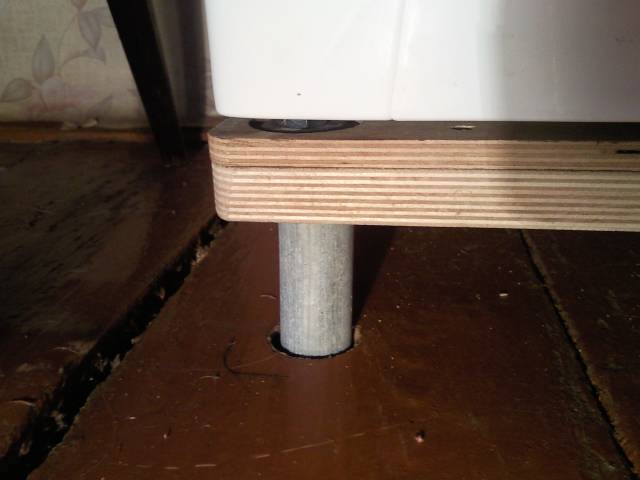
- Some users, in an attempt to create a solid and secure base for their washing machine, place a 150-kilogram concrete slab directly on the wooden floor. They reasonably believe that the solid, heavy slab will dampen vibration, creating favorable operating conditions for the washing machine. This would be fine, but in this case, such a heavy slab will cause the floor to warp and sway during operation. Furthermore, for the slab to effectively dampen vibration, the support surface must be at least 2 m2.2.
- Some DIYers try to secure the washing machine's feet directly to the floorboards by first screwing the base together and attaching metal plates to the threads. These plates have holes through which people easily and thoughtlessly screw the feet to the floor with wood screws. What happens then? Nothing good: during the spin cycle, the washing machine rocks and bounces so much that some of the floorboards simply come off, causing a terrible creaking and rattling sound from the floor.
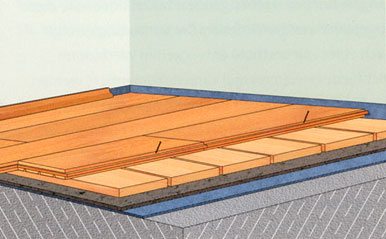
In general, many users indulge in eccentricities when attempting to install a washing machine on a wooden floor themselves. Ultimately, they fail, which leads to problems later. And what's most interesting is that most of them have an idea of how to best rework the floor to make it more suitable for installing a washing machine, but the problem is, "they're too lazy to do the work."
Concrete screed
Installing a washing machine on a wooden floor is practically impossible without a concrete screed underneath. Some experts believe this, and not without reason. A concrete screed will provide a secure platform for even the most demanding washing machine. We won't be so categorical about the assertion that this is the only way to properly install a washing machine on a wooden floor, but we also won't deny that it's a good method. How do you install a concrete screed under a wooden floor in a house?
- We determine the exact location of the washing machine on the floor, and then make marks on the floor and on the wall.
We mark out the space for the future concrete platform, leaving a few dozen centimeters of space to prevent the edges of the platform from collapsing during use.
- We carefully tear off the boards.
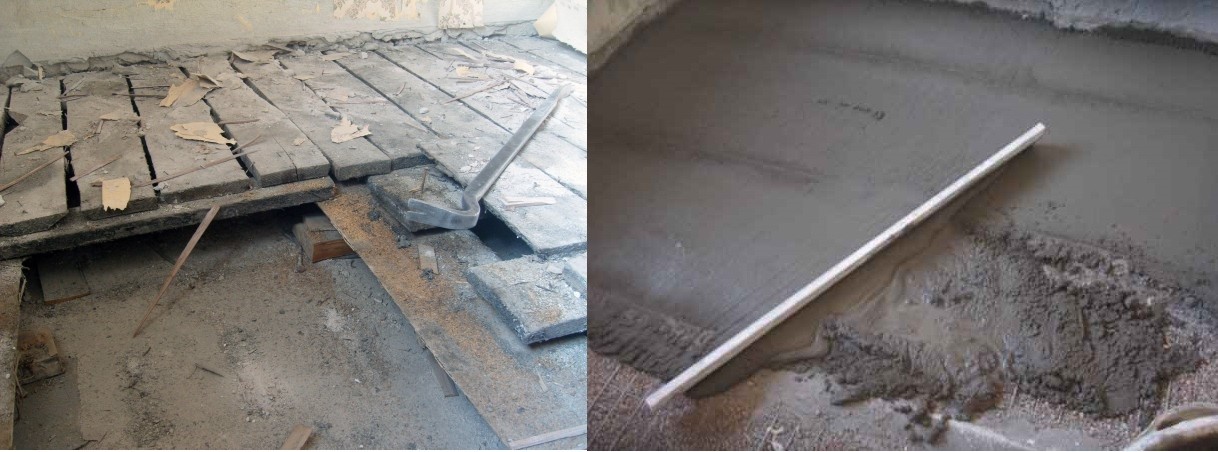
- Along the edges of the future concrete platform, we place wooden formwork made from scraps of unnecessary boards or slabs.
- If possible, weld reinforcing mesh to the platform to give it additional strength.
- We pour in the previously prepared solution, level it and compact it.
- We place additional joists along the edges of the platform to prevent the boards from hanging in the air.
- Next, we need to wait for the mortar to harden, then replace the boards, remembering to screw them to the new joists. Then all that's left to do is install the washing machine, plug it in, and enjoy.
On the pipes
Oddly enough, it's possible to install a washing machine on a concrete slab laid over a plank floor, but there are some caveats. First, you need to concrete the steel pipes under the floor, which will extend directly through the holes in the planks. The pipes must be installed strictly vertically; check this with a spirit level. Place a solid concrete or marble slab weighing at least 100 kg on top of the pipe ends.
The slab can be secured to the pipes, or left as is; it won't go anywhere. The trick to this method is that the pipes must be long, driven deep into the ground under the wooden floor, and concreted. Such a durable base will serve your washing machine well.
Finally, if you have a wooden floor in your home, especially an old one, you must take all measures to strengthen the space beneath your washing machine. Installing a washing machine on a worn or unstable foundation will reduce its lifespan, increase noise, and even reduce the quality of your wash!
Interesting:





Readers' comments
Headings
Washing machine repair




For buyers




For users


Dishwasher




Add a comment