
Installing a built-in dishwasher
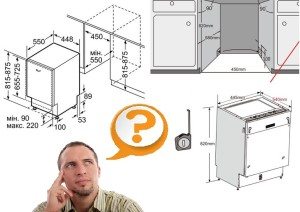 Installing a built-in dishwasher is something any good homeowner can do themselves. Even if some steps seem complicated, you can always consult a professional. Doing at least some of the work yourself can save you a significant amount of money. Read this article to learn what you need to do to install a dishwasher correctly.
We determine the location and calculate the dimensions
The installation of a built-in dishwasher should be planned in advance, along with the entire kitchen interior – this will be the ideal option. Trust me, it's much more difficult to find space and install a built-in dishwasher in a finished kitchen, so the sooner you consider installing a dishwasher, the better. Plan ahead and sketch out your future kitchen. Try to consider the placement and dimensions of all appliances.
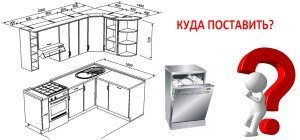
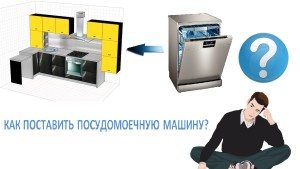
Additionally, include the locations of all electrical and plumbing connections in the sketch. This way, every outlet and pipe will be in its proper place and won't interfere with future installation of appliances. You can see an example of a kitchen sketch in the image below.
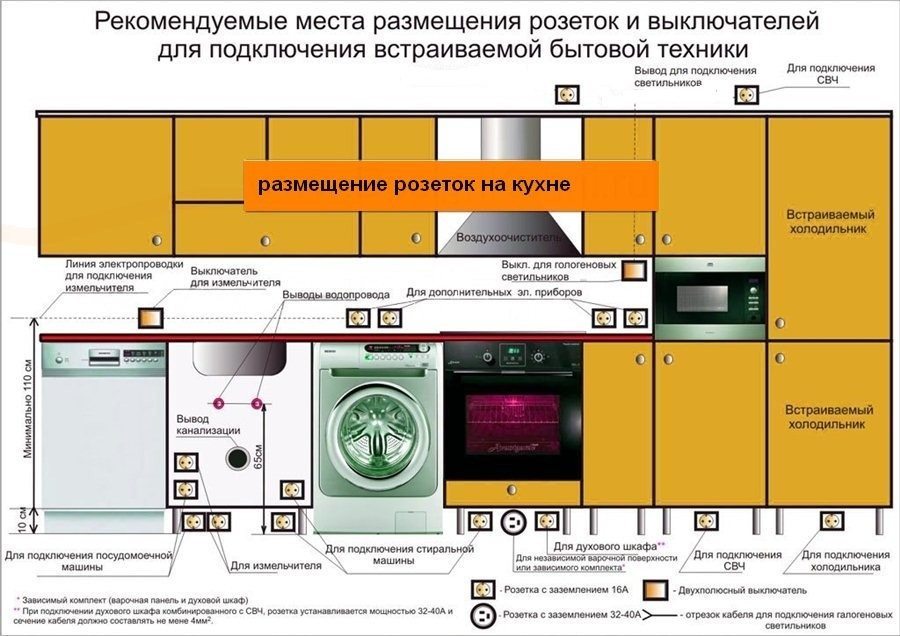
Important! The smaller the kitchen, the more carefully you need to calculate the dimensions and placement of each piece of furniture, including the dishwasher, and, of course, reflect these calculations in the sketch.
Some people believe that before ordering kitchen furniture, they should purchase appliances and then use their dimensions to create a drawing of the future set. This isn't necessarily a bad approach, but rather an inconvenient and expensive one.
- Firstly, to buy all the appliances at once, you need a lot of money, and then you have to pay for the kitchen furniture almost immediately.
- Secondly, the purchased equipment will need to be stored somewhere until the kitchen interior is completed, and this could take several months.
- Thirdly, even if you purchase the equipment in advance, this also does not guarantee that the furniture makers who will make the set will not miscalculate somewhere in the dimensions.
In general, experts say this: first, look at a built-in dishwasher model at a retail outlet, measure its exact dimensions, and do the same with other built-in and non-built-in appliances. Next, give all the dimensions along with the sketch to the furniture makers. If they make any mistakes, you can try to correct this by purchasing smaller equipment. For a built-in dishwasher, do the calculations like this.
- For example, a built-in dishwasher has dimensions WxDxH 450x820x550 mm.
- You will need to allocate space for the cabinet into which the installation will take place, taking into account the thickness of the material.
- You also need to leave a gap of at least 5 mm between the walls of the dishwasher and the walls of the cabinet.
So, for example, if the total material thickness (on both sides) is 20 mm, plus a 5 mm gap (on both sides), then we add 450 + 30 mm to the width = 480 mm – this is the final width of the cabinet with a dishwasher. Regarding the height, we leave a gap only at the top, but take into account the height of the legs. So, the legs are 60 mm high, add the total material thickness of 20 mm and the 5 mm gap, and we get 820 + 60 + 20 + 5 = 905 mm – the minimum height of the cabinet with a dishwasher.
When calculating the depth of the dishwasher, you need to leave space for the hoses and electrical cable, somewhere around 80-100 mm. The cabinet may not have a back wall, so the thickness of the material does not need to be included in the calculation. This gives us 550 mm + 100 mm = 650 mm. The resulting cabinet dimensions with a built-in dishwasher will be at least 480 x 905 x 650 mm (W x H x D). Successful connection and installation of the dishwasher depends entirely on how accurately you calculate everything.
Important! When calculating the cabinet size for a built-in dishwasher, don't forget about the front panel. Consider how it will be installed and any special features specific to the dishwasher model.
Preparing tools and components
Before connecting the dishwasher yourself, you need to gather the necessary tools and components. The exact tools and components you need will depend on the specifics of your kitchen cabinetry, the location of utility lines, and other factors. It's best to select everything you need immediately before installing the dishwasher, when you have a clear plan, a completed sketch, and a partially completed interior. The following tools may be required: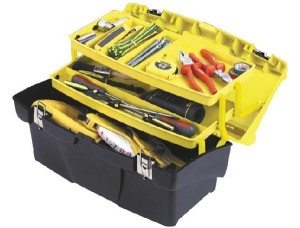
- small adjustable wrench;
- flat and Phillips screwdrivers;
- tape measure (preferably laser);
- pliers;
- hammer drill;
- screwdriver;
- chisel.
As you can see, the list is short. While installing a dishwasher doesn't require any special tools, you may need quite a few components.
- European sockets.
- Socket boxes.
- A two-millimeter copper cable with three cores.
- Tee for metal-plastic water pipe.
- Fumka type "Tangit".
- Tap on the inlet hose.
- Residual current circuit breaker.
- Set of rubber gaskets.
- A siphon with at least two outlets for drain hoses.
- Set of plastic clamps.
Sockets, a residual current circuit breaker, and wire will be required if you are preparing electrical connections for kitchen appliances. Choose the highest quality sockets possible, with moisture protection. Read the article to learn how to choose the right outlet. How to choose and install a power outlet for a washing machineAlthough this text discusses outlets for washing machines, the specifics for choosing an outlet for a dishwasher are absolutely identical.
Please note! The list of components may be significantly expanded as the project progresses. For example, if you want to protect your dishwasher from electrical risks, you may need a voltage stabilizer.
Preparing communications
It's no secret that a built-in dishwasher requires a stable electrical connection, a water supply (sometimes both hot and cold), and a sewer connection. It's best to prepare these utilities at the very beginning of your kitchen renovation. Let's start with the electrical system.
- Using a hammer drill and a chisel, we make grooves in the wall for electrical wiring.
- In the electrical panel we make a three-wire cable outlet and install a residual current circuit breaker.
- We connect a pre-prepared copper wire to the residual current circuit breaker and pull it into the kitchen, through a grooved channel to the location of the socket box.
- We carve out a niche for the socket box, install it and bring out the wire.
- We disassemble the moisture-resistant socket, connect it to the wires and screw it into place.
It might seem simple at first glance, but in practice, problems can arise, so if you're inexperienced with electricity, consult a professional. Now that the electrical connection is complete, it's time to install the plumbing. First, figure out how you'll connect your dishwasher to both hot and cold water, or just cold. Most often, repairmen connect dishwashers only to cold water – this is the best option.
- At the end of the cold water pipe outlet, we install a tee (or a tee with a tap).
- We get two free outlets, one will go to the sink faucet, and we will connect the dishwasher inlet hose to the other.
- All threaded connections must be sealed with fumka to ensure the connection is as secure as possible.
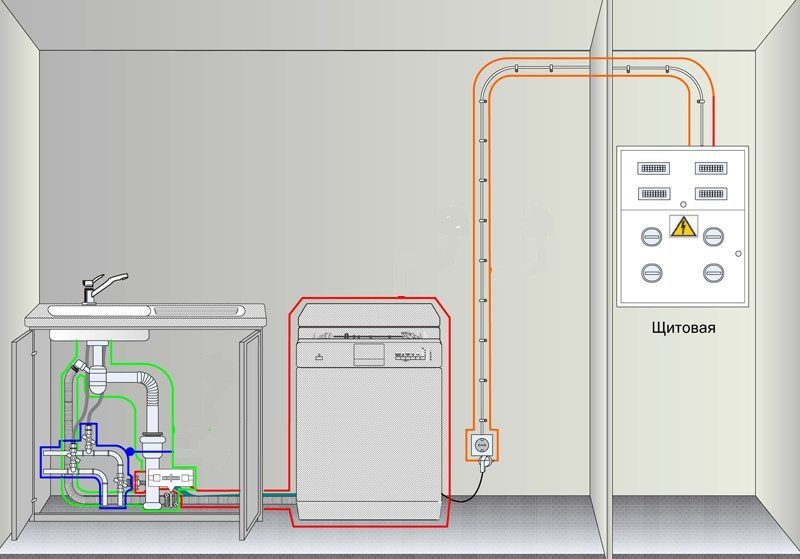
We'll connect the dishwasher to the sewer last, after the sink and trap are installed. All we need to do is connect the drain hose to the trap outlet, and the dishwasher can be connected in just a few minutes.
The nuances of installing a dishwasher
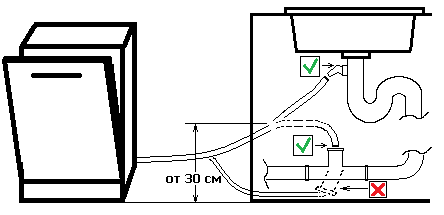
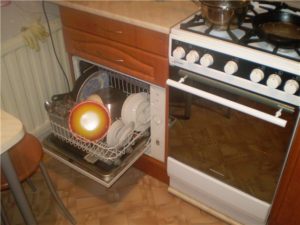
It's time to connect the dishwasher and place it in place. First, place the dishwasher close to the cabinet, then proceed with the plumbing connections. First, manually connect the drain hose to the drain trap outlet. Make sure to follow the instructions clearly illustrated in the image below.
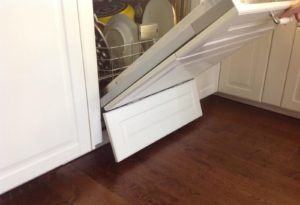
Next, connect the inlet hose to the pre-prepared outlet, and you're ready to place the dishwasher in the cabinet. Carefully, so as not to damage the hoses, slide it in. Finally, hang the cabinet front directly on the dishwasher door, as shown in the picture below. The connection is now complete.
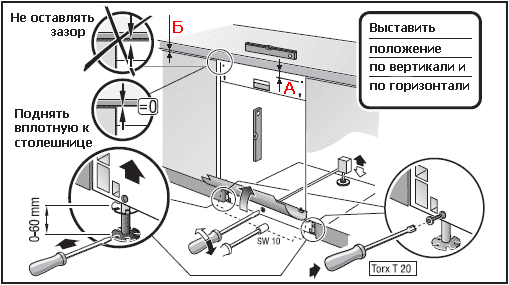
Please note! Hanging the front panel on the door of a built-in dishwasher is quite simple. There are special brackets into which the front panel is inserted and then secured in place using fasteners.
Finally, connecting a built-in dishwasher and installing all the necessary plumbing can be quite time-consuming. However, if you do the connection yourself, you'll save a tidy sum, which you can use not only to celebrate a successful kitchen renovation but also to buy some kitchen essentials. Wishing you the best with your dishwasher renovation and installation!
Interesting:

Readers' comments
Headings
Washing machine repair




For buyers




For users


Dishwasher




Add a comment