
How does a dishwasher work?
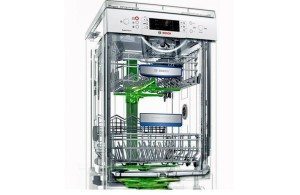 A dishwasher is a complex household appliance. While its design resembles that of a washing machine, it has many differences and features. Knowing these features will not only allow you to choose the best machine from a technical standpoint but also, in the event of a breakdown, avoid calling a repairman and attempt to fix the problem yourself. We'll explain what a dishwasher consists of, what its main components are, how one dishwasher differs from another, and, finally, how it works.
Basic design elements
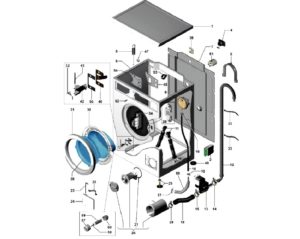
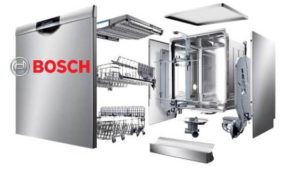
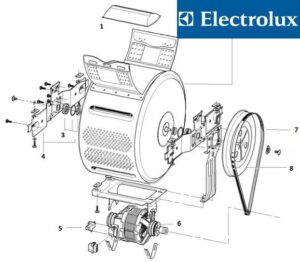
If you look inside a dishwasher of any brand (Bosch, Ariston, Electrolux), removing the body and tray, you will see the following main components and elements:
- Motor – starts the internal components of the machine.
- The main (circulation) pump is the “heart” of the dishwasher. Responsible for supplying water from the water intake to the sprinklers (rocker arms).
- A flow-through water heater is installed in one housing together with the main pump and is used to heat water.
- Drainage pump – ensures the drainage of waste water.
- Drain hose and fittings.
- Inlet hose with leak protection device.
- A coarse filter, located at the entrance of the inlet hose to the inside of the machine, traps rust and other dirt contained in the water.
- A pressure switch is a sensor that determines the water level (pressure) in the dishwasher.
- Water intake.
- An ion exchanger is a tank with resin for softening water.
- The control board is the electronic “brains” of the dishwasher, controlling the operation of all its “organs”.
- Connecting hoses, clamps and electrical wires.
- Soundproofing.
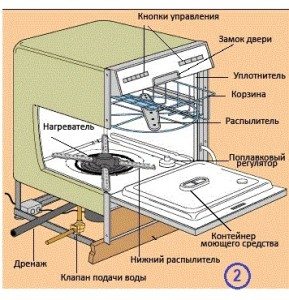
The following elements are visible from the dishwasher tank side:
- stainless steel tank;
- sprinklers (upper and lower);
- baskets for dishes and a tray for cutlery;
- filters - one in the form of a glass with a fine mesh, located at the bottom of the dishwasher, the second filter is a fine mesh, located on top of the first filter;
- compartment for pouring salt;
- containers for detergents located on the door;
- rubber seal around the tank contour;
- control Panel.
Differences in the design of different dishwashers
The elements listed above form the basic structure of a dishwasher, but in reality, different models may differ in the presence of certain elements. These elements include: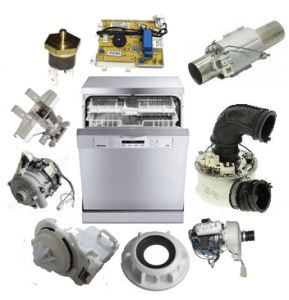
- The heat exchanger is a wide, flat plastic container of cold water located inside the dishwasher, next to the metal tank. The presence of a heat exchanger ensures efficient drying without energy consumption.
- A fan and additional heating element enable turbo drying. This drying feature dries dishes very quickly, but it's not available in all models. For example, we didn't find any Bosch dishwashers with turbo drying, but Ariston dishwashers (model LST 216 A and model LSF 712) do.
- A water purity sensor. This sensor allows the dishwasher to automatically select the appropriate wash program (temperature, water amount, and detergent).
- Salt and rinse aid sensors, and a 3-in-1 tablet compartment. Present in many modern models.
- Sensor Dry. This is a modern intelligent drying technology, used in expensive dishwashers, such as the Miele G4263Vi. The drying sensor detects the ambient room temperature, which is used to determine how to dry the dishes.
- A container with minerals is necessary for organizing drying.
Zeolite is used as a mineral, which can release dry heat when absorbing moisture. This technology is used in Bosch and Neff dishwashers.
- Automatic water hardness detection sensor and program selection according to the indicator. This type of sensor is only built into very expensive dishwasher models.
- Program end sensor and floor time projection. A red "beam on the floor" indicating the end of a wash cycle is built into all recent machine models, while a program progress and floor time projection sensor is found in Bosch and Siemens machines.
- A glass holder and a spray bottle for cleaning baking sheets. Some models come with these, others require separate purchase, and others don't include them at all.
In addition, dishwashers vary in size (small, narrow, or large), the number of arms (2 or 3), the metal used for these arms, and the design of the baskets. Baskets can be height-adjustable (a technology implemented by Bosch) and have folding elements. Furthermore, dishwashers can also differ in their software, but this is a topic worth discussing separately.
Stages of a dishwasher's operation
Now let's take a look at how a dishwasher works and how all the components we've listed interact. After you've loaded the dishes into the racks, closed the door, and selected a program, the machine begins drawing cold water (if there's no hot water connection) through the inlet hose and valve. The water then enters the ion exchanger, where it's softened by sodium ions and resin, and then flows into the water collector located at the bottom of the dishwasher.
After a while, the pressure switch, which detects the water level, triggers the pressure switch. The water supply valve closes, and the heating element turns on. As soon as the water reaches the set temperature, the circulation pump turns on and directs the water under pressure to the rocker arms, which begin to rotate.
Important! When choosing a dishwasher, be sure to pay attention to the shape of the spray arms and nozzle (holes). The more holes, the better. They should also be of different shapes and angles, so the water jets reach all areas of the dishwasher.
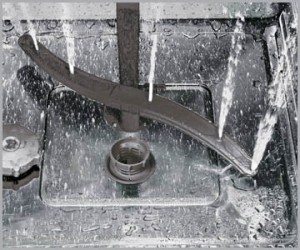 Water collected in the tank flows down the walls to the bottom of the machine and, through a filter, returns to the water collector for reuse. At this point, the water is saturated with detergent from the compartment and reenters the chamber through the rocker arms. This completes the first wash cycle, and the drain pump activates, removing the waste water. Clean water is then drawn in for the cold rinse cycle.
A second rinse is performed with clean water, using warm water and rinse aid. After this stage, the machine drains all the waste water, and the moisture begins to evaporate from the heated plates, either naturally (condensation drying) or by forced hot air (turbo drying). Completion of the process is accompanied by a sound signal. The entire dishwasher cycle can take from 30 to 180 minutes, depending on the mode, which you can read about in detail in the article. How long does it take for a dishwasher to wash?.
To summarize, we'd like to point out that detailed information about the design of your Bosch, Ariston, or other dishwasher can be found in the manual. We've tried to provide a general overview of how the dishwasher works and what components are included.
Interesting:


Readers' comments
Headings
Washing machine repair




For buyers




For users


Dishwasher




Add a comment