
Indesit washing machine design
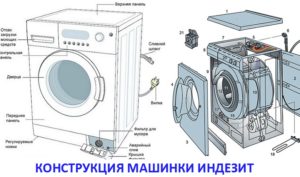 Since almost all front-loading washing machine models are virtually identical, we'll examine the internal structure of a washing machine using the Indesit brand as an example. It's currently the leading manufacturer and sales brand in the Russian market. So, let's illustrate the design of an Indesit washing machine.
Let's list the main elements
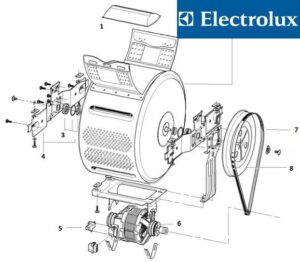
A washing machine consists of both primary and secondary modules. Your machine will only function properly if all components interact smoothly with each other. Every model includes:
- electric motor;
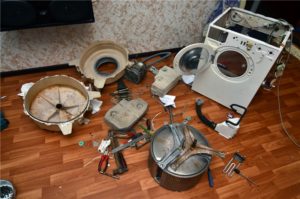
- tank and drum;
- drain pump;
- control panel with electrical module support;
- spring shock absorbers;
- special unit with bearings;
- the main body, the rear wall of which is made in the form of a hatch cover;
- liquid intake valve;
- tubular electric heater and its parts.
Please note that this is a completely basic set of parts for any washing machine. Once you understand the circuit diagram, you'll be able to easily analyze the operation of your Indesit washing machine.
How does the technology work?
The Indesit washing machine is equipped with a plastic tank. To prevent the tank from deforming, it is loosely connected to the body to prevent excessive vibrations that can damage the tank. After all, the tank moves very actively during washing and, especially, spinning, while the body remains motionless, which actually ensures the safety of the tank. In addition, two shock absorbers are placed at the bottom for support, and springs at the top.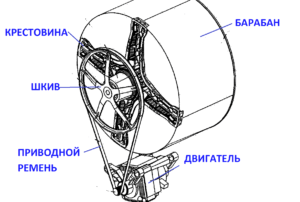
During washing, the drum rotates thanks to a special pulley, to which it is connected via a spider. The pulley, in turn, receives power from the electric motor via a belt drive. All these actions cause the pulley to rotate, and since it is attached to the drum, the drum also rotates, thereby washing our clothes. The drum itself is built into the tub with a mounting bracket.
The so-called "intelligence center" of a washing machine is the control board, which determines the sequence of operations and the coordinated interaction of all the components. For example, supplying the washing machine with water involves a number of actions by various parts: the inlet valve draws water from the water supply, the heating element heats it to the required temperature, the pressure switch controls the water volume, and a special pump removes waste water after the wash cycle is complete.
Now you can roughly imagine how your washing machine is designed and how it works, but to add more detail, you should look at the operation of each module separately.
Main tank and drum
Drums are mostly made of stainless steel, as are the tubs of some washing machines. This material is more durable, and as a result, your machine will last much longer. However, if you prefer a more affordable and lightweight option, choose a machine with a plastic tub. It's not as durable, but it's less expensive and easier to transport. The most common models have a horizontal tub, although some manufacturers also produce machines with inclined tubs.
All modern Indesit washing machines are equipped with plastic tanks.
So, the tub is the main compartment of any washing machine. As we've already established, it houses the drum, where you load your laundry. The drum typically has numerous holes through which water from the tub enters this compartment. Yes, water is drawn from the water supply into the tub, where it is heated and mixed with detergent, and then flows into the drum during the wash cycle. Furthermore, the metal tub's surface is highly ribbed, which improves washing quality. To prevent leaks and other problems, no foreign objects should fall into the tub.
Heating the mixture of water and powder
 A tubular electric heater, commonly known as a heating element, is responsible for heating the water in the drum. It's built into the bottom of the machine. During heavy use, the heating element is subject to the most damage because scale builds up on its surface, gradually destroying it. Furthermore, heating elements always wear out faster than other electrical appliances. The more often you wash in hot water, the sooner problems with the heating element will develop.
According to the technical specifications, the power consumption is approximately 1800-2200 watts. This is equivalent to the average power consumption of any heating element. Therefore, if you feel like your washing machine is consuming a lot of energy, the problem is likely the heating element.
What makes the drum move?
Remember how we talked about the connection between the drum, pulley, and electric motor? It's the electric motor that powers the device. Indesit uses commutator motors to save money and, as a result, to reduce the cost of the product. However, commutator motors do not have any enviable durability, and in addition, they are very susceptible to voltage fluctuations, so it is better to connect them through a stabilizer.
Brushed motors quickly lose their functionality and eventually stop working altogether if not carefully maintained (for example, you'll have to change the brushes regularly).
Water supply and removal
The supply of water from the water supply to the tank occurs according to the following scheme.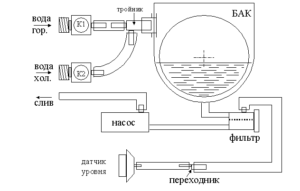
- A specialized module “commands” the intake valve to open;
- The valve opens, and since it is under high pressure, water immediately begins to penetrate into the tank.
- The pressure switch controls the volume of water to ensure that it collects exactly as much as needed (the same thing happens when draining water, so this sensor is indispensable for any machine);
- When the required volume is reached, the pressure switch signals the module, which in turn signals the valve that there is enough water and it needs to close.
- The valve closes and the water supply stops.
Once the wash cycle is complete, the control module communicates with the pump. The pump receives a signal to drain the water and begins pushing it into the drain through the drain hose. This effectively removes the water from the drum. Then, using the same process, the machine draws in water to rinse the laundry and then drains it in the same manner.
The brain of the washing machine
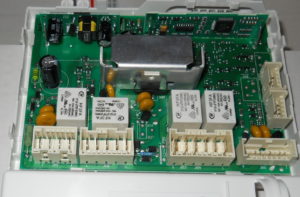 The control board is responsible for all the machine's components except the control panel (which contains all the buttons, indicators, etc.). There's a separate board for that. These two devices are integrated and function as the machine's "intelligence," issuing commands to the modules to ensure the smooth operation of the device.
Washing programs and modes are pre-programmed algorithms for specific actions stored on the control board. Consequently, it is responsible for the operation of any program you select. The board consists of numerous semiconductor components (including triacs, thyristors, and other components).
Contacts between parts are made via special conductive tracks, which are also located on the control board.
The control panel board has a slightly different purpose. While the control board coordinates the interaction of the parts, this one coordinates the interaction of the operator and the control board. That is, its task is to “explain” to the control board what exactly the user wants to do, as well as inform him about all the details of the wash (by displaying information on a special screen or through indicators).
Auxiliary elements
We've covered how the basic parts of an Indesit washing machine work. However, there are many additional parts. While their role isn't as fundamental, your washing machine won't work without them. Here's a list.
- Springs and shock absorbers are components that prevent the damaging effects of vibration on the tank. They dampen vibration.
- To prevent water from leaking out from under the hatch cover, there's a special cuff. This is a kind of rubber seal that tightly seals the hatch during washing.
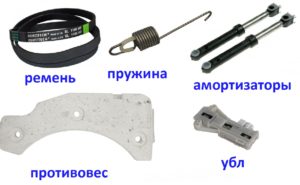
- The door locking device (abbreviated as UBL) ensures the door is fully closed and prevents it from being opened accidentally or unintentionally. As long as the UBL is functioning properly, water will not leak from the machine.
- The drive belt. The one that directs the rotation to the pulley, and the pulley, as you remember, helps rotate the drum. Therefore, this part is essential for the drum to function.
- Counterweights. Counterweights are very large stones, both in volume and weight, that are installed inside the body, increasing its mass. Thanks to these parts, the machine is able to resist centrifugal force during spinning. Otherwise, the washing machine would move very actively around the room due to pressure on the side walls.
- The hatch door. There's no need to describe the importance of this detail. Without it, washing is basically impossible.
- Powder compartment. This is where you place detergent and fabric softener, which are dispensed into the drum during the wash cycle. Typically, it has three compartments for different types of detergent.
- Pipes. These allow water to move into and out of the tank. They are built into the housing.
Now that you know all the details of your Indesit washing machine's operation and design, you can easily analyze its performance and condition. If a problem arises, you'll know what to look for first and, perhaps, you'll be able to carry out simple repairs yourself. Remember, with proper care, your appliance will last much longer and deliver much better performance.
Interesting:

Readers' comments
Headings
Washing machine repair




For buyers




For users


Dishwasher




Add a comment