
How does a washer-dryer work?
 Washing machines with integrated dryers were once a true luxury due to their high cost and limited availability. However, manufacturers gradually offered more of these units, and many began replacing conventional washing machines with washer-dryers. What is the basic design of a washer-dryer, and how reliable is this type of equipment?
How does tumble dryer work?
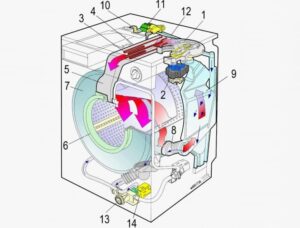
There are both vertical and horizontal loading washing machines, but in both cases the drying process is carried out according to the same algorithm, which consists of condensation of water vapor on a cold surface.
The dryer contains a special element—a condenser—whose inner walls are cooled by water entering through a valve. The drying system also contains a chamber equipped with powerful heating elements, which increases the temperature of the water vapor.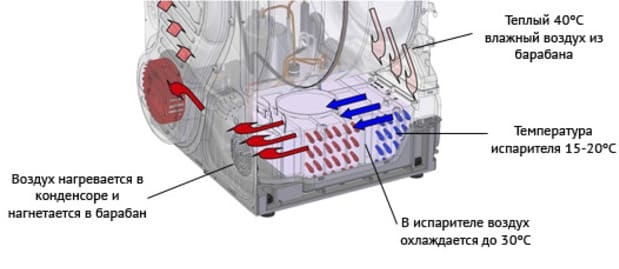
The condenser itself is a plastic or rubber component with a powerful fan, mounted either on the side or at the back of the washing machine. The heating chamber is screwed closer to the top of the washing machine's drum.
Thus, the condenser is connected to the drying chamber through the upper part, and to the tank through the lower part via a gasket.
How to dry laundry?
When the drying cycle starts, the machine supplies power to the heating elements, the fan, the inlet valve (through which water enters the condenser), and the drain pump. The drum containing the laundry rotates back and forth. A fan attached to the condenser starts to operate, pumping moist air from the tank into the heating chamber, where the moist air turns into hot steam and is directed into the condenser cavity.
At the same time, the water cools the walls of the appliance, so that when it enters, all the moisture from the hot steam condenses and flows into the bottom of the tank, where it is connected via a rubber hose to the drain pump. The pump removes the cold water and condensate, while the hot air dries itself and dries the laundry.
Important! The drying chamber contains special temperature controls that prevent the air from becoming too hot. The highest drying temperature is available for cotton fabrics (100-120 degrees).
Top-loading machines are designed a little differently: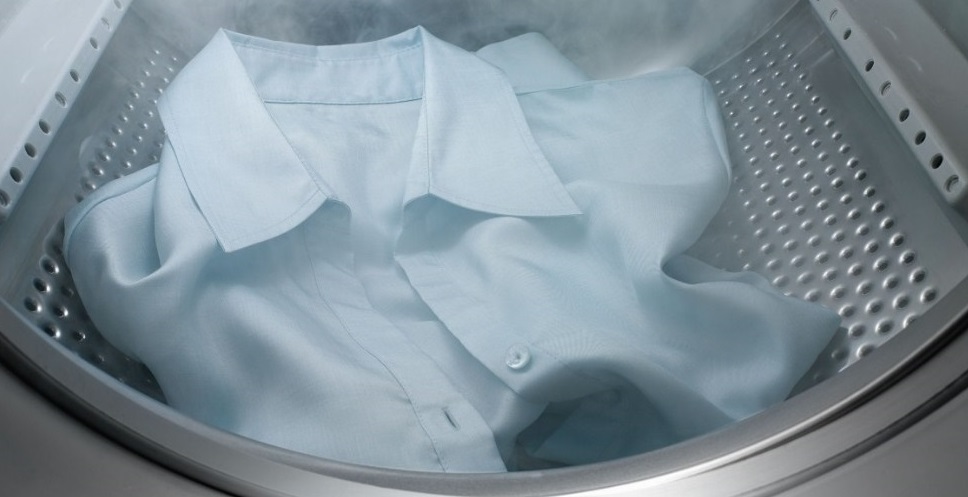
- The drying chamber is attached to the tank.
- The fan is located closer to the rear wall of the CM.
- There are only two thermostats, connected to each other and to the heating elements in series. One is responsible for temperature regulation, the other for overheating protection. This function is typically performed by the fan, but if it fails, the safety thermostat will interrupt the power supply to the heating elements.
Dryers are designed to require periodic maintenance, otherwise they won't last long. During the drying process, laundry is subjected to intense mechanical stress, causing fibers and small pieces of fabric to clog the condenser and heating chamber. What's dangerous about this? Over time, this debris sticks together and forms a solid plug, blocking the water and air inlets. Sometimes, the fibers can even damage the fan by restricting the blades.
Interesting:





Readers' comments
Headings
Washing machine repair




For buyers




For users


Dishwasher




Add a comment