
How a clothes drying cabinet works
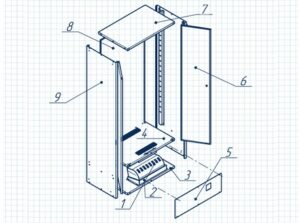 Today, more and more people are becoming interested in drying cabinets. This relatively new type of appliance in our country is very convenient for everyday use. These devices make it possible to dry large quantities of laundry at any time of year. They can accommodate a variety of items, including delicate fabrics.
Let's discuss the design of clothes drying cabinets. We'll describe the design features of these models and discuss what features to look for when choosing such equipment.
Structural differences of drying cabinets
All drying cabinets can be roughly divided into two groups. The first group includes models that exhaust moisture with air. These units have a discharge pipe that is directed either directly to the street (in single-family homes) or into a ventilation shaft (in multi-story buildings). This installation option has some limitations—the unit must be placed in rooms with ventilation vents.
The second group includes models that condense moisture. These drying cabinets are equipped with a special container for collecting water. The container needs to be emptied as it fills. Devices like these can be placed in any room and only require an electrical outlet.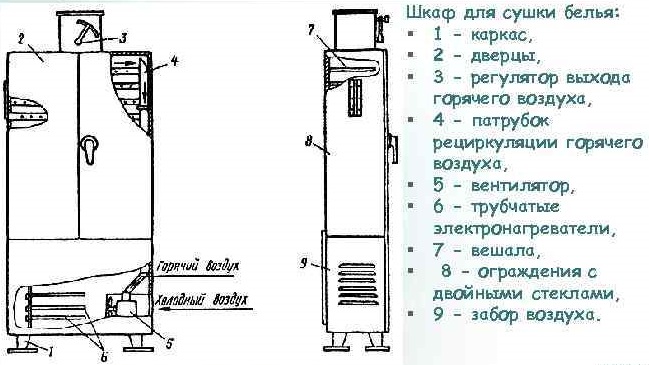
Some condensing drying cabinets can be connected to a sewer system. This eliminates the need to drain the container; the water will drain automatically.
Drying cabinets can either remove moisture along with the air or condense it in a special container.
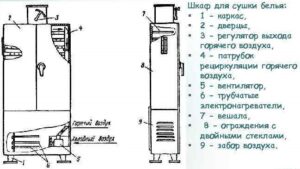
Drying of things is carried out according to the following principle:
- After placing the clothes, selecting the mode and starting the cycle, the heating element turns on;
- at the same time the fan starts working;
- moisture is either removed with air into the ventilation or condenses.
Some clothes dryers are equipped with sensors that monitor the humidity level inside the drying chamber. This allows the cycle to be stopped when the clothes are completely dry. To speed up the process, it's recommended to spin the clothes yourself before loading them into the dryer.
Although rare, it's possible to find wardrobes that operate using infrared rays. In this case, moisture is also removed by heating, but with one important difference. Clothes must be arranged so that they don't obscure each other from the electromagnetic radiation source.
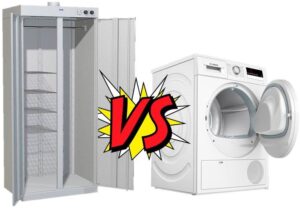
Or maybe it would be better to buy a tumble dryer?
There are two types of devices for drying clothes: cabinets and machines. What are the advantages and disadvantages of these types of equipment? How do they work? Which is better?
The dryer is the same size as the washing machine. Furthermore, these two units can be stacked, saving space. The cabinet will still need to be installed separately.
The dryer has a rotating drum. This allows for faster drying, as the drum moves, allowing moisture to evaporate from the laundry more quickly. While the shortest cycle in a closet takes 1 hour, in a dryer it's 20 minutes.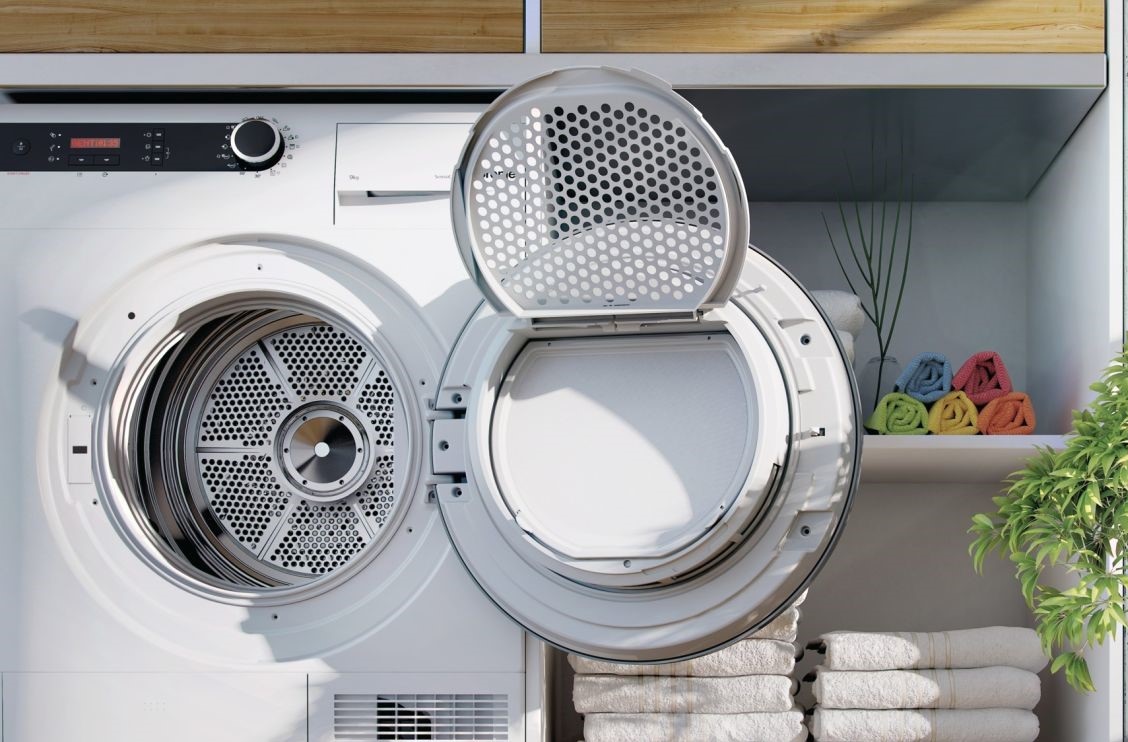
Looking at the software, machines have more available modes. On average, there are 5-7 algorithms, compared to 3-4 for a wardrobe. However, this isn't particularly important, as users generally get by with two or three programs. Typically, the following are sufficient:
- delicate drying for items prone to deformation;
- fast cycle;
- intensive drying for thick, multi-layered clothing;
- long-term mode at a moderate temperature for drying outerwear and bedding.
The loss in drying speed is easily offset by the other advantages of a drying cabinet. The advantages of these devices include:
- Almost any type of clothing can be dried in closets – cashmere coats, items with decoration, voluminous down jackets, winter and demi-season shoes, fur coats, blankets;
- It is also permissible to load accessories into the closet: hats, panamas, knitted stoles, silk scarves, gloves, etc.;
- Items hung on hangers or folded on shelves are not subject to friction, so they retain their appearance and properties longer.
The load capacity will depend on the model of the dryer and cabinet. Drums are often designed to hold fewer items than racks. However, stores now offer a selection of very capacious machines, capable of holding 9-10 kilograms of wet laundry.
You don't need to remove clothes from the dryer immediately after the cycle ends. They can hang there all day without wrinkling. Leaving clothes in the machine drum for even a few hours is not recommended, as this will cause creasing.
Dryers are quieter than washing machines. This is easy to explain – they don't have to constantly spin the drum. The heating element heats up silently, and the fan doesn't make any loud noise.
In terms of cost, dryers are more expensive than washing machines. Therefore, before purchasing, it's important to decide which criteria are more important: price and compactness, or the ability to dry absolutely any garment.
What to look for when buying a wardrobe?
When purchasing a clothes drying device, you should consider a combination of factors. When choosing a drying cabinet, pay attention to the manufacturer, cost, working chamber volume, and energy consumption. These are the main characteristics. Many buyers are also interested in the design and dimensions of the device.
What size dryer should you choose? This depends on the size of your family and the capacity of your washing machine. It's convenient when all your laundry can be loaded into the dryer at once, rather than having to split it into two loads.
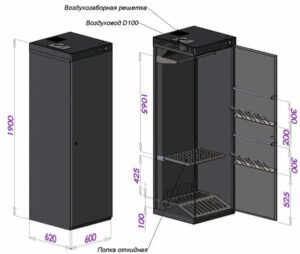
The standard dimensions of a drying cabinet are 60 x 60 x 180 cm, which is quite sufficient for the average family of four. Narrow, 50-centimeter-wide units and dual-chamber models (120 cm wide) are also available.
Cabinets with a height of 180 to 200 cm are ideal for drying long clothes: dresses, raincoats, coats, fur products.
Energy consumption is an important indicator. The power of such devices typically ranges from 2000 to 4000 watts. The lower the energy efficiency rating, the more kilowatts the dryer will consume, and the higher the bill will be.
Experts recommend purchasing drying cabinets with an energy efficiency rating of at least "A." This will ensure energy savings. The selected program also affects kilowatt-hour consumption: the cooler the drying cycle, the lower the consumption.
Another important factor is the moisture removal method. Whether it's a model that requires ventilation or a condensation-based unit will determine the dryer's possible installation location.
A drying cabinet can't be hidden—it's on display. Therefore, manufacturers give the cabinet a sleek, stylish design, without any frills. The unit is typically white or gray. The main focus is on the efficient organization of the interior space.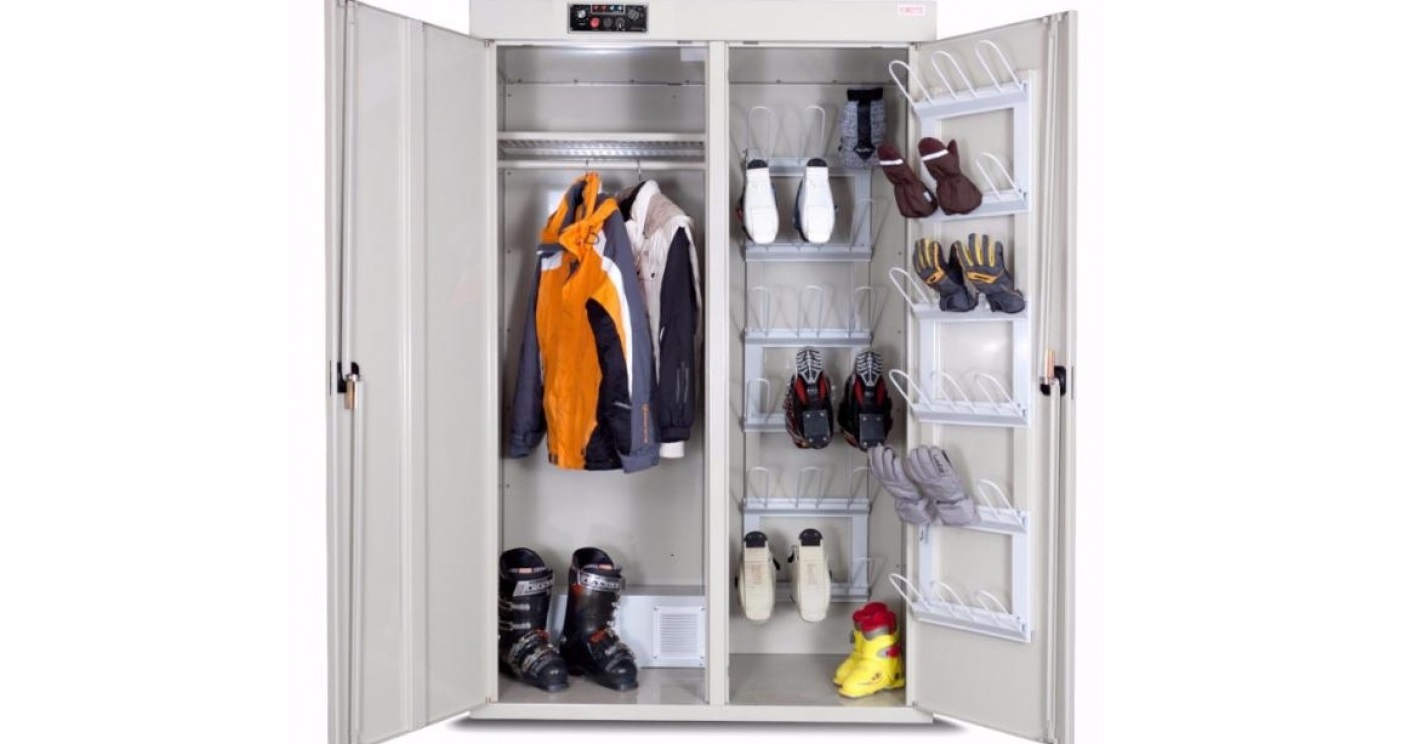
The appliance's efficiency will be higher if hangers and shelves are strategically placed. Therefore, it's essential to pay attention to the interior layout of the closet. The air flow generated by the fan should reach every item to ensure even drying.
Choose a cabinet with shelves that fold down when needed. This is ideal for drying long items vertically. It's also convenient if the door has hooks for hanging accessories like caps, hats, and scarves.
Interesting:

Readers' comments
Headings
Washing machine repair




For buyers




For users


Dishwasher




Add a comment