When you buy appliances in a store, you always receive documentation with all the technical information. If you buy a washing machine at a flea market, there's no information or specifications—only the machine itself. As a result, to thoroughly familiarize yourself with the washing machine and purchase spare parts, you have to look for the model name and year of manufacture on its body. Thanks to factory stickers and codes, you can identify the washing machine model without the manual. You just need to find the markings and read them correctly.
Find the right combination of letters and numbers
Many people mistakenly believe that the most reliable way to identify a washing machine model is to consult the manual. However, this is not the case: to save money, technical manuals are often printed as universal versions and written for the entire product line. Finding the necessary information among this vast amount of information is very difficult, especially for the uninitiated user.
You can find the model number without instructions. For safety reasons and for the convenience of the consumer, manufacturers duplicate the main data several times using special stickers - "nameplates". As a rule, information leaflets are located in several places at once:
behind the hatch door;
next to the trash filter;
on the back wall of the case.
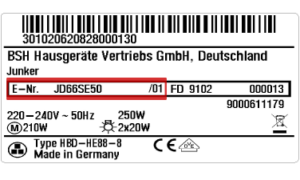
Information sheets with the serial number, FD code, Z-Nr. code and E-Nr. code are located behind the hatch door, next to the dust filter and on the rear wall of the machine housing.
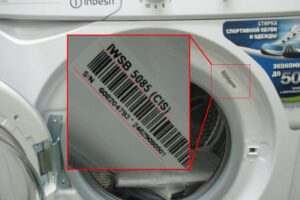
Most washing machines have an information sticker located near the drum. The sticker is either attached to the inside of the door or directly behind it, on the machine body above the door. It's usually small, often a long, miniature strip with one or two lines of letters and numbers.
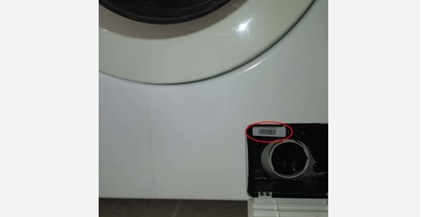
The second location for the factory marking is near the waste filter. To access the sticker, pry the access door with a flat-head screwdriver and unhook it from the housing. That's it! A piece of paper with a barcode and a combination of letters and numbers will be affixed above the waste filter cap.
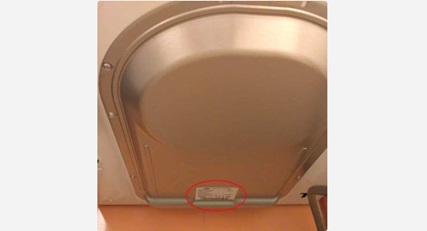
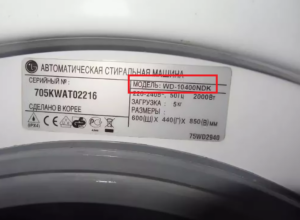
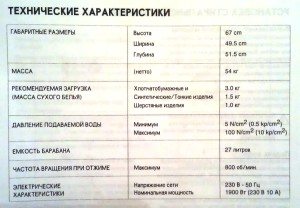
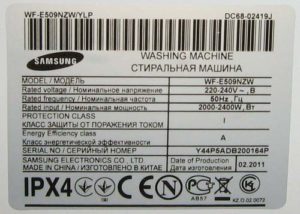
An information sheet is also always present on the back or side of the washing machine. Moreover, this main plate contains the most information: not only the model name and serial number, but also the FD code, Z-number code, technical specifications, and country of manufacture. Simply turn the machine to the correct side and decipher the information.
Once you find the label, you should write down the combinations on it and, ideally, photograph them. This will simplify the process of deciphering the data and save the information for future reference. It's important to understand that labels can fade, tear, or peel off over time, especially if the washing machine is not used carefully. It's best to be on the safe side and make a duplicate and store it in a dry place.
What information does the model number hide?
Finding the model name on the information sheet is easy. Typically, the desired combination is listed first and accompanied by a special designation. There are three options:E-Nr.», «Model" and the abbreviation of the latter "Mod.». Next will come Latin letters and numbers.
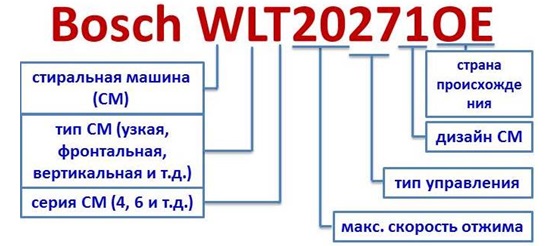
To the uninitiated, a washing machine model appears to be a random combination. But in reality, the manufacturer uses letters and numbers to encode key information about the appliance, from the load type and series to the design and country of manufacture. To correctly interpret the code, it is necessary to separate the number into its component parts.
The first letter denotes the type of appliance. Washing machines, regardless of brand, will always have a "W," which stands for "washing machine." The second character denotes the type of washing machine. For Bosch, the possible options are "L," "O," "I," "A," or "K." The decoding is as follows:
“L” is a narrow frontal with a depth of up to 45 cm;
"O" – top loading machine;
"I" – built-in front camera;
“A” – frontal model with a depth of 60 cm;
"K" – washer-dryer.
The third letter indicates the machine's series. The decoding will vary depending on the brand. For example, for Bosch, the following options are possible:
“T”, “K” – 6 series;
“G”, “H” – series 4;
“S”, “W” – 8 series;
“Y” – “Home Professional” series.
The next two numbers indicate the maximum spin speed. If it's "20," the machine spins at 1000 rpm; if it's "24," it spins at 1200. The rest of the numbers are as follows: "28" is 1400, "32" is 1600, "36" is 1800, and "40" is 2000.
The next two digits indicate the system control type, most often "27" for electronics. The next character indicates the design. Typically, it's "1" for a classic look. The outer letters indicate the country of manufacture. For example, the Bosch model WLT20271OE stands for "series 6 slim front-loading washing machine with a spin speed of up to 1000 rpm, electronic controls, and a classic design, manufactured in Russia, Belarus, or Ukraine."

 When you buy appliances in a store, you always receive documentation with all the technical information. If you buy a washing machine at a flea market, there's no information or specifications—only the machine itself. As a result, to thoroughly familiarize yourself with the washing machine and purchase spare parts, you have to look for the model name and year of manufacture on its body. Thanks to factory stickers and codes, you can identify the washing machine model without the manual. You just need to find the markings and read them correctly.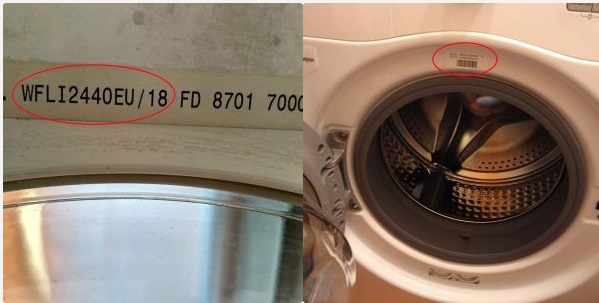














Add a comment