
Why is there water left in the dishwasher?
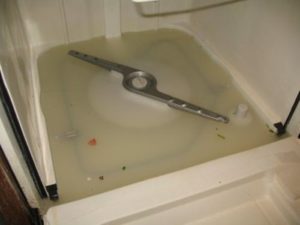 Is there water left in your dishwasher? Don't panic; in most cases, it's a minor issue that can easily be fixed yourself. The key is to avoid doing anything stupid, such as running the dishwasher repeatedly, adding chemicals (like Domestos), and, most importantly, slamming your anger on your dishwasher. You need to sit down, calm down, and begin tackling the problem step by step.
Reasons why the machine does not drain water
First, let's clarify how much water should remain in the bottom of the dishwasher after a wash cycle under normal circumstances. Manufacturers don't always specify in their instructions that water should remain in the dishwasher, and consumers are quick to panic over nothing.
Experts say that under normal circumstances, there should be a puddle of about 1 cm deep at the bottom of the dishwasher to prevent the rubber seals from drying out. In a confined space, water will slowly evaporate, wetting the walls and ceiling of the wash tank with condensation, and therefore the surrounding seals. Wet rubber seals will remain elastic for a long time, meaning they won't leak. If there's clearly more water in the dishwasher and food debris is floating in it, there's a problem that needs to be addressed.
Conclusion! If the machine is working properly, there should be a small amount of clean water at the bottom, but not water contaminated with food residue.
Experts identify a number of reasons why a washing machine won't drain. Here are those reasons.
- The drain hole is located too high from the floor, and as a result, the drain hose is positioned incorrectly. In this case, the pump cannot properly pump out wastewater, and some of the dirty water remains at the bottom of the wash tank.
- There's a blockage somewhere in the system. It could be a filter screen, a pipe, or a hose. Either way, you'll need to troubleshoot and clear the blockage, otherwise the water will continue to drain poorly.
- The water level sensor is broken, so the dishwasher control unit does not know the amount of water remaining in the wash tank and, as a result, does not command the pump to pump out the water.
- The pump is not working properly. If the pump breaks completely, the dishwasher will not be able to wash dishes at all, since no water will be pumped out at all. But if the pump works and then doesn't work, the dishwasher will continue to run the wash program, but will not be able to drain the water properly.
In 997 out of 1,000 cases of poor dishwasher drainage, the above-mentioned causes are at play. However, in about 3 out of 1,000 cases, the control module is seriously damaged. If none of the above applies to you, contact a qualified technician.
How to check the connection?
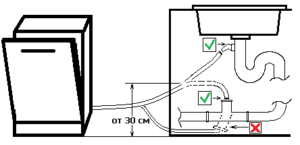 If you just bought a dishwasher, and especially if you connected it yourself without the help of a qualified technician, and a breakdown occurs immediately, it's quite possible the machine was improperly connected to the sewer system. How to connect a dishwasher to the water supply and sewerage system, as described in the manufacturer's instructions. In particular, the most common mistake is placing the drain hose connection to the sewer pipe or trap too high.
Please note that the waste water from the dishwasher is pumped out by a pump with a relatively weak motor. If the connection point of the hose to the sewer is located too high, the pump will not have enough power to pump out the water.Because, according to the laws of physics, it will flow back into the machine by gravity. The pump will have to expend power fighting the siphon effect, which will quickly lead to failure of the drain pump.
Important! The length of the drain hose can also affect the pump's performance. The longer the hose, the greater the load on the pump.
What needs to be done?
- Make sure your dishwasher's drain hose is no longer than 2 meters.
- Make sure that the drain hose is not positioned straight but has some bend.
- Make sure that the height of the hose connection point to the sewer is no more than 40-50 cm from the floor.
If you've completed all three steps and found any discrepancies, you'll need to redo the connection. If everything is OK with the connection, then you need to move on to investigating another cause of the problem.
How to identify and clear a blockage?
As experts rightly point out, clogs are the main reason why wastewater drainage is disrupted. After all, dishwasher users often neglect basic maintenance, especially cleaning. Where can a clog form?
- On a metal mesh, which is located at the bottom of the washing tank near the rocker arm.
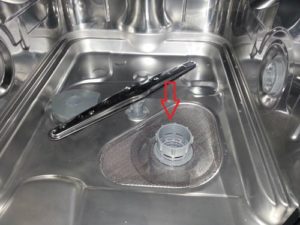
- In the coarse filter (a small cup with a grid, which is also located at the bottom of the washing tank).
- In the drain pipe.
- In the drain hose.
If you've never cleaned your dishwasher before, you should start by cleaning the fine and coarse filters, as this is the easiest step. First, pry up and remove the metal mesh, then unscrew the "glass." Rinse both under running warm water, making sure to pre-treat them with a sponge and dishwashing liquid. Replace the filters.
Note: To better clean dirt from the filter, you can soak it in warm water with detergent and then rinse with clean water.
Now let's check the drain hose for blockages. To do this, disconnect it from the trap or sewer pipe. Place a small container underneath to catch any standing water, then unscrew the hose and rinse it thoroughly with hot water. After all these steps, it's a good idea to dry-clean the dishwasher with a certified product.
How to check and repair the pressure switch and drain pump?
The connection is correct, and there are no blockages in the dishwasher. Why is the machine still not draining properly? There must be something else going on. Experts recommend checking the dishwasher's pressure switch. The pressure switch determines the amount of water in the dishwasher; if it's not working, the machine won't drain completely. Checking and Replacing the pressure switch in a dishwasher This is a more complex undertaking, involving disassembling the dishwasher. It's best to delegate this task to a professional, but you can do it yourself.
When you get to the pressure switch, don’t forget to check the functionality of its sensor contacts. Often, the contacts burn out, causing the unit to stop working. If the water level sensor is OK, we'll check the pump. You can generally determine how the pump is working even before disassembling the dishwasher by listening to how it drains and the sounds it makes. A poorly functioning drain pump will usually make a loud humming noise, but the sound of water will be barely audible.
Important! Some people tilt the dishwasher and peer into the tray to observe its pump operation. Experts advise against this, as it can disrupt the sensors, leading to more serious damage.
To access the pump, unplug the dishwasher and disconnect the hoses. Then, place the dishwasher on its back, placing some cloths underneath. In most cases, you'll immediately gain access to the pump through the bottom, without having to remove any of the dishwasher's walls. Here's how:
- we find contacts on the pump body;
- take a multimeter and set it to the lowest value in Ohms;
- We place the device probes on the contacts and measure the value, which should be within 1000;
- If the pump's electrical system is in good working order, unscrew it and clean it thoroughly. Sometimes, a foreign object gets stuck in the pump impeller, slowing its rotation;
- If the pump is clean but still doesn't work, either replace the pump or call a technician to help you figure out the problem.
To summarize, there are many reasons why a dishwasher refuses to drain properly, but the result is the same: a tank full of dirty water. To solve the problem, you'll need to carefully examine all possible causes; this is the only way to find the root cause. Happy repairs!
Interesting:





Readers' comments
Headings
Washing machine repair




For buyers




For users


Dishwasher




Add a comment