
How much laundry can I load into my washing machine?
 When buying a washing machine, we always check the drum capacity and its maximum load capacity. But once we start using it, we don't even think about how much laundry we're putting in or how much it weighs. Of course, no one weighs the laundry before washing, but constantly overloading the drum can lead to rapid wear and tear.
On the front panel of the machine, large numbers indicate 4, 5, 6, or even 8 kg. But what does this mean—the maximum laundry load? The question then becomes, what kind of laundry: dry or wet? We'll try to answer these questions.
Minimum load
Let's start with the minimum amount of laundry you can put in the drum, because the minimum is just as important as the maximum. The amount of items in the drum during washing will determine the degree of vibration during spinning, and therefore the length of the machine's trouble-free operation.
Any automatic washing machine should be loaded with at least 1-1.5 kg of dry laundry.
Not all washing machine manufacturers specify this limit, arguing that it's better to load more to save energy. However, for some, the need to wash three pairs of socks or one T-shirt is more important than energy savings, which is not at all safe for the machine. The 1 kg limit is no accident; during a high-speed spin, the laundry needs to be evenly distributed throughout the drum to ensure balance.
An unbalanced drum will vibrate more intensely. Even if the machine isn't a narrow model and is properly installed, internal vibrations will persist, which can cause microcracks. We hope this explains why you shouldn't wash just one pillowcase or pair of underwear.
Maximum weight of dry or wet items
Now let's talk about the number on the front panel of the washing machine—or, more precisely, its maximum load capacity. Today, automatic machines can have load capacities of 8, 10, and even 12 kg of dry laundry. In reality, this is a lot; to put it into perspective, a set of bed linen consisting of one duvet cover, one sheet, and two pillowcases weighs an average of 1.3 kg when dry. This means that a washing machine with a 12 kg capacity can hold about 9 such sets. However, don't blindly trust these numbers; it's not as simple as it seems.
Please note: Some manufacturers intentionally inflate this parameter to attract attention to their car model and increase sales.
The technical meaning of the machine's maximum load in kilograms, indicated in the passport, is as follows: the machine must rotate the indicated weight without overloading the engine during its service life. But this doesn't mean you should load the drum with this amount of laundry and clothes, weighing them on a scale every time—and you're unlikely to succeed. Furthermore, the manufacturer doesn't guarantee wash quality at maximum load. Most users report that even if they wanted to, they couldn't push and pack the maximum load.
This is likely no coincidence. Some washing machine manufacturers, such as Bosch, use thick, heavy fabric cut into small pieces when testing their machine's maximum load. As is well known, the denser the fabric, the heavier it is and takes up less space. Therefore, it fits easily into the drum, while still leaving enough room for it to slosh around. Based on these tests, the manufacturer specifies a maximum load with some margin, so that the machine isn't overloaded even when fully loaded.
In reality, we wash linens and other items that are bulkier and therefore lighter. Furthermore, the density and composition of the fabric also influences water absorption. Imagine a throw blanket. When dry, it fits easily into a regular basin. But hand-washing it in a basin would be extremely difficult, practically impossible. It's much easier to wash it in a bathtub, which is several times larger.
It's the same in the washing machine drum. The larger the item, the larger the load and drum volume should be. If you plan to wash jackets, down jackets, and blankets in the washing machine, you should choose a machine with a larger load capacity to ensure thorough cleaning. The manufacturer takes this into account and specifies the load capacity for a specific wash cycle in the machine's instructions.
Important! The weight of the laundry being loaded is measured dry. No one will weigh wet laundry and load it into the machine; it's problematic.
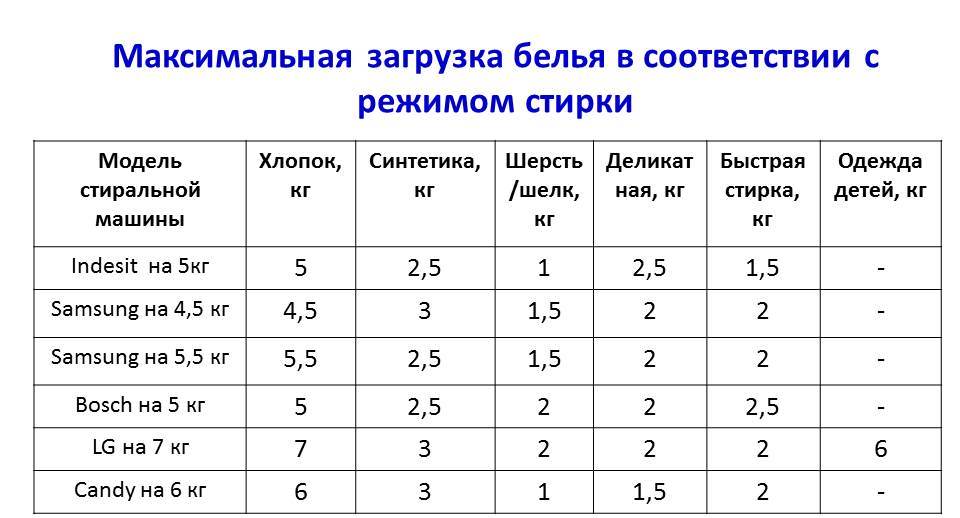
After analyzing this table, we can conclude that regardless of the washing machine manufacturer, the load capacity across different cycles is roughly the same. Wool is the smallest fabric to load into the drum, as it is the bulkiest and absorbs a lot of water. Avoid washing large quantities of synthetic and delicate fabrics in the machine, as this will prevent them from stretching and will result in excessive wrinkling.
Cotton items, bedding, and baby clothes are the most suitable loads for your machine. This doesn't mean you have to fill the drum to capacity. The drum should be filled 2/3 full so that the laundry is washed and rinsed well. This will also ensure the laundry is evenly distributed throughout the drum, preventing imbalances or poor spin results. Imbalances can cause the machine to stop and display an error message, such as: UE error on a Samsung machine.
How much does the laundry weigh?
Now it's logical to talk about how much laundry can be washed in a washing machine in one wash cycle without weighing it. Each item of clothing has its own weight in grams; for example, a women's T-shirt can weigh on average between 70 and 140 grams, depending on the size. Several similar examples are shown in the table below. Using this table, you can easily calculate how much laundry to put in the drum.
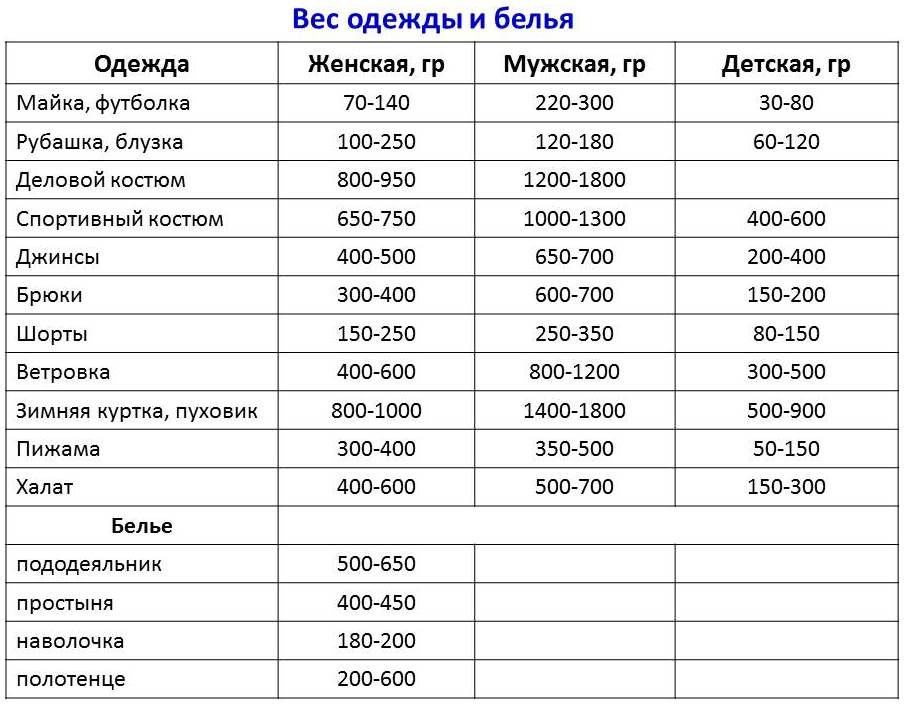
A 5 kg load on any cotton cycle can wash a couple of sheets, a couple of pillowcases, and 3-4 towels. The laundry will rotate freely in the drum without twisting or wrinkling. But outerwear should be washed separately.
Remember! Avoid mixing small items with large ones, such as underwear with jeans.
Modern washing machines feature an "Autoweigh" feature. Now you don't have to worry about the weight of your laundry; the machine automatically retrieves the necessary information. The main benefit of this feature is that, after determining the weight of your laundry, the machine will determine the amount of water needed for washing and select the optimal wash cycle. This provides a triple benefit:
- the machine eliminates the need to think about how much laundry to put in;
- saves water and electricity;
- selects the best program to wash your laundry properly.
Automatic weighing also protects the washing machine from breakdowns, since overloading can lead to drum imbalance. If the machine has an automatic weighing system, then if the drum is overloaded, it simply will not start and will display an error.
Therefore, you should load your washing machine drum not according to the machine's maximum load, but according to the maximum load for a given wash cycle. We hope this article has helped you understand how much laundry to load. Good luck!
Interesting:


47 reader comments
Add a comment
Headings
Washing machine repair




For buyers




For users


Dishwasher




Great! Now I understand how it works! Thanks to the website developers!
Thank you! The information is useful.
Thank you! Everything became clear!
Washing jeans with underwear isn't really washing; it's spreading germs. Normal people always wash underwear separately from outerwear! And it's important to follow the temperature rules, as bedding should be free of germs, which are only killed at high temperatures. Agapkin also talks about this in his program.
What about silk underwear? Both underwear and bed linen? Even satin is limited to 60". I always washed it at 30-40". And it seems there were no germs...
Have you looked under a microscope? 🙂
In this case, as in ancient times after washing, boil in a large cauldron.
Yeah, boil the silk )))
Why does my wife wash her panties with towels, but mine with socks? 🙂
Well, your laundry is full of germs, and hers is full of pollen and candy.
Thank you.
It's a whole article, and I still don't understand whether 5 kg is dry or wet. 🙂
Load dry. If your items are heavily soiled, it's best to load half as much for better cleaning results.
Dry!
Thank goodness! I was struggling with this question 🙂
You need to read where the letters are. And you will understand everything.
A whole scientific work! On a simple and specific question. A real gem about English scientists!
Thank you so much for such an accessible and understandable explanation.
This is a scam from the manufacturers. There's a "Can hold 8 kg" label, but the drum only holds 3.5 kg of dry cotton. It's pure fraud. Almost all drums have a diameter of 0.5 m; the difference is in length. Bloomberg holds 6 kg. The drum length is 300 mm. The same as mine. It holds 8 kg. The tank capacities are the same—58 liters.
If you load the drum with, say, two or three bricks according to the specifications, and turn on the spin cycle, the bearing will fall off 🙂
So should I load up to 5 kg of dry laundry and spin at no more than 600 rpm? Or can I use 1000 rpm?
But I didn't understand anything.
If I have a Bosch 7 kg machine, how much dry laundry should I load? Please give me a quick answer. Thanks everyone!
Two-thirds of the drum, so that it washes properly (and it depends on the fabric).
Hello! Could you please tell me how much laundry I can put in my Indesit 5kg at a time? I need to wash a set of bed linen that weighs 1,800. Can I wash that amount and what spin cycle should I use?
Hello Anna! If you need to wash bedding weighing 1800g, and it's a double bed set, you can certainly wash it in a 5kg capacity. It's best to always wash double bed sets separately from other items to ensure they're properly washed and spun. A gentler cycle of 700-800g is recommended to preserve the fabric's freshness. Don't forget to turn your pillowcases and duvet covers inside out.
Thanks for the article!
I'm laughing at the questions in the comments)))
Thanks for the article!
Brevity is the sister of wit.
Brief and very accessible.
I had an LG machine with a direct drive that held 5 kg, I think. I stuffed it with so much laundry that the door could barely close. And it washed just fine. Now I have an old HANSA... the tank holds 4 kg. I throw in a couple of sweaters, and it can't handle them. I can't figure out if this is normal or if there's a problem.
I also have a 4 kg LG direct drive washer with auto weighing. The manual says 4 kg of dry laundry. But that's not realistic. You can only load 1.5 kg of dry laundry (even for cotton). Otherwise, it gives an error message and shuts off. I have to run the washer empty, with only a third of the load. I'd also like to know if this is normal or a malfunction.
Just imagine, 4 kg for that poor little tank. 🙂 When you're carrying 3 kg of groceries from the store in a bag, your hand falls off and the bag rips. And the machine wrings out with incredible shaking!
You can only load very light weights, 900 grams maximum (one duvet cover). Is that logical?! And only occasionally might you wash something from your work clothes (like a work jacket).
Hello! Why is there a 1.5-2 kg limit for the short wash cycle? If I set the short wash cycle on my Samsung, but the water temperature is 40°C, it takes 1 hour instead of 30 minutes. Is it possible to load the drum full then? Thank you!
Finally saw the answer to my question. Thank you!
Thanks for the helpful article. I have a Hotpoint 6kg machine. I found the charts with the approximate weights of each type of laundry helpful; I've saved them.
This is all bullshit. The main thing is that the tank mounts and bearings are designed for the load weight specified in the data sheet. If this is a manufacturer's trick, that's very bad. And someday, the manufacturers will screw up and set a precedent.
Remember, the most fragile part of a washing machine is the bearing. In my opinion, any vibration during the spin cycle is simply not recommended. Ideally, it's best not to spin large or heavy items in the washing machine at all.
I almost always soak my laundry in the bathtub before washing it, and I weigh it first to determine how much detergent to use. Won't the machine consider 3 kg of dry laundry as 5 kg, including the water, and select different wash settings?
5 kg of underwear (dry) won't fit in the machine, and even if it does, when they get wet, it won't be 5 kg anymore. Washing it—it does, but only with the spin cycle!?
Is it possible to wash a thick cotton blanket with a maximum load of 5 kg?
My BEKO with a 5 kg capacity is already 13 years old. I wash a huge European-size blanket and synthetic blankets in it.
Very useful article, thanks to the author!
A huge thank you to the author for the information. I have a 7 kg Candy-Rapid. It was important for me to learn how to use the machine correctly.
Are you spinning? I have a 6 kg Samsung. I need to wash an IKEA blanket, but I feel like the machine is screwed. I put it in, and the door slammed shut. I have nothing to wash it in 🙁
Thank you so much for the helpful information. I've learned a lot. My Indesit used to wash double blankets without any problems, but this time the whole machine is shaking terribly. It's probably best to get it repaired; it's been working for 17-18 years.
Someone wrote somewhere above why a wife washes her underwear with towels, but her husband's with socks. Well, that wife is just plain crazy. Then let him wipe his face with a rag. How can you wash underwear with towels? Horrible.
What do you wash your underwear with?
Are you really saving them for more than two months if the machine has a 4.5 kg load? Panties weigh an average of 0.2-0.25 g.