
What types of dishwashers are there? Types and varieties
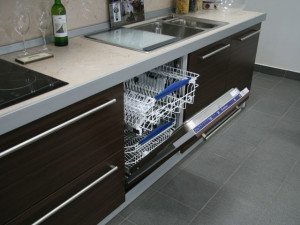 Much has changed since the patent for the first dishwasher was granted. The introduction of new technologies, coupled with accumulated experience with dishwashers, has led to the development of new varieties.
Now, to make the right choice, consumers must first study the different types and styles of dishwashers, determine their differences, and determine the advantages and disadvantages of each type. We'll address these questions together in this article.
The history of the dishwasher
 The world's first dishwasher was invented by American Joel Houghton. Although he can hardly be called the "inventor of the dishwasher," he was more likely the creator of an idea he never brought to fruition. The prototype he built in 1850 was difficult to use, required heavy physical labor, and the resulting dishes were still dirty. Houghton conceived the idea of automating dishwashing, but was never able to implement it.
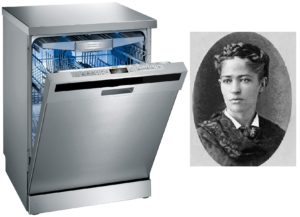
The history of the creation of a full-fledged dishwasher begins with the invention of American Josephine Cochrane. Her machine already resembled a modern one in some ways. Cochrane's dishwasher featured manually operated piston pumps, a heating element that constantly heated the water to the desired temperature, and a convenient basket for placing dishes.
Note! Although Cochrane's invention was revolutionary, it was not widely adopted due to its high cost and poor cleaning performance. However, her dishwasher marked the beginning of the design of dishwashers.
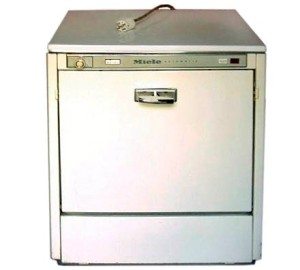 The history of dishwashers continues in Europe. The fully automatic dishwasher was invented by Miele engineers in Germany in 1929. Now, to wash dishes, there was no need to stand by the machine and turn a handle, as hot water was supplied to the drum by an electric pump. In 1960, the same company released a dishwasher that looked like a modern one and washed dishes fully automatically. This is where the history of modern dishwashers begins.
Types of dishwashers and their distinctive features
Just 15-20 years ago, the question of what types of dishwashers there are could be answered simply, quickly, and comprehensively. Now, this is becoming increasingly difficult. To shed more light on this issue, we decided to present one of the most common classifications, which includes almost all types of modern dishwashers. You can see a schematic representation of the dishwasher classification in the image below.
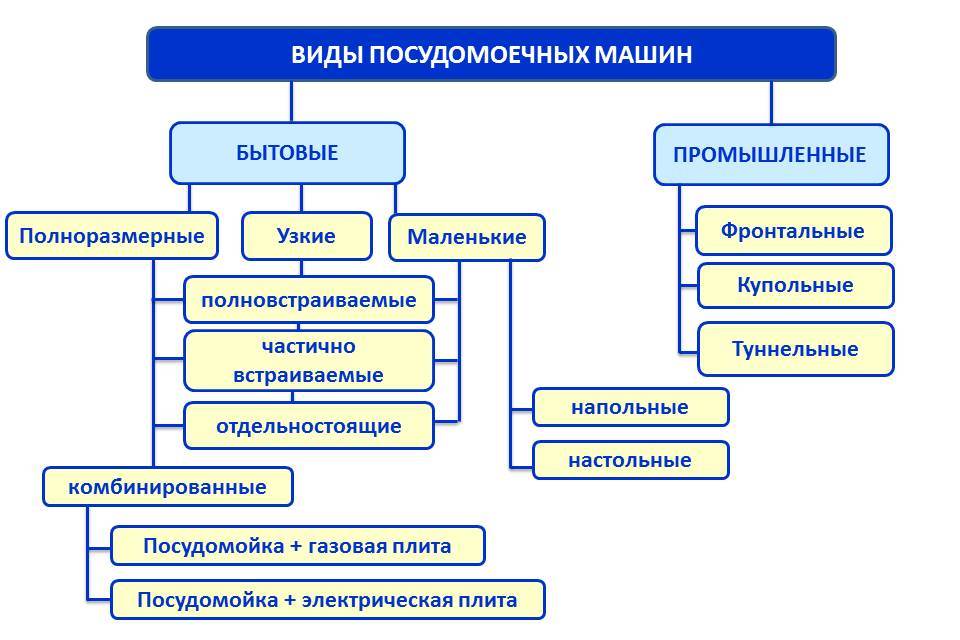
All dishwashers are divided into domestic and industrial. There are three main types of industrial dishwashers:
- Front-loading dishwashers are very similar to domestic dishwashers; they also have a front door, a basket inside, and a similar control panel. The difference lies in reliability. Front-loading industrial dishwashers have all metal parts, clean more dishes, and last much longer than domestic dishwashers.
- Dome-type dishwashers are unique industrial machines that have no door. The wash tank covers the container like a dome, hence the name. The dome machine usually comes with a sorting table and sink.
- Tunnel dishwashers are the largest and most productive, installed in large catering establishments and hotels. The machine resembles a conveyor belt, along which dirty dishes move, enter a wash tank, and then emerge clean.
Please note! Tunnel dishwashers require a lot of space, approximately 18 square meters.
There are numerous companies that manufacture industrial cleaning equipment. Such equipment is very expensive, so it's not practical for domestic use. Learn more professional and industrial dishwashers are discussed in the article of the same name on our website.
Household dishwashers that consumers most often encounter are conventionally divided into:
- full-size;
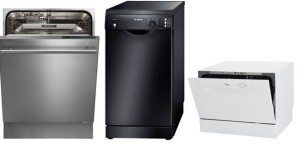
- narrow;
- small.
Full-size dishwashers are those with a height of 82-87 cm and a width of 60 cm. The depth of such dishwashers can vary between 55 and 60 cm. Modern full-size machines can wash from 10 to 17 sets of dishes in one cycle, That's why they are considered the most capacious. Full-size machines can be fully built into furniture, partially built-in or freestanding.
Narrow dishwashers differ from full-size models only in width, which ranges from 44.5 to 49 cm. They are also divided into three categories based on their built-in design. Small (compact) dishwashers available for sale also vary in their built-in design, with widths ranging from 50 to 60 cm, depths from 50 to 55 cm, and heights from 44 to 60 cm.
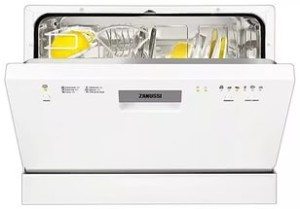
Among the full-size ones, the following stand out: combination machinesThese can be dishwashers combined with a gas stove and oven, or with an electric stove and oven. This type of appliance is new to the market and, due to its complexity, is expensive and in low demand.
Which dishwashers are more reliable, more economical, and wash dishes better?
The reliability of a dishwasher is determined by several factors.
- The first is the material used to make the inner tank, rocker arms, and baskets. The fewer plastic components, the more durable the unit will be. As a rule, manufacturers use more plastic in compact dishwashers, so draw your own conclusions.
- The second point is the software “stuffing” of the dishwasher: the more complex it is and the more modes it has, the more vulnerable it is. The complex design of combination dishwashers makes them the least reliable. If a part of a gas stove breaks down, the entire unit will have to be taken in for repair, which is very inconvenient.
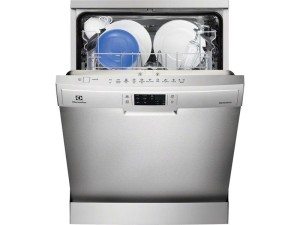
- The third thing to consider when considering a dishwasher's reliability is the country in which it was assembled. German-made dishwashers (Miele, Bosch, AEG) are considered the most reliable, while Italian dishwashers are also considered reliable, while Chinese-made dishwashers are not. However, don't be too negative about Chinese appliances; there are some decent units that perform reliably, depending on your luck.
It's difficult to say which type of dishwasher is more efficient; you need to consider the specific model's specifications. Full-size machines use an average of 11-12 liters of water, while premium models use up to 10 liters. For example, the Neff 51M65X4 uses 7.5 liters of water, but not many can afford such an energy-efficient model. Most compact dishwashers, however, use 7-8 liters of water, and some use as little as 6 liters.
Important! Whether water consumption in small dishwashers is considered economical depends on the number of loads per day, as such a dishwasher can clean only half as much as a full-size one.
The same can be said about energy consumption: in full-size and slimline models, it averages 0.73–0.9 kWh, while in smaller models, it's 0.61 kWh. However, if you run a smaller machine twice a day, the energy consumption will be higher.
Modern dishwashers are known for their high-quality dishwashing performance. It's difficult to say which type is superior in this regard, but some conclusions can be drawn. A dishwasher equipped with a soak mode can handle even dried-on dirty dishes, whereas machines without such a mode are not able to cope with “dried” dirt.
Machines that can recognize 3-in-1 detergents and those with a wider range of temperature settings perform better. Some may dismiss such subtleties as professional nitpicking, but as the saying goes, "the devil is in the details"—a small flaw can ultimately lead to unsatisfactory dishwashing results.
Which are more expensive and which are cheaper?
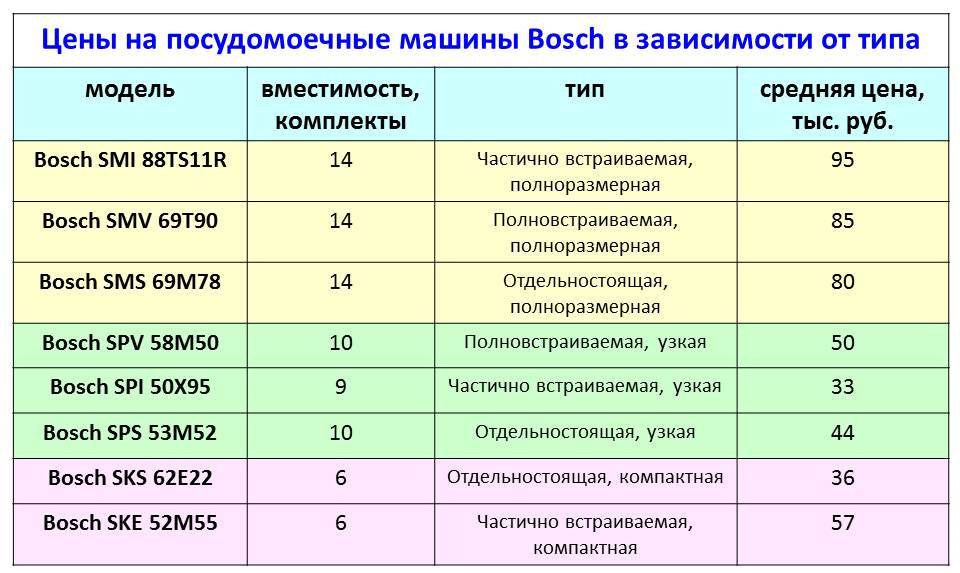
The final cost of a dishwasher doesn't depend on its type. The truth is, a significant portion of a dishwasher's cost is the brand and country of manufacture. Many dishwashers are assembled in Europe, particularly Germany, which adds up to an immediate 25% premium. Then there's the brand: the more a company spends on promoting and maintaining its brand, the more expensive the product, although much also depends on the company's policies.
The world-renowned Bosch company focuses on budget-friendly dishwasher models. Despite spending heavily on advertising and image maintenance, they strive to capture the market through sales growth rather than price increases. Generally, the final price of a dishwasher is influenced by the following:
- who made the dishwasher;
- where the dishwasher was made;
- how new is the model and what technical features does it have;
- How technically complex is a dishwasher?
Combination dishwashers are expensive because they contain not only a dishwasher but also a cooktop and an oven. But this doesn't make combination dishwashers the most expensive. Standard dishwashers from the German company De Dietrich can cost $2,000 or more, while combination dishwashers cost approximately $1,000 to $1,200. Pricing is very difficult to explain; sometimes it defies logic.
In conclusion, the history of the dishwasher began in America and continued successfully in Europe. Although the first examples of these machines, to put it mildly, failed to perform their intended function, people liked the idea and continued to develop it. Today, a huge number of different types of dishwashers have appeared, making it sometimes difficult to choose the right one for your home.
Interesting:




Readers' comments
Headings
Washing machine repair




For buyers




For users


Dishwasher




Add a comment