
Installing a built-in washing machine under the countertop
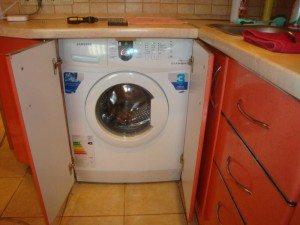 Built-in undercounter washing machines are a special type of compact household appliance. Their main difference from conventional washing machines is that they can be discreetly installed in a small room. They fit perfectly into any interior, regardless of style. However, installing such a machine isn't always easy, especially if you're unfamiliar with the nuances. These are the details we'll discuss in detail.
Where to start installing a washing machine
The built-in dishwasher has been purchased, the countertop and niche have been made, and it's time to start preparing for installation. First, let's assemble everything. necessary tools and components To connect the machine to the electrical and water supply systems, we will need:
- necessary fasteners;
- a set of wrenches of different sizes and an adjustable wrench;
- pliers;
- laser or regular tape measure;
- household level;
- sealing tape and automotive sealant;
- screwdriver and ammeter;
- water supply hoses and filters of suitable diameter;
- compression coupling or tee;
- special shut-off valve;
- sharp knife.
When preparing to install a built-in washing machine with a removable lid, carefully read the instructions included with it. The manufacturer has likely already covered some installation details to avoid any mistakes on your part.
It's especially important to understand how to connect the machine to the electrical system, so don't try anything yourself – follow the manufacturer's instructions.
Machine installation algorithm
Installing a washing machine under a countertop consists of the following steps:
- Connecting the machine to the water supply.
- Installation of sewer hoses.
- Installing the machine in its permanent location.
- Connecting the power supply.
To connect to the water supply system, only cold water supply is required.The hose running from the pipe to the machine should be positioned at an angle of 350, provided that the water intake point is located to the left of the machine (if you look at it from behind) and 450, provided it's on the right. So, let's connect the filler hoses:
- We take the wiring element and embed it into the supply.
- Then we screw the shut-off valve onto it.
- We connect the inlet hose, which comes with the washing machine, to the valve.
Don't forget to seal all threaded connections with tape and sealant.
The sewer outlet can be connected in one of the following ways: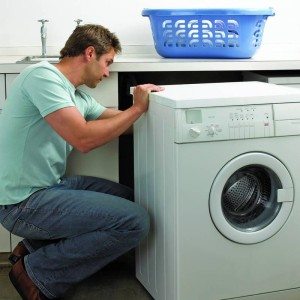
- Screw the trap to the sink drain hole seal. Connect the drain hose to the side outlet of the trap, secure it with a clamp, and seal it.
- Connect the drain hose directly to the sewer pipe, preventing wastewater from entering the machine.
Important! The drain point must be located between 60 and 90 cm above the floor.
The installation of the machine itself can be carried out in one of the following ways:
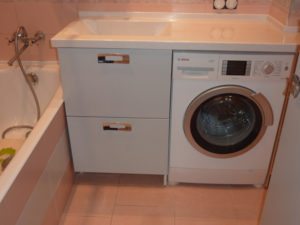
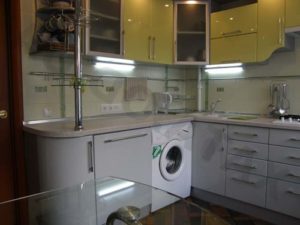
- The washing machine is placed in the kitchen in a separate cabinet with side walls, a front door and a countertop on top.
- A machine with fasteners for front doors is placed between the individual parts of the kitchen set, connected by a countertop.
- The washing machine is positioned similarly to the previous option, only the front doors are attached not to the machine, but to the side panels of the furniture.
- The machine is installed between the parts of the kitchen unit under the countertop, but is not closed by doors in front.
Whatever the machine's placement, the back wall of the cabinet should be removed. This will ensure the hoses have free access and prevent them from tangling.
The final step is connecting the machine to the power supply. This must be done through a grounded outlet. For more detailed information on installing the washing machine, watch the video.
Problems related to installation
Installing washing machines under a countertop can cause unexpected problems. Essentially, these issues stem from small details that weren't immediately apparent. The main problem can arise if there isn't enough space for the machines. Don't assume the machines are already narrow and the hoses will fit somehow—calculate the depth in advance with a few extra centimeters.
Important! There must be a gap between the side walls of the cabinet and the washing machine to prevent the machine from hitting these walls when it vibrates.
The width of the countertop also plays a role. Avoid having the depth of the washing machine match the width of the countertop. This will cause water and liquid from food to drip off the countertop and end up in the washing machine, which can have disastrous consequences. The cabinet should be designed so that the built-in washing machine is completely enclosed.
When ensuring the proper installation of a built-in washing machine, don't forget about the countertop itself. It should be positioned at a comfortable height: not too low, but not too high. This will ensure maximum comfort.
During installation, difficulties often arise due to the insufficient length of the inlet hose included with the machine. In this case Experts advise against saving money and extending the hose; it is better to buy a new one of the appropriate length. Otherwise, you could cause a real flood. Also, when installing the machine, don't neglect to reinforce the floor underneath and use a level. Reinforcing the floor and leveling the machine will reduce vibration and noise.
Types of built-in washing machines: which are better?
 The installation process for a washing machine is directly related to the type of machine being built-in. There are only a few types of built-in undercounter washing machines.
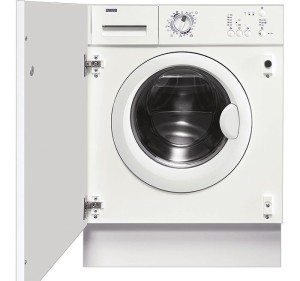
- Fully built-in. Washing machines that fit inside furniture, such as under a countertop with doors in front or in a cabinet. Manufacturers of these machines have ensured that their machines have a variety of grooves for fastening door hinges, lids, and other furniture components.
- With the possibility of embedding. While a fully integrated washing machine can be seamlessly integrated into a piece of furniture, a built-in washing machine cannot always be positioned so conveniently, as not all of its plastic panels (front and top) are removable, and there are not enough necessary fasteners.
Important! Fully integrated machines, unlike built-in machines, are more compact and can be placed in a variety of niches.
- Horizontally loading built-in machine. The most common type of machine. They load laundry through the front, where a cabinet door is attached, mimicking a closet or cabinet. Opening the cabinet reveals a detergent drawer and the interior of the drum, ready to receive your dirty laundry.
- Top-loading built-in machine. These machines are considered less common because they're less convenient. Top-loading machines with a hinged top lid that mimics a countertop surface are very common. The color and material of the lid can be customized.
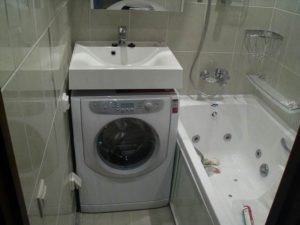
Some people debate until they're hoarse about which room is best for a built-in washing machine: the kitchen or the bathroom. Experts say the room's purpose isn't as important as the owner's preference, the amount of available space, and the ability to connect the machine to utilities. These same factors don't allow us to answer the question: which type of built-in washing machine is best? The best option depends on the situation. We suggest you take a look. Rating of the best washing machines.
Possible dimensions of built-in machines
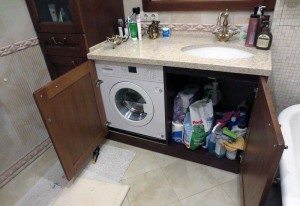 Some experts believe that if the entire bathroom or kitchen furniture layout is planned in advance, each element is measured, and custom-made, then there will be no problem fitting any washing machine into a pre-prepared niche. This assertion is not entirely true, especially when space is at a premium. In such cases, every centimeter of usable space is at a premium, so purchasing a conventional, bulky washing machine is an unaffordable luxury.
The dimensions of a built-in washing machine are crucial. Some homeowners make the mistake of creating a niche under the countertop for the washing machine before purchasing the machine itself. But it's easy to get the dimensions wrong, so we buy the machine first and then create the space for it.
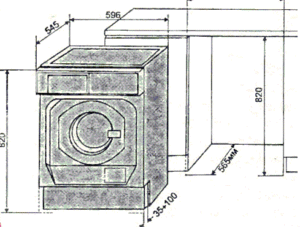
It should be taken into account that the minimum depth of some built-in washing machine models is 52 cm, and the maximum is 60 cm. Accordingly, their height is from 81 to 85 cm, and the width is from 57 to 60 cm. You can find out more about compact washing machines Here.
In conclusion, installing a built-in undercounter washing machine isn't a complicated process. However, without the proper knowledge and skill, it's a challenging task for an untrained person. Therefore, it's important to consult with experts and read the instructions carefully.
Interesting:
Readers' comments
Headings
Washing machine repair




For buyers




For users


Dishwasher




Add a comment