
We install a dishwasher into a countertop and furniture
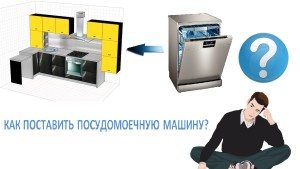 When planning the kitchen's interior design, the designer calculates the precise placement of every element, down to the centimeter. A sketch of furniture and appliances is drawn, dimensions are taken, and then the actual kitchen is created based on this sketch—the ideal version. In this case, the location for the dishwasher and its utilities is calculated in advance; all you have to do is purchase and install the "iron" helper.
Unfortunately, more often than not, things turn out differently. We start by renovating the kitchen: buying and installing furniture, all the necessary appliances, getting things in order, and then suddenly remembering it wouldn't be a bad idea to buy a dishwasher as well. By the time we make that decision, there's no more room for one, and the dishwasher's dimensions are too large to just shove it in just anywhere. We're forced to make unconventional decisions, which we'll discuss in this article.
Where can a dishwasher be built into a finished kitchen?
First, you need an idea... Indeed, before you begin installing a dishwasher and doing the calculations that go along with it, you need to figure out where you'll put it. There are no obvious locations, so you'll have to redesign something, possibly sacrificing the functionality of some kitchen cabinetry. There are three possible options.
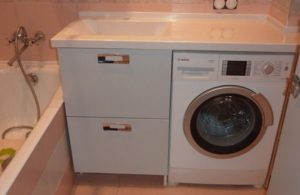
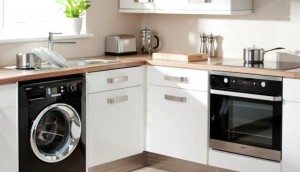
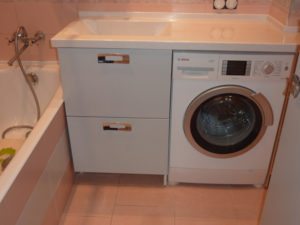
- Build a dishwasher into a niche under the countertop, after removing the base cabinet
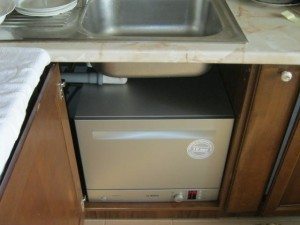 or some household appliance, such as a washing machine.
 - Build a dishwasher under the countertop directly into the base cabinet, having first remodeled it.
- Installing a dishwasher directly into the sink will likely require some modifications to the sink itself.
This, perhaps, is the most basic list of options for "integrating" a dishwasher into a finished kitchen. There are also special cases where it's possible to install a dishwasher in sturdy wall cabinets, but these are the exception rather than the rule.
Important! When planning the installation of a dishwasher in a finished kitchen, consider not only the dimensions of the cabinet, sink, or niche, but also the utility connection options.
What is the best way to prepare for dishwasher installation?
You should only prepare the tools and materials needed for installation once you've planned where and how you'll install the dishwasher, as well as how you'll connect the hoses and electrical connections. We'll discuss the installation details a bit later, but for now, let's list what you might need, starting with the tools. You'll need:
- a small adjustable wrench (so that you can easily get into hard-to-reach places and tighten nuts);
- pliers (they may not be useful, but if necessary they can be very handy for grabbing some fasteners and tightening them);
- a set of screwdrivers (you mainly need a large flat-head screwdriver and a Phillips screwdriver);
- laser or regular tape measure (laser measures more accurately and is more convenient to use);
- drill (needed for making holes for new fasteners when remodeling furniture);
- screwdriver (may be needed for screwing and unscrewing screws from furniture).
Note: If you're used to screwing screws by hand, you can get by without a screwdriver, but it's not as convenient.
The tools, as you can see, are very simple. All of these can be found in the garage or storage room of any normal homeowner who occasionally does some housework. In addition to tools, you will also need some materials, the list of which will also depend on the specific situation. You'll have to go to a specialty store to get them. What might you need?
- Moisture-resistant euro socket.
- High quality socket box.
- Three-core copper wire (usually no more than 2 m long).
- Automatic machine for household electrical networks.
- Tee-wiring for plastic water pipe with tap.
- Any winding for plastic pipes.
- Rubber gaskets of different sizes.
- Horizontal siphon with outlet for drain hose.
- A pack of plastic cable ties.
If you're concerned about the safety of your kitchen appliances, a voltage stabilizer is a must-have. You can read more about these essential devices in the article. How to choose a stabilizer for a washing machineTypically, a single stabilizer is purchased and installed for both the dishwasher and washing machine, thus protecting both "household helpers."
We build a dishwasher under the countertop
If there is a base cabinet under the countertop of your kitchen unit that is slightly larger in height, width, and depth than the built-in dishwasher, then there is nothing easier than removing it and installing the dishwasher in its place. When removing a cabinet, consider the distance to water and electrical lines. If the distance to the water and sewer lines is too great (more than 1.5 meters), look for another option. So, let's do the following.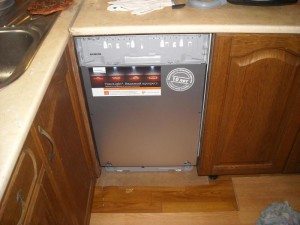
- We remove the cabinet doors by unscrewing all the fasteners from the side walls.
- If the cabinet has its own walls, then unscrew the corner fastenings and remove these walls.
- We unscrew the legs and remove the base of the cabinet.
- We remove the back wall.
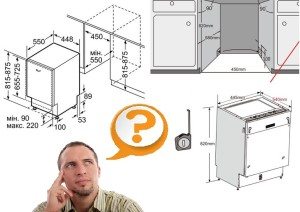
- We carefully measure the resulting niche, place the dishwasher next to it, and estimate whether it will fit in there based on width and height.
- We connect the inlet hose through a tee to the pipe.
Please note: If the hose supplied with your machine is not long enough, you can purchase a longer hose.
- We connect the drain hose of the dishwasher to the side outlet of the siphon.
- We plug the power cord into the socket and perform a test run of the machine.
If your kitchen doesn't have a proper dishwasher outlet, you'll need to install one. Turn off the power and disassemble the stove outlet. Using a screwdriver tester, locate the ground and neutral wires. Connect a piece of pre-cut copper wire to the terminals and route it to the desired location. Secure the wire to the wall using a special fastener. Next, install a flush-mounted box and a moisture-resistant European-style socket. Connect the wires to the circuit breaker, then to the socket contacts, and enclose the wires in a plastic conduit.
We've described one simple way to install a socket, but there are other safer options you can use. If you are afraid to work with electrical networks yourself, involve a professional electrician in this work.
The next option for installing a dishwasher under a countertop involves partially preserving the base cabinet. While the cabinetry won't be intact, its appearance will be preserved. Let's do this.
- We open the doors of the floor cabinet wide.
- We remove all internal shelves, partitions and fastenings for them.
- If the dishwasher does not fit into the cabinet in terms of height, then we remove its bottom and legs, as well as the back wall.
- We leave only the doors with side walls, estimate the size of the dishwasher, and make sure that it fits.
- Next, you will need to order a front panel that will cover the bottom of the dishwasher just under the doors and screw it in place using brackets.
- Now all that remains is to connect the dishwasher to the utilities, place it in the cabinet, and run a test wash.
We are building a dishwasher into the sink
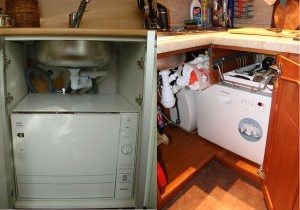 If your kitchen sink is large enough to accommodate a dishwasher, you can do so, but you'll need to do some prep work. In this case, we won't be touching the cabinet walls, the sink, or the front. Our primary task is to redesign the interior so that the dishwasher fits in there without any problems, but the main obstacle is the siphon.
The standard trap is attached to the sink drain hole, and its body extends vertically from the hole directly to the drain pipe. This will likely interfere with the proper installation of the dishwasher, so we need to replace it with a special horizontal trap, whose body is designed specifically for this type of installation. We screw in the new trap, while removing anything from the sink that might interfere with the dishwasher's installation. We install the dishwasher, connect it, and test it.
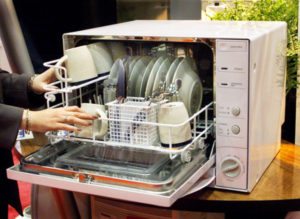
Important! Standard dishwasher sizes rarely match those of standard sinks; you'll likely need a narrow or even compact dishwasher.
In conclusion, installing a dishwasher under a countertop or in a sink in a finished kitchen is quite challenging. You need to calculate the dimensions of the resulting niche, taking into account the wall thickness, accurately measure its depth, and calculate the distance to the utility connections. But overall, this job is quite doable. Good luck!
Interesting:
Readers' comments
Headings
Washing machine repair




For buyers




For users


Dishwasher




Add a comment