
Installing a washing machine in a kitchen unit
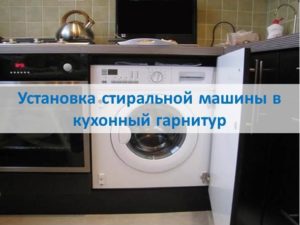 The most popular place to install a washing machine is the bathroom. But not every bathroom can accommodate such a large unit, and high humidity is harmful to electrical appliances. It's safer, more functional, and more convenient to integrate the washing machine into the kitchen cabinetry, so as not to disrupt the overall style or attract unnecessary attention. We'll explain how to organize the "relocation" efficiently and beautifully in this article.
The advantages and disadvantages of this option
Before planning any major interior changes, let's consider the pros and cons of installing a washing machine under the counter. Let's start with the positive aspects.
- Functionality. The top lid doesn't sit idle, but rather hides under the actively used countertop.
- Safety. Kitchens have better humidity and air conditioning, which directly impacts the quality and longevity of the unit.
- Aesthetics. In the bathroom, the washing machine looks out of place and clashes with the interior, but in the kitchen, thanks to the single countertop and similar stove and refrigerator, it looks harmonious and appropriate. There are also no strict restrictions on the location of the machine.
- Silence. Complete noise reduction isn't guaranteed, but a wooden frame will significantly reduce the decibels emitted.
- Savings. The cabinet allows you to hide the unit from prying eyes behind a cabinet door, so there's no need to overpay for a stylish and stylish cabinet design.
Among the disadvantages are limited access to the machine, which will require additional effort if repairs are needed. The list also includes the inability to store dirty laundry in the machine and the need to constantly remove and bring back detergents stored in the bathroom. Some people find loading and unloading laundry difficult due to the door getting in the way.
Existing solutions
There are numerous options for integrating washing machines into kitchen cabinets – it all depends on the residents' imagination, room layout, budget, access to utilities, and existing furniture. Moreover, the stage of the ongoing remodeling is important, as planning a completely new interior will offer greater freedom and flexibility in choosing the right location for the washing machine. However, the basic solutions offered by designers remain the same. Let's take a look at each.
Under the work surface of the countertop
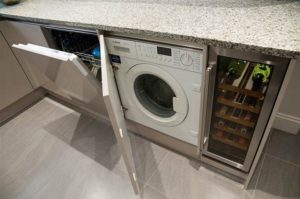 Recessed installation of a washing machine is popular: under the countertop or behind the front door. This option is best if the kitchen interior is meticulously designed and a "foreign" washing machine would ruin the overall atmosphere.In addition to its aesthetic appeal, it also benefits from full integration and noise reduction. This method will also work for top-loading washing machines, with the only difference being that a folding tabletop is installed.
The most important thing is to carefully arrange your existing household appliances. It's undesirable to place several appliances close together because their housings can become hot; otherwise, consider thermal insulation. Also consider the vibration emitted by the appliance.
With an open front
When a washing machine has a stylish design and matches the color and texture of other furniture, it doesn't necessarily have to be hidden behind a door. In fact, a consistent metallic tone for all appliances, including the range hood and countertops, is one of the most popular design solutions. However, even a washing machine that clashes with the rest of the decor can be "dressed up" in the following ways:
- cover with a special decorative film in the same tone;
- paint the body in a certain color;
- Order custom decor from specialized companies.
Then it will be easier to use the washing machine, since there will be no need to control another door.
But there's a catch. Built-in appliances with open fronts must fit perfectly into the planned space without any gaps or protrusions.
Unusual embedding
For those who like to surprise, another option is to mount the machine in the center of an elongated cabinet. This leaves open niches below and above the appliance for use. By raising the equipment 30-40 cm from the floor, safety is increased, as it prevents interference from children or pets.
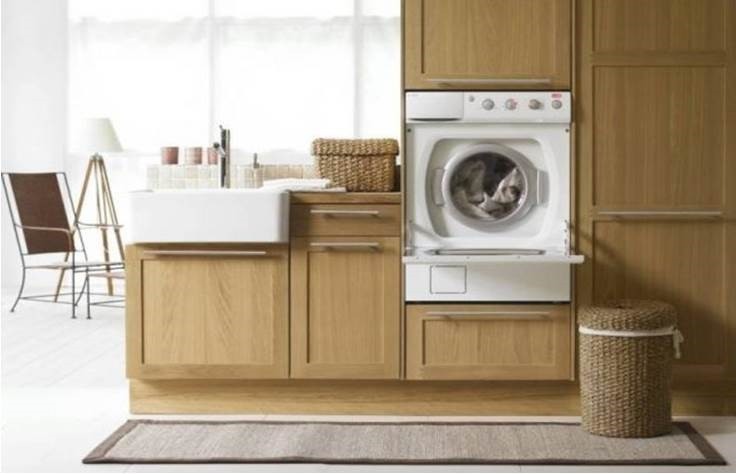
This arrangement is unusual and perfectly suited to minimalist interiors. It also has another advantage: loading and unloading laundry is easier and faster, as there's no need to bend or squat. However, there's a catch: developing and implementing such an idea requires considerable financial and labor resources.
Getting ready for installation
The washing machine can be placed between two cabinets, in a separate compartment with a door, or with a separate door that fits into the cabinet's hinges. In either case, a countertop is placed above and a dedicated panel below. The following conditions must also be met: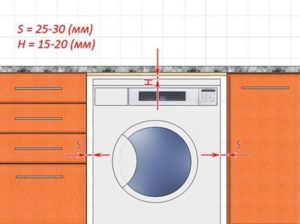
- Free air circulation is ensured by not installing or removing the rear wall.
- The machine is placed on a stable surface: the floor, a cabinet or a cupboard (or, as a last resort, the base of a cabinet with mandatory reinforcement).
- We align the body of the machine by changing its position using a building level and rotating special regulators on the legs.
- Leave some space between the countertop and the top of the unit to ensure easy opening of the detergent drawer (if this is not possible, you will have to pour the detergent directly into the drum).
By considering these points, you can extend the life of your washing machine and simplify its use. In addition to preparing a space for installing your "home helper," gather the necessary installation tools. These include a tape measure, pliers, an indicator screwdriver, a knife, metal clamps, a level, an adjustable wrench, a filter, a hose, a siphon, and a seal.
Connecting to communications
Now let's move on to connecting the machine to all necessary utilities. This includes the sewer, water, and electrical systems. If you have any doubts about the upcoming work, call a repairman from a service center, as the health of users and the longevity of the device depend on the correct connection of lines. However, there is no need to worry too much – it is not difficult to connect the machine yourself.
Let's start with the drainage: take the drain hose and attach it to the installed trap. Secure it securely with a metal clamp.
Important! A simpler way to drain the drain is to lower the free end of the hose into a container or sink.
Next up is setting up the water supply. Find the curved end of the inlet hose and screw it to the washing machine. Create a branch on the water supply pipe by screwing in a special tee. Install a filter, especially if the incoming water is very hard. Attach the hose to the water supply and tighten it with a clamp. Finally, connect to the power supply.
- We allocate a separate socket and an individual output to the machine.
- We organize grounding or include it in the electrical circuitRCD with a cut-off current of at least 30 mA.
- We connect a stabilizer to eliminate the harmful effects of voltage surges.
- We pull the cord to the socket so that it is not pinched or kinked.
Caution! Using extension cords is unsafe.
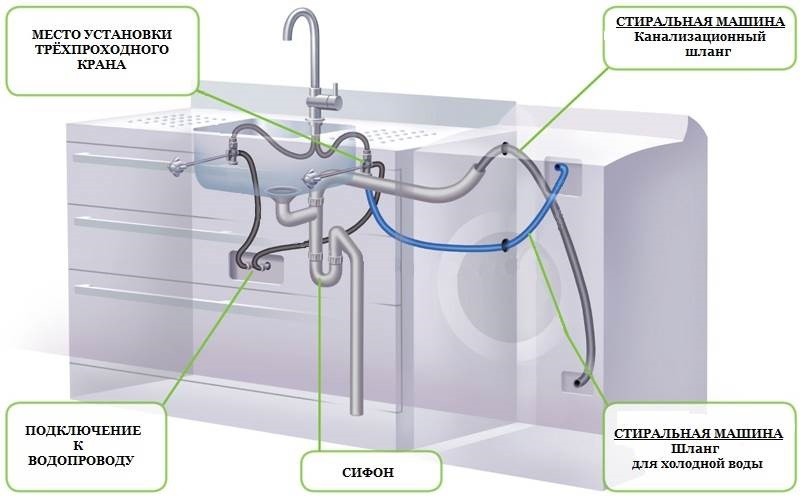
All that remains is to place the connected washing machine into the designated box. This isn't as easy as it seems, as the average machine weighs over 55 kg, and the housing is smooth and free of protruding elements. Don't forget about the connected hoses and wires either. It's best to ask a friend or neighbor for help to avoid broken cords or other related problems.
Interesting:
Readers' comments
Headings
Washing machine repair




For buyers




For users


Dishwasher




Add a comment