
Choosing washing machine footrests – anti-vibration, shock-absorbing, rubber
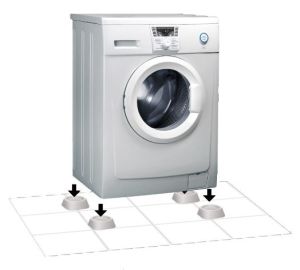 Anti-vibration pads for washing machines are essential for reducing vibration during operation. And they really do. But before you rush out to the store and buy them, it's worth making sure your machine is installed correctly.
Most often, excessive vibration of this type of household appliance occurs precisely due to improper installation. The washing machine must be installed on a clean, level, and solid floor. It's best not to place it on a wooden surface. If the floor where you plan to place the washing machine is wooden, consider creating a separate section and filling it with concrete.
How to align
You should also check whether the washing machine wobbles when washing on a level floor. If this happens, you need to adjust its feet to make it more stable. The feet, as you might have guessed, are located on the bottom of the machine. Most washing machine models allow you to increase or decrease their length by twisting them. So, to increase the height of a foot, twist it in one direction. To decrease it, twist it in the other.
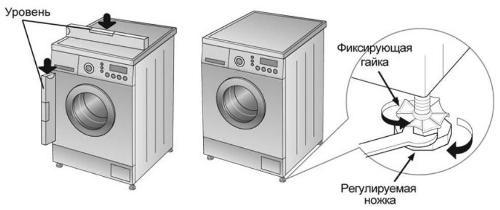
To determine which feet need adjustment, we need to rock the washing machine. If it's level and stable, the feet don't need adjustment. If the washing machine is tilting to one side, the foot on that side needs to be raised. This is the simplest way to level the washing machine.
We also recommend using a spirit level to determine the correct leveling of the washing machine. Ideally, there shouldn't be any tilt. If there is, it needs to be corrected. This is done by adjusting the feet. You already know how to adjust them.
Washing machine stands
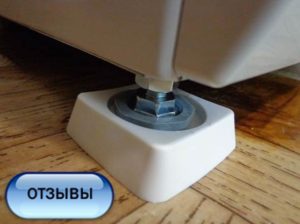
If you have checked the installation of the machine and leveled it, but it still vibrates too much, then you should use special stands. It's also worth noting that, in addition to reducing vibrations from our household appliances, they also reduce noise and prevent them from sliding or jumping. Therefore, special washing machine stands can be useful for almost all machine owners.
This addition to the machine helps the built-in anti-vibration systems cope with their task. It's worth noting that they are long-lasting and rarely fail. And, if necessary, they can be easily replaced with new ones. You can watch the video and compare how the machine operates with and without the pads. First, we'll show how it operates without the pads:
The pads are made of rubber or polyurethane. They are usually white, black, or transparent. They fit under the feet. The diameter of one pad is approximately 40-50 millimeters. Incidentally, they may not fit all models of washing machines. Installation issues with built-in appliances are most common. This is because the pads make the washing machine slightly taller, preventing it from fitting properly.
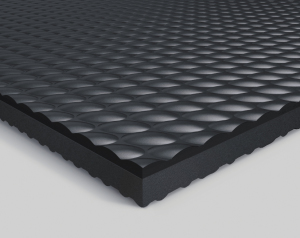
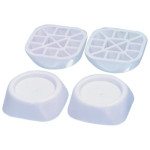 There's also a larger version of a washing machine stand: an anti-vibration mat. It doesn't fit under each foot like the stands. Instead, it's simply placed on a pre-designed spot. The machine is then placed on it. It works in much the same way as the footrests, dampening noise, vibration, and so on.
The cost of pads is generally lower than the cost of a mat. This is due to their smaller size. Typically, you won't need to spend more than twenty dollars to purchase a set of washing machine pads.
If your washing machine is still under warranty, it's worth checking whether the use of any pads is permitted. In some cases, manufacturers refuse warranty repairs if anything has been placed under the machine. So, be careful. Read the instructions and speak with the seller, if possible.
Is it necessary to use various vibration dampening pads?
It's generally accepted that any hard, level surface is ideal for a washing machine, such as a concrete floor. Many technicians who repair large appliances recommend avoiding the use of any pads under the machine. The feet should provide adequate traction. And the springs and shock absorbers included in the design should be adequate to reduce vibration during the washing and spin cycles.
You should also ensure the machine is installed correctly. We briefly discussed this above. You can learn more about this in this video:
It's also worth considering that some washing machine models can be noisier and vibrate more than others. This typically occurs with narrow models. Some models may not even have balance and imbalance control systems. To reduce vibration, these machines are often equipped with additional weights.
In addition, noise and excessive vibration can be caused by breakdowns:
- One of the most frustrating problems is bearing failure. It's frustrating because replacing the bearings requires disassembling the entire machine. While bearings and seals are relatively inexpensive, having a professional repairman do the work can be quite expensive. Replacing bearings yourself is entirely possible, though not easy. We have an article dedicated to this topic on our website.
- The caps on the legs may also fall off. In this case, they will need to be replaced.
- A washing machine may be making loud noises if a foreign object is stuck between the tub and the drum. This is usually removed through the heating element opening.
- There are also other malfunctions that can cause loud noise and vibration. However, these are less common, so we won't describe them in detail here.
So, is it necessary to use washers? You can only do this if you've already verified that the machine is installed correctly and that there are no defects. You should also check with the manufacturer to see if they allow this type of use for their appliances. And again, if the machine isn't particularly noisy or vibrates excessively, why bother changing anything?
Interesting:


Readers' comments
Headings
Washing machine repair




For buyers




For users


Dishwasher




Add a comment