
Secrets to choosing a washer-dryer
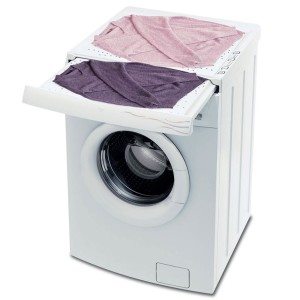 A washer-dryer combo is an attempt at a radical solution to the problem of wet laundry. If you live in an apartment, drying clothes naturally is either indoors or on the balcony, which comes with serious drawbacks. Drying clothes indoors means problems with excess moisture, and drying them outside requires careful monitoring (in case it rains or a strong wind kicks up dust), which is generally inconvenient. Therefore, the question of how to choose a washer-dryer combo comes to the forefront, and we'll try to answer it.
What are the differences between a washer and dryer and a regular one?
The main difference is obvious: a washer-dryer essentially combines two appliances: an automatic washing machine and an automatic dryer. An automatic washing machine performs three cycles for laundry care:
- washing;
- rinsing;
- wringing.
A washer-dryer automates four of the five laundry cycles, adding drying to the list. There are five cycles in total: wash, rinse, spin, dry, and iron. Unfortunately, no household appliance has yet been invented that can effectively perform all five cycles. If such a machine were to appear, housewives would be overjoyed.
Some might ask, "Why bother with such a household appliance when you can dry your laundry perfectly well outside?" After all, the clean air outside gives your laundry a freshness no fabric softener can replace. This statement is partially true if you live in a village or suburb and have free time. But imagine if you live in an apartment in a stuffy metropolis and are pressed for time—for such people, an automatic dryer would be a real lifesaver.
Please note! Experts have calculated that even the most modest (in terms of the number of programs) washer-dryer saves a homeowner an average of 15 hours per month.
How does such a machine work?
A washer-dryer is somewhat more complex than a standard automatic washing machine. What additional structural components are built into it?
- Ten. It has an additional built-in electric heating element for heating the air.
- Fan with air duct. Hot air is forced through an air duct into the drum containing the laundry using a fan.
- Small blades in the drum. The drum with blades rotates during drying to prevent laundry from caking and creasing.
- Humidity sensors. The drum contains sensors that determine the degree of drying of the laundry.
- Tank, into which moisture condenses. Excess moisture condenses on the walls of the tank and settles in it as a liquid.
Please note! In tankless washer-dryers, condensed moisture is discharged into the sewer system rather than into a tank, which is very convenient, as there's no need to empty the tank periodically.
The drying function is activated manually or automatically after the washing, rinsing and spinning program has been completed. The damp laundry continues to rotate in the drum at a low speed, while a preset amount of hot air is introduced to dry the items. Drying programs vary, and examples of the main types can be seen in the diagram.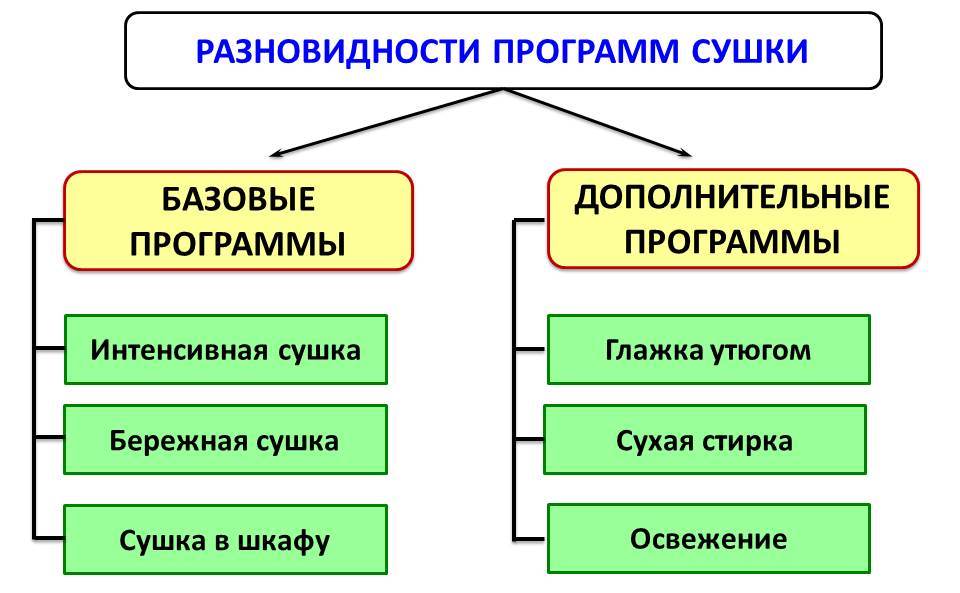
The names of basic and additional drying programs may vary among washing machine manufacturers, but their functionality remains the same. The most common and in-demand program is "Intensive Drying" or "Quick Drying." It's available on all washer-dryers and ensures that items are completely dry in the drum in 40-60 minutes. It's an indispensable program if you need to dry items quickly.
"Gentle Dry" and "Cupboard Dry" are much longer programs, but they help prevent items from wrinkling, creasing, and drying out. Additional drying programs can also be quite useful. "Iron Dry" is a drying program that additionally shakes and steams the laundry to facilitate ironing. "Dry Wash" is a set of programs that clean laundry without water, including "Sterilization" and "Odor Removal."
Important! The "Sterilization" program is very useful if you have a baby. It allows you to quickly disinfect baby items that have been sitting in a closet for a long time—without having to wash them.
Energy efficiency and reliability
Consumers still believe that washer-dryers break down quickly and don't last long due to their overly complex design. This is actually untrue. Any certified and tested appliance, provided there are no manufacturing defects, will last at least the warranty period. Washer-dryers from reputable manufacturers can, in some cases, last for decades.
The lifespan of such a machine directly depends on its proper operation. If you follow all the manufacturer's and specialist recommendations, the machine will last a long time; if you violate all the rules, it won't last more than a few months. The following recommendations apply to the operation of a washing machine and dryer.
- IT IS FORBIDDEN overload the drum with laundry.
- IT IS FORBIDDEN Do not allow small children to access the washing machine control unit.
- IT IS FORBIDDEN connect the machine to a socket with other energy-consuming devices.
- IT IS FORBIDDEN wash clothes without emptying the contents of their pockets.
- IT IS FORBIDDEN Machine dry: wool, nylon, silk, bulky items, items with foam, down jackets.
Drying clothes requires intensive operation of heating elements, which leads to increased energy consumption. While modern automatic washing machines without a drying function have an energy efficiency class of A, or even often A+ or A++, you won't find washing machines with a drying function in this energy efficiency class.
At a minimum, we'll be talking about class C, and most often even D and E. Therefore, if you plan to frequently dry clothes directly in the machine in the future, be prepared for a slight increase in your electricity bills. You can read more about washing machine energy classes in the article about washing machine power.
Review and characteristics of the best models
Choosing a high-quality washer-dryer that meets your needs can be challenging, especially given the sheer number of models available on the market today. The price range is also vast, so let's look at the best models, compiled by our experts. In providing this information, we've also taken consumer reviews into account, as we aim to be highly reliable. So, here are the best washing machine-dryer models.
Siemens WD15H541OE. This relatively compact 84.5 x 60 x 59 cm washer-dryer has a drum load capacity of up to 7 kg (up to 4 kg with the drying program) and a drum speed of 1500 rpm. Its built-in washing modes are clearly visible in the photo.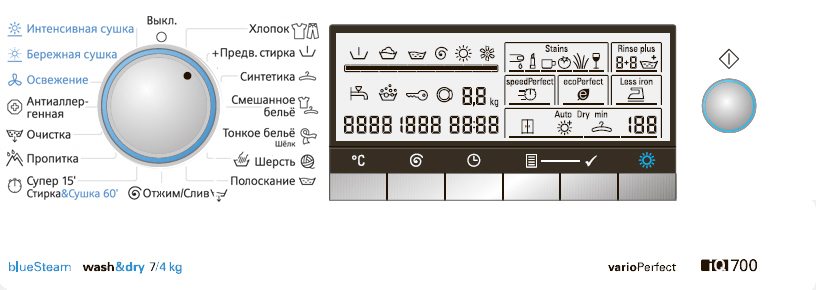
This is everything you need and more. It features a display that shows the program progress. The machine is equipped with safety systems: leak protection, oversuds protection, and a reloading feature. It features built-in humidity control, fast yet even wetting of laundry, water dosing, self-cleaning heating elements, and a brushless motor. It has a C energy efficiency rating for drying. The average price is $1,800.
Bosch WVH28442OE Avantixx. One of the best washing machines with a drying function in its segment. Its dimensions are 84 x 60 x 59 cm. The maximum drum load is 7 kg (4 kg when drying), and the maximum drum speed is 1400 rpm. Its control unit includes the following modes, shown in the photo:
It features a large, easy-to-read display. The machine is equipped with a safety system: leak protection, foam prevention, spin cycle imbalance prevention, and additional laundry loading. It also features ecosilencedrive, a quiet motor, a special water management system, and more. It has a C energy efficiency rating during drying. The average price is $1,600.
AEG L87695WD. This excellent washing machine and dryer measures 85 x 60 x 60 cm. It features a spacious drum with a load capacity of up to 9 kg (7 kg during drying) and a spin speed of 1600 rpm. Its control unit includes the following preset modes: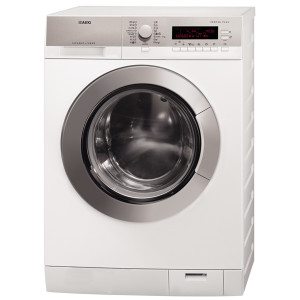
- cotton washing;
- washing synthetics;
- steam treatment;
- quick wash and dry;
- eco-friendly washing;
- drying wool;
- eco-friendly cotton washing;
- drying synthetics;
- drying cotton;
- rinsing;
- spin+drain;
- easy ironing;
- delicate wash;
- wool +.
Convenient LCD display. The machine has a built-in safety system: leak protection, protection against excessive foam formation, imbalance prevention during the spin cycle, and additional laundry loading. Energy efficiency class C during drying. Average price: $1,650.
Electrolux EWW1697MDW. A quiet washing machine with a drying function from a reputable manufacturer. Dimensions: 85 x 60 x 61 cm. The spacious drum holds up to 9 kg (7 kg during drying) and spins up to 1600 rpm. Available modes:
- steam treatment;
- washing down duvets;
- washing delicate fabrics;
- drying wool;
- drying synthetics;
- drying cotton;
- quick wash;
- washing synthetics, cotton and wool;
- washing delicate items;
- eco cotton.
It features a user-friendly display, leak protection, a solenoid valve, and a dual hose. It also features foam control, imbalance control, a program save function, and a delayed start button. Energy efficiency rating during drying is C. Average price: $1,000.
In conclusion, our review of washer-dryers shows that the best modern models are in the high price range. Ratings on other information portals confirm our findings. However, these machines are worth the money, as they make life much easier for any homeowner.
Interesting:


2 reader comments
Add a comment
Headings
Washing machine repair




For buyers




For users


Dishwasher




Thanks, lots of useful information. It's not really relevant to me right now, though. We've had the Indesit for years, and we have no plans to replace it. Although, we might consider a more modern Indesit model later. This brand has proven its reliability.
We specifically bought a washer-dryer combo (we ended up choosing a Whirlpool, it's a good one!) to put an end to this laundry hanging everywhere! These machines are the future!