Which extension cord should I choose for my washing machine?
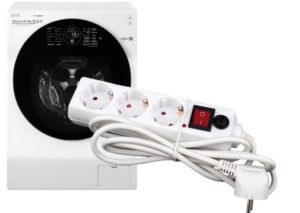
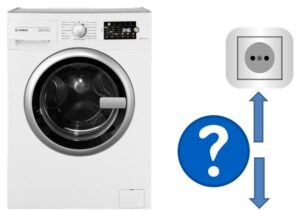
Manufacturers of large household appliances categorically discourage connecting washing machines to outlets via extension cords. Electricians share this opinion, as the additional connection between the appliance and the electrical network can pose a fire hazard.
When your washing machine is located far from an outlet, this connection method is the only option. Choosing the right extension cord for your washing machine can minimize the risk of an emergency. We'll tell you which one is best.
What should you pay attention to when choosing?
Stores offer a variety of extension cords: with one, two, or more outlets, with or without an on/off button, with or without a voltage indicator. Models with a residual-current device (RCD) and grounding are also available—these are considered the safest.
Since there's a risk of leakage when the washing machine is in operation, water can come into contact with the conductive parts of the extension cord. This places higher demands on the device.
When choosing an extension cord for connecting an automatic washing machine, you should pay attention to the following characteristics:
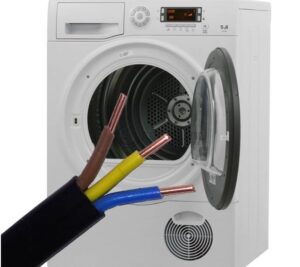
cable length, material of manufacture, cross-section of wires;
number of sockets in the block;
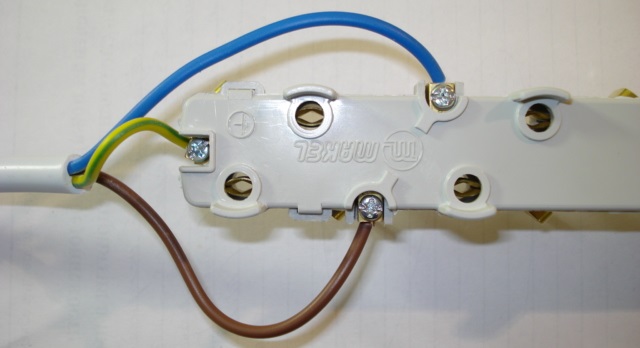
equipped with a grounding wire;
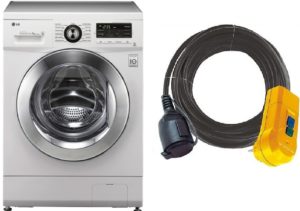
the presence of a device that protects against short circuits in the network.
The optimal thickness of the wire core is calculated individually and depends on the power consumption of the automatic machine.
For example, if a washing machine consumes 2.5 kW, the current at 220 volts will be 11.4 A. Therefore, a cord capable of handling 16 A is required. This corresponds to a copper cable cross-section of 1.5 mm². The cord length should be between 3 and 7 meters.
A washing machine puts a significant strain on an extension cord, so avoid buying a unit with multiple outlets. A single-plug unit is ideal. It is important to have a ground wire, it is easy to find, it is painted yellow-green.
Since the extension cord is typically used in bathrooms, a room with high humidity, it must comply with the IP20 protection rating against moisture and dust, as well as the IP44 rating, which indicates that the device is splash-proof.
It's essential that the extension cord be equipped with fuses to protect against short circuits in the electrical circuit. This is necessary so that in the event of a power surge, the device can absorb and neutralize the current spikes.
An extension cord with a grounding device and a residual-current device will cost twice as much as a model without these features. However, in this case, skimping isn't worth it—the safety of not only your expensive appliances but also your family's safety is at stake.
When purchasing an extension cord, give preference only to reliable and proven manufacturers.
Basic rules of application
Before connecting your washing machine to a wall outlet through an extension cord, you should understand how to use an extension cord. By following the manufacturer's recommendations and basic rules, you can minimize the risk of a dangerous situation.
If you have an old cable lying around at home, or you bought an unsuitable device, you shouldn't mess with it and try to improve it yourself. It is strictly forbidden to change the design of the factory extension cord with your own hands. This is fraught with adverse consequences.
When planning to use an extension cord to connect an automatic washing machine, you need to remember:
You cannot plug other household appliances into it together with the washing machine;
It's best to purchase a device with a protective cover. This will prevent water splashes from getting into the connectors.
When plugging in an extension cord, it's important to fully unroll it. A coiled cord quickly overheats and wastes power.
the device must not be used if the cable cross-section does not correspond to the machine power;
During washing, touch the cable—it should be at room temperature. If the cable gets very hot, it indicates a problem. Using such an extension cord is unsafe.
Don't buy the cheapest models you can find at any supermarket. It's better to pay extra for a product equipped with grounding, a lockable unit, and a residual-current device.
It's important to store your extension cord properly. Do not twist or tie it into a knot, or place anything on top of it. Do not plug it into a faulty outlet, or if the plug or cord itself is defective. Do not place the cord under a carpet or rug, or throw it over a high threshold.
The extension cord should be positioned as far away from the floor as possible to prevent water from coming into contact with conductive parts in the event of a leak.
Which device should I buy?
The product range is quite wide, but washing machines require specific models. As mentioned earlier, the extension cord must be equipped with an RCD. You can choose from the following products:
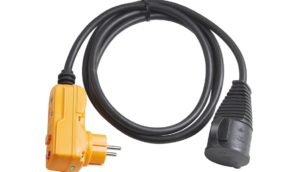
The German Brennenstuhl electrical extension cord. This high-quality model features a sensitive RCD, copper conductors, a moisture- and dust-resistant plug, an indicator, and a switch. Its main drawback is its high cost. The minimum cord length is 5 meters.
The UB-17-U extension cord, manufactured by the Russian company RVM Elektromarket, is a 16-amp model with a 1.5 mm² wire cross-section. The residual-current device (RCD) operates instantly. A significant drawback can be the cord length—at least 10 meters.
UB-19-U extension cord. This product is from the same manufacturer. Specifications: 16 amps, 2.5 mm² cross-section. Equipped with an RCD and a waterproof plug.
Not every extension cord is suitable for an automatic washing machine. Therefore, don't buy the cheapest model. It's better to pay extra for your safety and the safety of your appliance.

 Manufacturers of large household appliances categorically discourage connecting washing machines to outlets via extension cords. Electricians share this opinion, as the additional connection between the appliance and the electrical network can pose a fire hazard.














Add a comment