
Choosing a built-in dishwasher
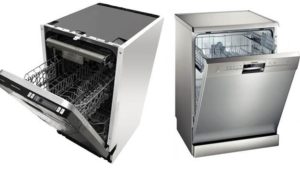 While a dishwasher was once a luxury for many, it's now much more common. The wide range of modern models, built-in design, and affordability have all played a significant role in its popularity.
Now comes another challenge: how to choose the right built-in dishwasher to free up your time and ease your household chores, rather than having to wash dishes in the appliance. Knowing the optimal features and proven brands will help you avoid unnecessary expenses and narrow your search, as discussed below.
Machine selection criteria
When choosing a dishwasher, relying on appearance and price is extremely imprudent. Many devices have an unreasonably high price due to their sophisticated, but completely unusable in everyday life, functions and options.It's better to immediately identify practical and useful features and avoid overpaying for "empty" devices. So, be sure to pay attention to the following characteristics:
- installation type;
- capacity of the device;
- number of available programs;
- energy consumption and water consumption class;
- degree of protection against leaks;
- noise level;
- washing class;
- control type.
You can also pay attention to the presence of a drying mode.
Simply reviewing the listed parameters is enough to understand how reliable, safe, and efficient the unit you purchase will be. However, drawing definitive conclusions about the appliance's functionality and capabilities without understanding each item. Therefore, we'll take a detailed look at all the performance characteristics of a good dishwasher.
Installation features and loading capacity
When choosing a built-in model, the appliance's dimensions and installation features play an important role. These factors determine how harmoniously the appliance will look in the kitchen, whether it can be integrated into the kitchen cabinetry, and how much dishware can be loaded in a single cycle. Therefore, we first consider the installation type and the size of the cooking chamber.
Built-in installations are simple: either choose fully integrated models and "hide" the dishwasher behind a cabinet door, or opt for partial visibility of the front control panel from the cabinet's ends. In the first case, the appliance's appearance isn't important—you won't see it from the outside. In the second case, it's best to consider the color and material of the exposed part in advance. Price will also play a role, as semi-integrated appliances are more individual and cost slightly more.
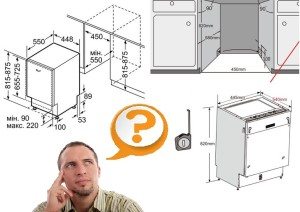
Next, look for information on the loading chamber dimensions on the label. Three standard sizes are most common:
- Standard – 60/60/85 cm.
- Narrow – 45/65/85 cm.
- Small-sized – 45/45/50 cm.
There are also non-standard dishwasher sizes designed for non-standard kitchen units.
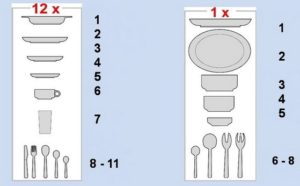 To correctly determine the depth and height of your dishwasher, you need to check the price tag to see how many place settings the machine can hold at one time. This number is the first thing to consider when considering the appropriate size. On average, we are talking about 4-18 sets, each of which includes a soup plate, a salad plate, a flat plate, a saucer, a mug, a spoon and a fork.
If it's difficult to calculate in sets, we take a different approach and add up the number of dirty cups for 1-2 meals. This figure depends on the number of people living in the apartment and the frequency of washing. We use the following as a guide:
- For 1-2 people, a machine for 4-6 sets will be more than enough.
- For 3-4 people, it is better to take a model with a capacity of at least 6-10 sets.
- For companies of up to 5 people, dishwashers with 8-14 sets are optimal.
- Loading of 16-18 sets is necessary for large families with 6 or more people.
Pots, spatulas, cutting boards, baking sheets, and saucepans are not included in the standard cookware set, so it is recommended to take 1-2 sets "with a reserve."
We also shouldn't forget the manufacturers' recommendations, which advise against stacking dishes tightly, but rather allowing the water to rinse them from all sides. However, we shouldn't blindly trust the chambers. Some machines won't start if the load is partially full, forcing dirty dishes to accumulate to fill the multi-level rack.
Modes and economy
To vary the duration and intensity of washing, when choosing a good dishwasher, you should also evaluate the available modes. Machines with 4-12 programs are more common, but you can also find more functional models.Don't forget that the price of a dishwasher depends on the number of buttons. The simplest and cheapest ones have 4 basic buttons.
- Quick wash that allows you to clean lightly soiled dishes in a short period of time.
- A normal cycle, considered a universal mode.
- Intensive wash designed for heavily soiled and greasy utensils.
- Soaking is necessary for preliminary soaking of dried food on dishes.
Owners of more advanced models are additionally offered:
- Express wash. For surface cleaning of lightly soiled utensils, glasses, lids, and jars.
- Delicate program. It offers gentle cleaning and is ideal for delicate materials.
- Bio. Special enzyme-based cleaning agents are needed to remove dirt without harming human health when heated to 30-40 degrees Celsius.
- Automatic mode. During automatic mode, the system scans the degree of dirt and adjusts the cycle individually.
- Alternating wash. Allows you to adjust cleaning intensities on the first and second levels, allowing you to simultaneously wash heavily soiled and semi-clean dishes.
- For children's dishes. This involves thorough rinsing with water heated to 60-80 degrees Celsius and steam treatment.
In addition to the basic modes, many machines have additional options. These include a delayed start, illuminated control panel, a timer, cleaning sensors, and other features. Most often, these additions do not significantly affect the quality and speed of washing, but they significantly increase the price of the device.Therefore, it's best to decide for yourself which features will be in demand and useful, and which ones are better off being omitted.
It's much more important not to skimp on energy and water consumption ratings. Paying more upfront can make each wash significantly cheaper in the future—the resources used during cleaning directly impact your utility bills. It's easy to figure out: the volume consumed is always indicated by the manufacturer on the label as an assigned class. Water consumption is classified as follows:
- A is the most preferable option with an average consumption of 5-15 liters per wash (the final value is determined by the specific mode).
- B – about 15-20 liters are used per wash.
- C – more than 20 liters are consumed at a time.
Energy consumption is also represented by letters from A to D. It is most cost-effective to use energy-efficient machines marked "A+++".
The lower the water consumption, the less energy is spent and vice versa – both indicators are interconnected.
It's a mistake to think that dishwashers consume a lot of resources every day and are expensive to use. In fact, much depends on their energy and water consumption ratings, and today's machines can clean dishes and pots at a cost no greater than hand washing. Experts even give a clear example, comparing a dishwasher cycle to boiling an electric kettle twice.
Machine protection and noise level
 It's also not recommended to skimp on a safety system—it will help prevent flooding if the dishwasher breaks down. No one is immune to a suddenly burst hose or a slipped clamp, so leak protection is a must. It promptly detects any water in the tray and shuts off the machine. Protection comes in both full and partial versions, with the former considered more reliable and safe.
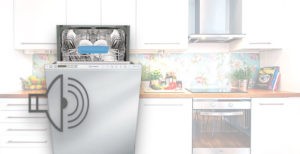
The noise level of the dishwasher ensures comfortable operation of the machine. If your apartment is small or you don't want to hear the sound of water, it's best to choose cameras with a noise level of 37-45 dB. And vice versa – the closer the value is to the maximum mark of 57 dB, the louder the machine will work.
Wash quality, control and availability of drying
One of the most important parameters for housewives is dishwashing performance. Here, too, there's a special scale with classes from A to D. Level "A" guarantees perfect cleanliness after each program, while the other classes allow for the presence of small particles of dirt on washed dishes. However, finding machines with ratings lower than A is virtually impossible—such machines are no longer produced for home use.
 The situation is similar with controls. Mechanical switches are quickly becoming a thing of the past, replaced by electronic panels with buttons and sensors. Many expensive models even boast built-in "intelligence" that can scan the load and automatically select the optimal program.
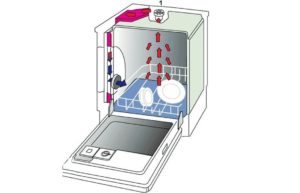
Another advantage is the presence of a drying function. Inexpensive dishwashers use a condensation system, where the machine blazes the contents with boiling water before the end of the cycle, which dries the dishes faster, but not completely. More expensive models are equipped with a turbo dryer, a special system that provides a full-flowing air flow.
Review of machines that meet the criteria
Knowing the parameters to consider when choosing a dishwasher makes it easier to choose a model and avoid wasting money. So, don't neglect the recommendations listed above and find the most suitable option. In conclusion, here are the top 5 dishwashers based on price and quality.
Among budget models, the BEKO DIS 25010 stands out. This slim, fully integrated machine can wash up to 10 place settings at a time. Its advantages include low energy consumption, Class A+ cleaning and drying performance, a quiet operation, and electronic touchscreen controls. Safety is ensured by the Aquastop system's complete leak protection. Four standard programs are also available: intensive for thorough cleaning, express rinse, delicate for gentle care, and economical with reduced water consumption.
Consumers also note the useful half-load option, which allows the cycle to be run at reduced speed.
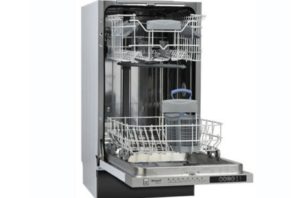 The Weissgauff BDW 4004 continues our list of affordable dishwashers. This slim, fully integrated model features a 9-place setting capacity. It's considered energy-efficient thanks to its A++ energy rating and water consumption of up to 10 liters. The lack of many modes and features also contributed to the machine's price: it offers only four basic programs and a timer from 3 to 9 hours.
If you are choosing between full-size dishwashers, you should consider Bosch Series 2 SMV25EX01R. It has a capacity of 13 place settings and a minimum energy efficiency rating of A. It has five programs, including an automatically adjusted mode. It also features distinctive features such as audible signals, a floor indicator, a spoon and fork tray, and a silent night mode. Another highlight is VarioSpeed technology, which significantly speeds up cycles without compromising quality.
One of the most expensive models is the Schaub Lorenz SLG VI4600. Its high price is due to its child lock, 8 programs, 6 temperature settings, water purity sensor, and more efficient turbo drying.
The MAUNFELD MLP-06IM is a compact dishwasher. Despite its compact size, it can wash up to 6 sets of laundry at a time and offers 6 modes, including delicate, quick, economy, standard, and intensive. A timer can be set to run for up to 24 hours, and an audible signal notifies you when the cycle is complete. However, it does have a drawback: partial leak protection.
A built-in dishwasher will become an indispensable assistant only if you choose and install it correctly. We've explained how to do this without hesitation or unnecessary expenses.
Interesting:

Readers' comments
Headings
Washing machine repair




For buyers




For users


Dishwasher




Add a comment