
Why do you need salt in your dishwasher?
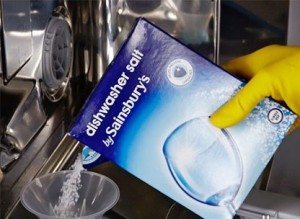 Dishwasher users have long debated whether dishwasher salt is necessary and why, whether it can be replaced with regular table salt, or whether it's better to use nothing at all. We decided to express our opinion on this matter after first understanding the chemical composition of salt and how a dishwasher works.
Composition of special salt for dishwashers
Few of us remember chemistry lessons in school, so we'll try to explain as simply as possible the composition of dishwasher salt, which manufacturers strongly recommend using.
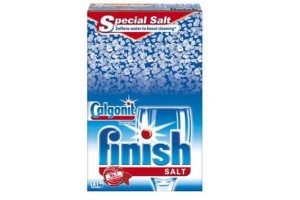
On the packages of such well-known salts as Finish or Somat, it is written that the composition includes sodium chloride, the chemical formula of which is NaCl. Sodium chloride is the sodium salt of hydrochloric acid. Sodium chloride is commonly referred to as table salt, which is 98% sodium chloride. The composition listed on the Ecover salt package is: evaporated 100% rock salt, which is identical to the term "table salt."
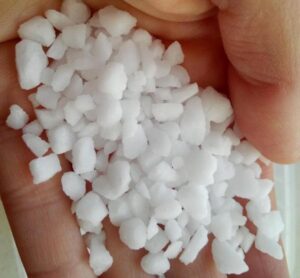
However, in appearance special salt It's slightly different from regular table salt, at least in that its granules are significantly larger and more uniform. But we'll talk about that later.
How salt works
Why is it necessary to add specially treated sodium chloride to a dishwasher? This is primarily due to the dishwasher's design and the water's hardness. Everyone knows that tap water can be very hard, which can be indicated by limescale deposits in the kettle, limescale stains on the faucets, etc.
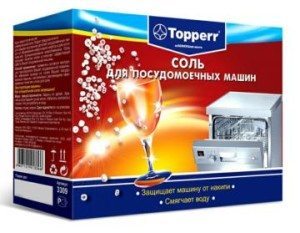 When water is heated to high temperatures, calcium and magnesium salts precipitate, which we call scale. Scale reduces the lifespan of the dishwasher's heating element. To address this, a special reservoir filled with ionized resin was installed in the dishwasher. Water passing through the resin becomes softer because positively charged calcium or magnesium ions are attracted to negatively charged sodium ions in the resin. The water entering the dishwasher tank is already soft.
Over time, the resin's ability to soften water diminishes. To restore its softening ability, sodium ions, which are found in salt, must be added to the resin. If salt is not used, the ion exchanger will soon fail, and the harder the water, the faster this will happen. Therefore, salt is necessary:
- to soften water;
- prevent the formation of scale on the heating element and the inner surface of the tank;
- to wash dishes better, because it is known that in soft water everything is washed and cleaned much more effectively.
Using salt in the dishwasher is a must, but there are different ways to do it. If the water in your region is soft enough, you can replace the salt with dishwashing tablets, which already contain salt. However, if your water is hard (you can find out with a special test strip), you must use salt separately. If you don't add salt to the ion exchanger, it will become clogged with sediment and break down, as water will constantly flow directly through it. This will necessitate repairs.
Please note! In some dishwasher models, when using tablets, water bypasses the ion exchanger, which will not affect its operation.
When the ion exchanger is low on salt, an indicator light on the dishwasher's control panel lights up. It's time to add salt to the reservoir, but the question arises: how much? You can add more at once, but be careful not to fill the compartment too full. The amount of salt needed depends on the quality of your water; the harder it is, the higher the consumption. Using salt tablets, the question of how much salt to add is eliminated; they contain only the amount that will dissolve in one wash cycle. small dishwasher This tablet can be divided in half, but not crushed into powder.
Special or food grade: is there a difference?
The need for salt in a dishwasher is more than clear; salt is necessary and you can't do without it, no matter what anyone says. But can special salt be replaced with regular table salt, given that their composition is 98% identical, despite table salt being several times cheaper than special salt? There are still differences, however.
- Firstly, table salt differs in granule size and appearance.
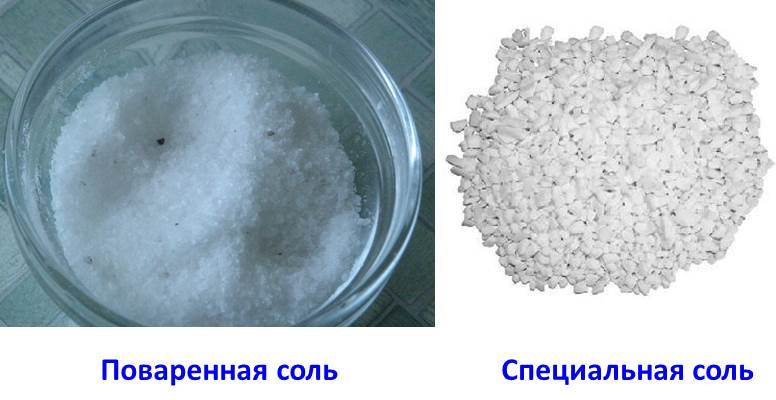
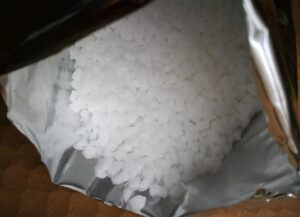
- Secondly, table salt is less refined than special salt, even though it's considered edible. It may contain sand particles, as you can see in the photo, as well as a host of trace elements: iron, manganese, potassium, iodine, boron, and others. Some of these elements will settle inside the dishwasher, which may affect its operation.
- Thirdly, the dissolution rate of table salt differs from that of special salt. Since it is finer, it dissolves faster.
If you do replace regenerating salt with table salt, use only "Extra" salt, as it undergoes superior processing. Even then, before adding salt to the compartment, inspect it for any obvious impurities or stones.
Important! Don't fill the salt compartment to the brim with table salt, otherwise it may not dissolve at all and may stick together.
So, it's essential to use dishwasher salt, and we hope you've figured out why and how much. It's up to you to decide which salt to use—either a more expensive one, but one that's guaranteed to be free of additives, or a cheaper one, which carries the risk of damaging your dishwasher.
Interesting:
16 reader comments
Add a comment
Headings
Washing machine repair




For buyers




For users


Dishwasher




Since when do we have negatively charged sodium ions?
Finish is now asking over 200 rubles for 1.5 kg of salt! Good business.
After reading the ad for Finish dishwasher salt, you can conclude that this salt is much safer for you, not to mention your machine :))
Has anyone tried eating it? What were the results? What does the manufacturer recommend if Finish dishwasher salt accidentally gets into food after being left on the dishes?
My car is already 10 years old. I've never used salt. It works like a charm.
I don't use salt, the water is soft.
The article was written by an illiterate manager, not a chemist. This process is called sodium cation exchange. Sodium ions are exchanged for calcium and magnesium ions, which determine water hardness. As the sodium ions are depleted, they must be added to the water to regenerate the ion-exchange resin.
Why does everyone write in their publications that the difference between salt and coarse salt is that it's coarser? Take SOMAT salt—it's very fine, finer than extra-fine salt.
Fine or table salt will stick together and will not work, and coarse salt will take too long to dissolve.
So, do I need to add salt or not? I just bought a dishwasher. I use tablets. I'm hoping for your advice.
If you're using Somat tablets, you don't need to add salt. But if you're using a cheaper option like Cinderella, you'll still need salt.
People, buy the salt that's sold for geyser filters and other types, 25 kg for 500 rubles. The savings are obvious.
Is this the one for water treatment plants?
I use Finish salt and Finish Quantum tablets. I don't see any point in skimping.
We used salt, and the machine rotted. Luckily, the warranty wasn't up. The service technician was shocked and advised against using salt on the new one.
😀
Well, you made me laugh!!!
I used coarse salt, the kind used for pickling fish. It's been fine for 8 years, but the tap water is very hard and has a lot of limescale.