
How to load dishes into a Midea dishwasher
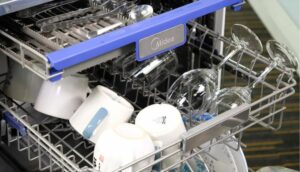 Housewives often don't realize how important it is to load dishes correctly. Incorrectly loading cutlery can not only result in poor cleaning results, leaving dishes dirty after the cycle, but can also damage your dishwasher. To prevent this from happening, we've prepared a detailed guide on how to properly load dishes in your dishwasher.
Let's pay attention to the dishes
The first step to properly loading dishes is to prep your cutlery. In other words, remove any food scraps or other debris from the dishes. Pieces of food, remains of beans and corn, fruit and berry pits, tea bags, coffee grounds, napkins and toothpicks – all of these must be removed from dishes before loading them into the washing chamber of the Midea dishwasher. Remember that the more thoroughly you remove all excess debris and dirt using wet wipes, sponges, or any other available items, the better the cleaning cycle will be, and the less likely it is that the waste filter and the dishwasher's drainage system will become clogged.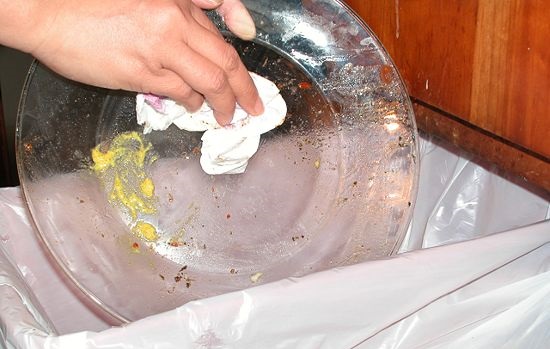
Pre-rinsing isn't so straightforward. On the one hand, why bother rinsing dishes by hand and getting your hands wet every time when you have a Midea dishwasher? However, it does make sense if you've been accumulating dirty dishes for a long time, with food and grease residues drying on them for days or even weeks. If you wash dishes immediately after meals, pre-rinsing by hand isn't necessary, so you can place the cutlery directly in the baskets inside the dishwasher. Finally, if you accumulate dirty dishes throughout the day, placing them directly in the dishwasher to wash them all at once in the evening, you can activate the pre-rinse to avoid dirtying your hands when removing and re-inserting dishes into the baskets.
Where to put glasses and wine glasses?
Now that we've gotten the pre-cycle preparation sorted, it's time to move on to the dishes themselves and their placement inside the Midea dishwasher. Glasses, mugs, and cups are often simply misplaced, so they pile up on top of other dishes, which is absolutely not a good idea. Most dishwashers have a top tray specifically designed for this type of dishware, where the dishes should be placed upside down so that water can enter, rinse thoroughly, and then drain freely. Placing these utensils horizontally is not recommended, as this will prevent liquid from getting into the dishwasher.
Each piece of cutlery must stand firmly so that it is not knocked over by a powerful stream of water during operation.
As for wine glasses and fragile glasses, there is usually a special holder for them, in which they need to be secured with the stem facing up. Be sure to ensure that fragile glassware does not touch each other to prevent glass from cracking during the cycle. Keep in mind that the plastic holder can also be used for small cups, for which it is also perfect.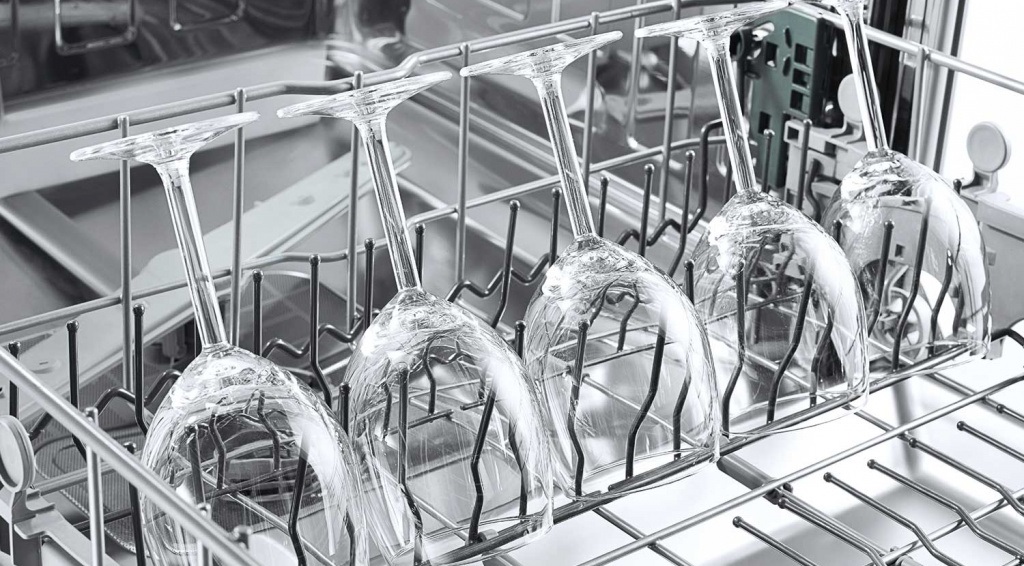
We place saucers and bowls
Now let's move on to the main section—plates, saucers, bowls, and other similar cutlery. If you have enough space inside the sink, the top tray should accommodate:
- small kosushki;
- bowls;
- ice-cream bowls;
- saucers;
- sauce boats;
- spice jars.
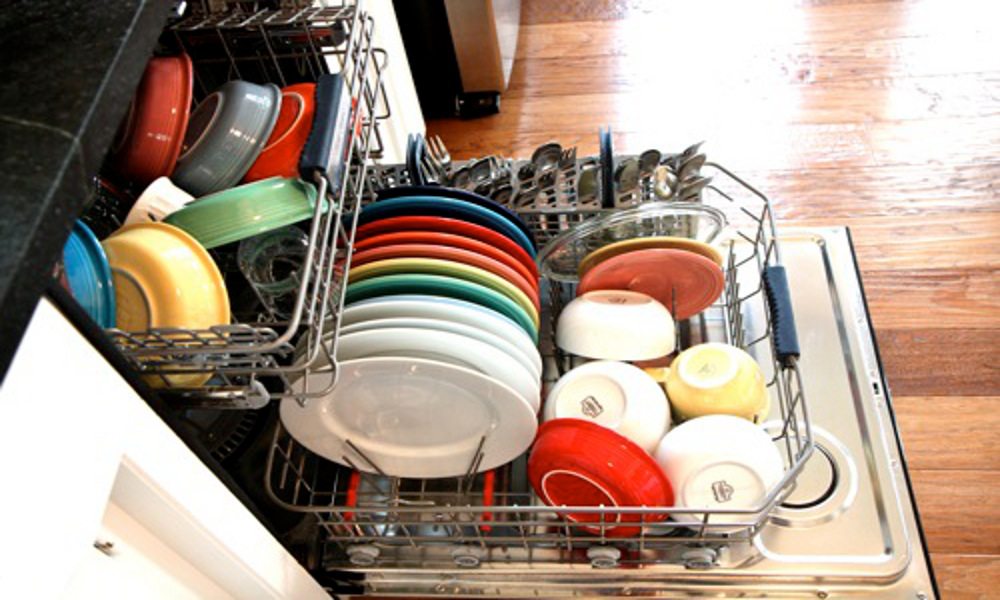
If desired, you can also place plastic containers on top, but in this case, you should choose gentle operating modes that do not heat the water too much. Additionally, plastic utensils should not be placed near the heating element, otherwise they may melt and fall onto other utensils and key components of the Midea dishwasher.
The lower basket is designed for larger items, such as main course plates. Be sure to place the largest plates at the edges, leaving the center of the basket for plates with a smaller diameter. This will allow the water from the spray arms to better clean the utensils in both the lower and upper baskets. It's also crucial to place the plates facing the center of the Midea dishwasher to prevent them from touching each other. Keep in mind that there should be at least a minimal gap between each item to ensure the water has access to the entire surface of the dishes.
Where to put spoons and forks?
The final item on the daily dishwashing list is forks and spoons. Midea dishwashers typically feature a special basket for the smallest cutlery. You can freely arrange forks, spoons, and knives in it, alternating them and leaving a small gap between each item. Ceramic knives and those with wooden handles deserve special attention; they are not recommended for dishwashers. Ceramic knives can become dull, while wooden knives can become unusable due to the wood swelling in the water.
Be sure to place the knives with the blades facing down to avoid accidentally injuring yourself when removing the dishes after washing.
Please note that in the newest Midea dishwashers, cutlery should be placed in the topmost tray. The manufacturer hopes that this will encourage users to arrange not only knives horizontally but also spoons and forks, which will not only improve dishwashing quality but also provide significantly more space inside the dishwasher compared to standard dishwashers.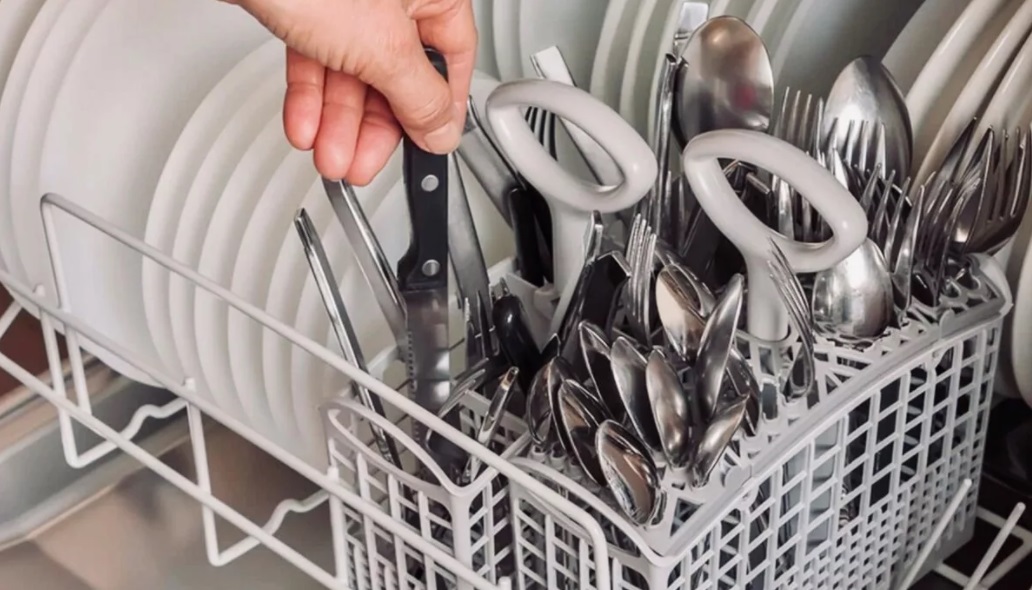
How to wash large items?
We're only left to discuss the largest types of cookware, which are used for preparing meals for the whole family, guests, holidays, and so on. Large frying pans, large pots, saucepans, baking sheets, and other items should be placed in the bottom rack, separated from glass, porcelain, crystal, and other fragile items that may not withstand the intensive washing cycle at the highest temperature. 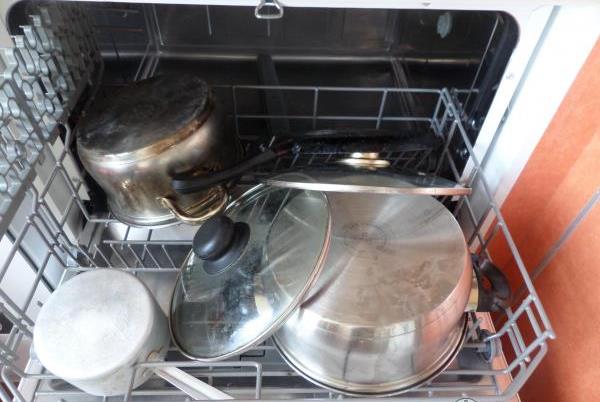
Place pans and baking sheets on their sides to avoid obstructing the spray arms. Place pots upside down or on their sides to prevent water from pooling in them.
Before loading dishes, be sure to check the coating information for each piece of cutlery to avoid accidentally washing Teflon-coated dishes or other items that are not dishwasher-safe.
If the handle on your saucepans or frying pans can be removed, it should be removed before the cooking cycle. If it cannot be removed, make sure that it does not touch the walls of the washing chamber. Finally, don't forget about the half-load mode for situations when you don't have a lot of dishes but still need to wash them—this will allow you to clean dirty dishes and save water and energy.
Recommendations for placing items in the PMM
Finally, let's review a few rules to help you properly load your dishwasher. Never overload your appliance, as this will directly impact both the cleaning performance and energy consumption. Consult the official instructions to find out the maximum number of place settings your dishwasher can hold. A small Midea dishwasher can wash up to 6 place settings at a time, a narrower dishwasher can wash up to 11, and a full-size dishwasher can wash up to 17.
But don't always rely solely on the number of place settings, as all tableware varies in size. A set of soup bowls isn't the same as a tea set with small dessert saucers, so keep this in mind when using your "home helper." As for final tips for housewives, here are some:
- Watch out for overloading and don't allow it, because it's better to split the wash into two different cycles than to wash everything poorly in one go;
- Always check your dishes to see if they can be washed in a Midea dishwasher;
- do not allow dishes to touch each other;
- It is better not to wash heavily soiled items such as frying pans together with lightly soiled ones such as mugs or glasses;
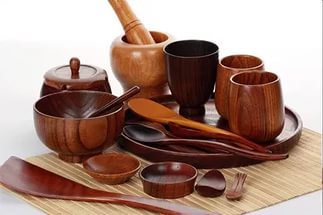
- Do not wash wooden utensils to prevent them from getting damaged after cleaning;
- If you're used to collecting dishes all day and washing them in the evening, place them in the washing machine immediately so they don't dry out and are easy to clean.
At first glance, loading dishes correctly may seem like a complex art, hard to master. But while your first load can take up to half an hour, with experience the process will take no more than 5-10 minutes.
Interesting:





Readers' comments
Headings
Washing machine repair




For buyers




For users


Dishwasher




Add a comment