
Replacing the dishwasher filter
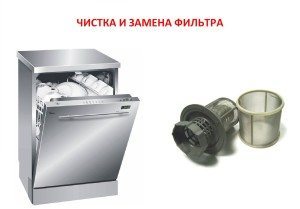 To prevent your dishwasher from breaking down quickly, it's important to at least regularly check it. Experts recommend performing a light preventative cleaning about every two weeks. This maintenance consists of cleaning the filter. If your dishwasher has been in use for a long time, you should also consider replacing the filter. Replacing and cleaning the dishwasher filter is the topic of our discussion.
Dishwasher waste filter and its components
Any Bosch dishwasher user (or anyone else) who's taken the time to read the manual knows where the dust filter is located. Ideally, after purchasing, installing, and running the dishwasher for the first time, the first thing you should do is familiarize yourself with the dust filter, locate it, unscrew it, and examine all its components.
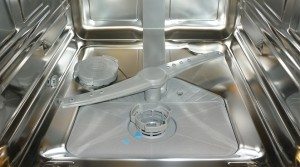 The debris filter is located at the bottom of the dishwasher tank. In this case By "tank," we mean the inside of the machine, the bin where the dish racks are located. And where we place the dirty dishes. If you remove the infamous dish racks, you'll see a rotating plastic spray arm at the very bottom of the Bosch dishwasher. To the right or left of it is a glass-like, twist-out element—this is the debris filter, which consists of the following components:
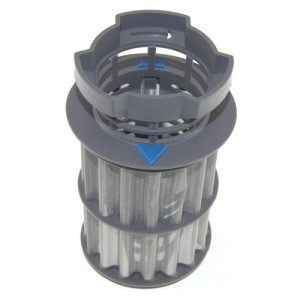
- from a flat metal mesh called a fine filter;
- from an external coarse filter, similar to a fine-mesh glass, which is located directly under the mesh;
- From the internal coarse filter, which is inserted into the external filter. It is also located under the mesh.
The waste filter is designed to trap food residue washed off dirty dishes and prevent these residues from entering the circulation pump.
As you can imagine, a significant amount of this residue will accumulate on the filter, even though dirty dishes are cleaned before they're placed in the wash basket. If the fine mesh filter, and especially the coarse filters, become clogged with dirt and grease, water will stop flowing from the tank back into the circulation system, and your Bosch dishwasher will stop working.
Important! After each dishwashing, look at the bottom of the tank and check the condition of the metal mesh. If food particles or other dirt are clearly visible, it's best to perform an extra cleaning.
Cleaning the filter correctly
Properly cleaning a Bosch dishwasher filter doesn't require any special knowledge or skills; anyone can do this simple task. The key is to do it promptly and avoid clogging, as clogging can lead to machine failure. Each brand and model of dishwasher may have its own specific instructions for cleaning the dust filter. Filter shapes, locations, and removal methods may vary, so we'll describe a typical procedure that works for most dishwashers. Here's what to do, in order.
- Remove any extra baskets from the tank that might interfere with cleaning the filter. Typically, this is the bottom basket for dishes.
- Unscrew the outer coarse filter clockwise.
- We take out the fine mesh and take out the internal filter.
- Arm yourself with an old toothbrush and a toothpick and begin cleaning the filter elements of any greasy deposits and dirt. Note! Typically, the filter is cleaned under running water, but if there's a lot of dirt and grease, you can place the filter elements in a basin of water, add dishwashing liquid, and soak briefly before cleaning.
- All elements need to be cleaned thoroughly, especially the fine filter mesh. To remove
 Use a toothpick to remove dirt from hard-to-reach places.
 - Next, remove the impeller bar and clean all the holes in the sprinklers from dirt and limescale with a toothpick.
- Now, grab a rag and brush and thoroughly clean the bottom of the tank where the filter is located. A fair amount of grease tends to accumulate under the mesh, especially if the user is being careful with the detergent.
Once the blockage is cleared, you can safely reassemble the filter and replace it, but before doing so, carefully inspect each element. Incidentally, it's not just the filter that needs cleaning; sometimes the tank and the exterior of the dishwasher also need to be cleaned. You can read about how to do this correctly in the article. How to clean a dishwasher yourself.
The plastic cup and plastic grid must be intact, and the fine mesh must also not have any visible damage. If you find broken elements on the external or internal filter, or damage to the metal mesh, then it is better to replace the filter of the Bosch dishwasher (or another one).
How do I know if a filter needs to be replaced and how do I change it?
Replacing the filter isn't difficult at all. It's really not that difficult: just unscrew and discard the old filter, remove it from the packaging, reassemble it, and install the new filter—it takes three minutes. But the real crux of the matter isn't the process of replacing the debris filter, but rather the practicality of such a replacement, and whether it's even necessary.
By the way, the cost of a new coarse filter can reach $35–$40, although it looks like a simple plastic part, albeit manufactured somewhere in Germany or Italy.
Many dishwasher users ask: why buy and install a new filter when the old one, even if damaged, still works just fine, collecting dirt? Why spend a fortune when everything works perfectly? In fact, this is a big mistake, as it could lead to costly repairs. Imagine leaving a damaged coarse filter running—what could happen?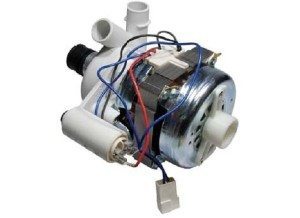
- Some food debris will still settle on the intact parts of the damaged filter mesh, but some dirt will slip through the damaged element.
- Getting into the circulation pump, dirt settles inside the tanks, pipes, and heating element.
- At best, this leads to a deterioration in the quality of dishwashing, and at worst, the dirt can burn out the heating element and cause the circulation pump to fail.
Now let's do the math. Replacing a dust filter will cost you an average of $25. Replacing a heat circulating pump, which can break down due to poor filter performance, costs an average of $70, and that's not even taking into account the post-crisis markup. That's the math. What to do in this situation, and whether this approach is right for you, is up to you. We're simply providing objective information.
Important! The high cost of spare parts for Bosch dishwashers (and other brands) is due to the fact that they are often manufactured in Europe, where production costs are significantly higher, not to mention the exchange rate differences.
How do you know when a filter needs to be replaced? In this case, it's simple: if the filter has any damage that could potentially allow dirt to escape, it needs to be replaced. If it looks very old but remains intact, it's safe to use, and the blockage can be removed.
In conclusion, both cleaning and replacing the filter in a Bosch dishwasher doesn't take much time, even if you're new to it. Cleaning should be done promptly and avoid clogging, as this will cause the machine to stop working and display an error code.
Interesting:



Readers' comments
Headings
Washing machine repair




For buyers




For users


Dishwasher




Add a comment