
How to replace bearings in a Haier washing machine
 Knowing how to replace bearings in a Haier washing machine can save you money on a technician's labor. This can be difficult without experience, but it's possible if you strictly follow the instructions, observe safety precautions, and avoid experimenting with parts. We'll explain in detail where to start, what to prepare, and how to perform the repair.
What might be needed for repairs?
Disassembling a Haier washing machine is a standard process, and is virtually no different from other brands. You'll need to access the drum and remove a fair number of parts, so a tool kit is essential. It's a good idea to have the following on hand:
- pliers;
- screwdriver;
- a flat-head and Phillips screwdriver (or better yet, a universal screwdriver with several bits);
- round-nose pliers;
- hammer;
- set of wrenches;
- rubber or wooden mallet;
- a chisel with a blunt tip.
It's best to have waterproof sealant and WD-40 all-purpose cleaner on hand in advance. Rags and protective gloves are also helpful. To install a new bearing assembly, you'll need to purchase a pair of seals and bearings. Replacement parts can be purchased at a service center or in a specialized online store. The appropriate diameter of the spare parts is selected based on the serial number of the existing machine. Another option is to remove the old one and show the consultant a used sample.
The machine itself also needs to be prepared for repair. Disconnect the unit from the sewer, power, and water lines, and reel in all cords and hoses. Then, move the unit away from the wall, ensuring easy access to the machine from all sides. Drain the water through the waste filter and begin the disassembly process.
We release the tank and drum
The bearing assembly is located on the drum shaft, so you'll need to remove the entire drum. Once again, check the power supply and begin disassembling the machine. Follow these instructions:
Important! Hobbyists are strongly advised to document their work with a camera or label all parts and wires.
- We approach the washing machine from behind and unscrew the back cover.
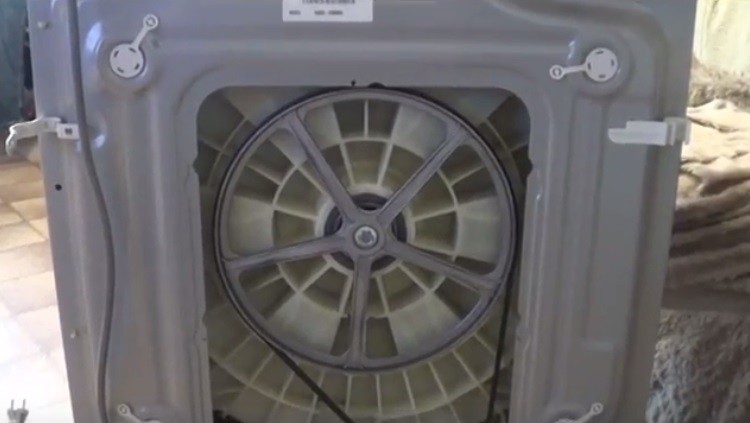
- We unscrew the bolt on the pulley.
- We remove the drive belt by carefully pulling it towards ourselves while simultaneously rotating the pulley.
- We loosen the outer clamp on the cuff and tuck the sealing rubber inside.
- We take out the powder receptacle.
- Unscrew the top bolts at the back, push the top cover forward and remove it.
- Using a screwdriver, unscrew the two pairs of screws holding the front panel and the rail.
- Using pliers, we attach the clamp to the hose under the tray, as well as to the pipes and channels connected to it.
- We remove the dispenser from the machine.
- Using a 14 mm wrench, unscrew the bolts holding the upper and lower counterweights.
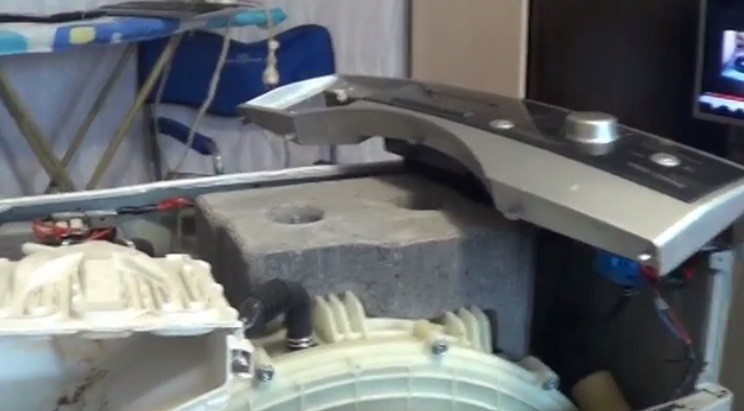
- We take out the counterweights.
- We pay attention to the drainage system: we unhook the clamps on the casing, pipe, drain hose and remove the debris filter, pump and snail as a whole.
- We release the wiring.
- We use our hands to spring and remove the shock absorbers, and then the water level sensor.
The tank is now completely free. To remove it, squeeze a pair of side springs with one hand and pull sharply on the edge with the other. All that's left to do is place the tank in a convenient location for further disassembly and begin removing the bearings.
Disassembling the tank and replacing the bearings
That's not all: to remove the bearing assembly, you'll have to disassemble the tank and knock the shaft out of the drum. It's best to perform these steps by lifting the tank onto a springy surface (such as a tire) and turning it upside down. Alternatively, raise the part by 3-4 chairs laid on their sides and place a soft cushion underneath. Then, proceed as follows.
- We unscrew the screws in a circle at the central joint and remove the small half of the casing.
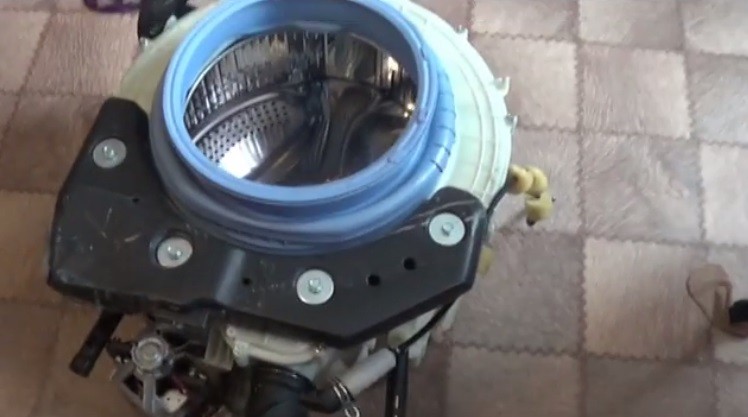
- We turn the tank over with the open hole facing down.
- We take a mallet and with sharp blows knock the drum out of the remaining part of the protective casing.
- We treat the inside of the tank with WD-40, removing scale, rust and accumulated dirt.
- We knock out the bearing and seal from it.
- If necessary, wash the hole with cleaner and wipe dry.
- We insert the outer bearing using a puller, and if there is none, we place the ring in the groove and carefully tap it in a circle with a hammer through a chisel.
- We turn the tank over and place the inner bearing, securing it by tapping it in the same way.
- We place the oil seal on the bearing ring.
It is recommended to pour a waterproof sealant over the oil seal and cover it with a layer of superglue to prevent water from getting into the bearing assembly and washing out the factory grease.
This is where the instructions for removing the bearings yourself practically end. All that's left is to put everything back in place. Place the removed half of the tank on the shaft and secure it with a few hammer blows. Next, connect it to the other half and securely tighten all the screws provided. Next, we install the container in the machine, and most importantly, we check the quality of the repair: by rotating the drum and assessing the smoothness and quietness of rotation.
If there are no suspicious braking or squealing sounds, we install the shock absorbers, attach the pressure switch, and connect the wiring. Next in line are the counterweights, the dispensing unit, the instrument panel, and the drive belt. Finally, we perform a final test: run a test cycle at minimum RPM and monitor for any abnormal noise.
Interesting:




Readers' comments
Headings
Washing machine repair




For buyers




For users


Dishwasher




Add a comment