
How to change a belt on a washing machine
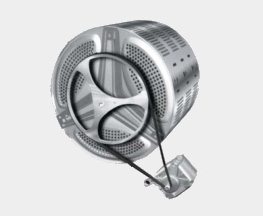 How do you know when your washing machine's belt needs replacing? Belt problems can manifest themselves in several ways. The drum may not spin during a wash cycle. In this case, the motor or control module may also be faulty. However, since checking the drive belt for integrity and wear is the easiest, we recommend starting with that.
This malfunction may have several causes, all related to the belt. It can break, in which case it needs to be replaced. It can also fall off, in which case it needs to be replaced. If it falls off frequently, it's best to replace it with a new one. It can also become so worn that it simply starts slipping. To confirm this is the problem, try spinning the drum by hand. If it spins very easily, the belt is not properly positioned.
If the drum still rotates, but only very slowly or not fully, the problem is most likely a worn belt. It should also be replaced.
Changing the belt
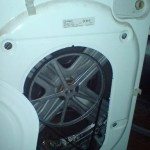 To change the belt ourselves, we'll need to access the machine from behind. Then, we'll need to unscrew the bolts securing the cover to the back of the washing machine. For this, we'll need a standard Phillips-head screwdriver. Once all the bolts are removed, we can remove the cover and the front.
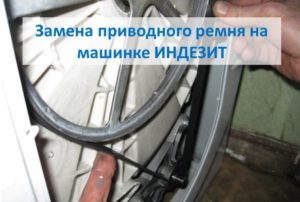
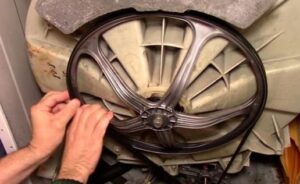
 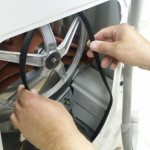 We open the pulley. If there's an old belt on it, remove it. To do this, pull it toward you while simultaneously turning the pulley. If the belt has slipped or broken, it's located inside the housing. You need to locate it and remove it.
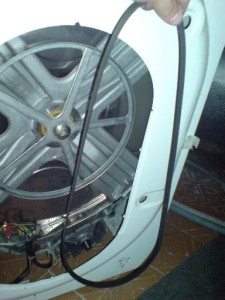 Next, take the belt you want to install. Place it first on the engine, then on the pulley. To place it on the pulley, first stretch the belt partway around, then turn it. After this, adjust the belt and make sure it fits snugly in the groove. Then, turn the pulley a few times to ensure everything is working properly.
After that, you can replace the back cover, tighten the screws, and perform a test wash. As you've seen from experience, the entire process is quite simple and doesn't require any special skills.
If you don't have a replacement belt, you can purchase one from appliance repair and maintenance shops. How do you find one? The easiest way to find one in a large city is online. Yandex, Google, and other search engines will help you find what you need.
Video instructions
By the way, you can also watch how to replace a washing machine belt yourself in the following video:
This type of failure has its own causes. It's best to know the possible causes in advance. This way, you can prevent a recurrence.
Causes of this malfunction
- This malfunction can occur for various reasons. For example, the belt often wears out very quickly on narrow washing machines. This is because it is located quite close to the machine body. As a result of wear, the drum can wobble during the wash cycle. The belt can also rub against the machine body, causing fraying.
- The pulley is broken or cracked. Pulleys are made of fairly brittle metal. If used improperly or if there's a manufacturing defect, they can break. Consequently, the belt will slip off or break.
- Bearing failure and wear can also cause pulley vibration, causing the belt to simply slip off.
- The cause may also be an imbalance in the items being washed or overloading the machine with dirty laundry.
- In top-loading washing machines, this problem can occur after 7-8 years of use. This is due to deformation of the plastic drum, which can change shape over time.
- Belt breakage can also occur if the machine is used very infrequently. A belt that remains in one position for too long can dry out, which can cause it to break.
Interesting:

1 reader comment
Add a comment
Headings
Washing machine repair




For buyers




For users


Dishwasher




Thank you! I was able to put the belt back on myself when it came off! I thank you from the bottom of my heart, I didn't have to call a repairman and pay for it.