
How to replace a washing machine pulley
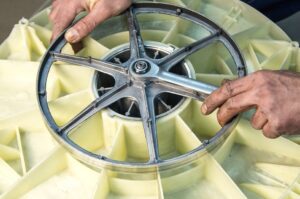 The urge to replace a washing machine's drum pulley may arise when the part no longer performs its primary function. Despite its apparent simplicity, this part is difficult to remove, even by a professional. Beginners may even have to spend a long time removing this part. Our instructions will help you replace your washing machine's drum pulley and avoid various problems.
Let's prepare the machine for repair
First, let's clarify what a pulley is and what it does. This device acts as a wheel, attached to the drum shaft with a special bolt. A washing machine also has a motor pulley. These components work together: thanks to a drive belt, one pulley rotates the other, thus performing the wash cycle. Therefore, it's clear that any malfunction will result in the machine simply not working.
If this situation does occur, you'll need to prepare your washing machine for repair. This is a simple step, but it shouldn't be skipped. First, you'll need to turn off the water supply valve. If your machine has a separate valve, turn it off; if not, use the main valve on the cold water riser and close it.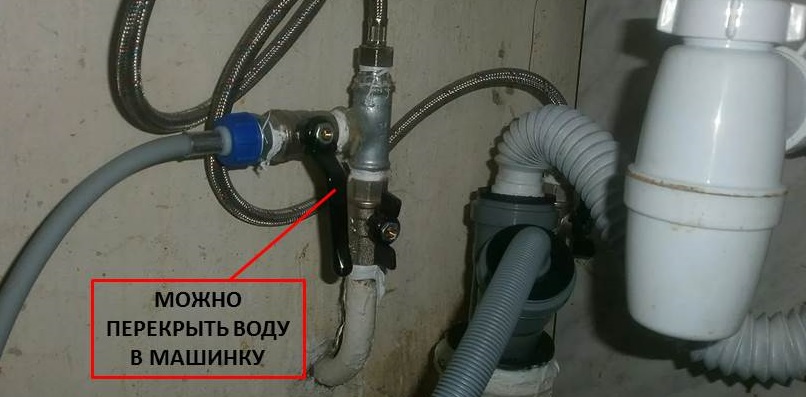
Next, turn off the power to the machine by unplugging it. Disconnect the drain and inlet hoses and move the unit so it's easy to work with. For easy access, you can move the washing machine to the center of the room. Next, proceed as follows:
- Arm yourself with a Phillips screwdriver and unscrew the screws on the back wall of the machine body;
- we remove the wall, thereby opening up access to the drum pulley;
- we remove the drive belt.
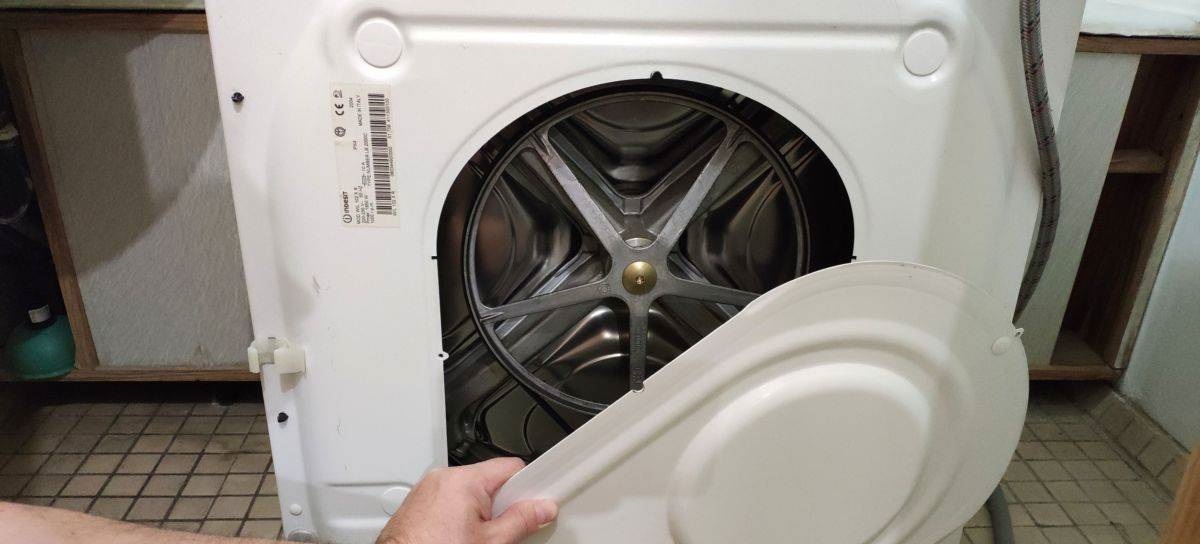
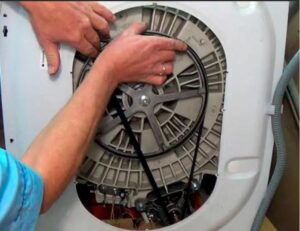
To remove the belt, you need to pull it toward you while simultaneously turning the pulley. After this, you'll need to feel the drive belt and inspect it for wear. You can also check the pulley. Often, loose fasteners can cause problems.
We remove the bolt
If the bolt holding the electric motor pulley is intact, replacing the pulley is easy. Simply select the appropriate size wrench, place it on the socket, and turn it counterclockwise. However, there is one important point: it will be necessary to slow down the part with a wooden block.
If moisture is present inside the bushing, the bolt threads may corrode, making removal difficult. Another possibility is that the manufacturer may have applied a special lubricant to the bolt threads, which can also make removal difficult. As a result, the mechanic must apply more force to the wrench in an attempt to overcome the resistance of the fastener, but ultimately only breaks the star. We'll discuss what to do in this situation later, but for now, let's discuss the tools available for removing pulley screws on different machines.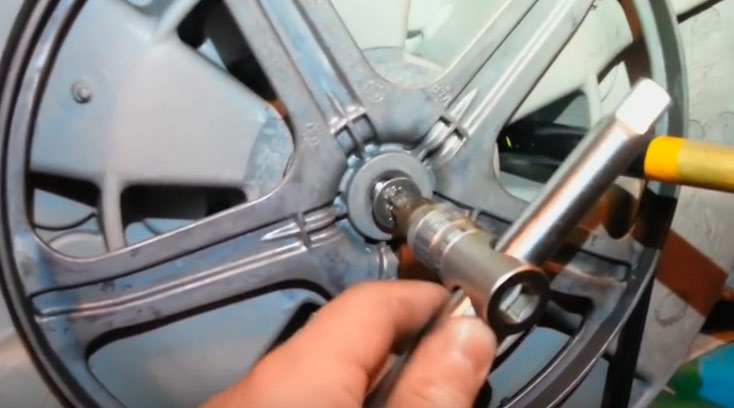
- On an Indesit washing machine, you have to use a star wrench. It's quite easy to strip the edges. You'll have to resort to an emergency method to remove the fasteners.
- Samsung machines are a bit simpler. The pulley is secured with a standard bolt, easily removed with a 17mm socket. If necessary, you can use an open-end wrench of the same size or an adjustable wrench.
- But on a Candy washing machine, removing the bolt without a star wrench is impossible. It's just as easy to strip the edges as on an Indesit. You'll have to resort to an emergency method.
Unable to remove the screw
When the head is damaged, it's much more difficult to deal with, as the wrench has nothing to grip. In this situation, treat the bolt with WD-40 cleaner and wait 15-20 minutes. 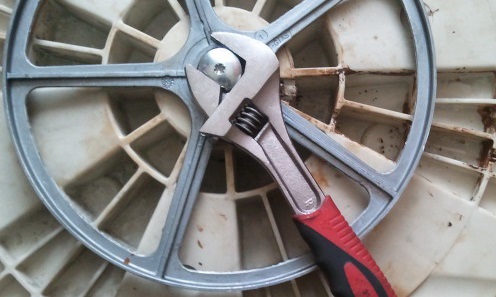
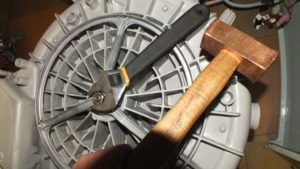
Next, use a chisel and hammer to make a notch on the head. A penetration of 1-1.5 mm should be sufficient. Then, insert the chisel horizontally into the hole and, using a hammer, try to turn the mechanism counterclockwise.
It doesn't matter which way you turn the screw, the main thing is to move it from its current position!
Sometimes, when a chisel fails, some mechanics cut off part of the bolt head so they can use a regular adjustable wrench. Alternatively, they heat the bolt head with a gas torch. However, this method isn't always effective, so it's recommended to simply use a chisel patiently.
The pulley won't come off even without a bolt.
Sometimes the situation becomes completely hopeless. The pulley becomes stuck to the bushing, making a chisel or hammer useless. This is caused by rust or deformation of the wheel. To quickly remove the buildup, use WD-40. Here's how:
- we ask a friend to hold the drum, and we take the pulley with both hands and try to unscrew the wheel;
- we begin to loosen the pulley, pulling the wheel off the tank;
- At the same time, we treat the joints with the product every 15-20 minutes.

If the pulley still won't come out, you'll have to knock it out. It's important to avoid using metal tools here, as they risk damaging the bushing and worsening the problem. A shovel handle, sharpened at one end, works better for this task: point the tip toward the center of the wheel, then tap the wood with a hammer. Make sure to hit hard and accurately. Be patient – you will have to wait until the part gives way and pops out.
Once the repair is complete, don't rush to replace the pulley—first, prepare the mounting surface for it. WD-40, a familiar product, will come to the rescue. Apply it in several steps, clean, and lubricate the bushing threads. If you see a damaged bolt, replace it. Install the new pulley and tighten the bolt. tighten the belt, close the back cover, connect the machine to the utilities and check its operation.
Interesting:

Readers' comments
Headings
Washing machine repair




For buyers




For users


Dishwasher




Add a comment