
The drum of the Zanussi washing machine does not spin.
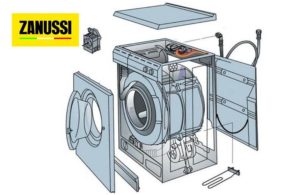
 If you notice that your washing machine isn't spinning, you need to take immediate action and fix the problem. Slowdown can be caused by problems with the belt, motor, heating element, or the machine's electronics. To avoid guesswork and hassle, we recommend checking all possible causes and eliminating any obstacles that prevent proper rotation. Full instructions for diagnosing and repairing your Zanussi washing machine are in our article.
Symptoms of failure, possible causes
The drum can stop at any stage of the wash cycle: at the start of the cycle, midway through, or during the spin cycle. The slowdown may be sudden or gradual, depending on the specific model, the underlying fault, and the motor's acceleration. The following symptoms may indicate something is wrong:
- water has poured in, but no unwinding occurs;
- the indicators on the dashboard are on, but there is no water intake;
- The machine is ready to start the cycle, the motor is humming, but the drum is static.
It's difficult to immediately explain this behavior. Moreover, there are about ten possible causes of a Zanussi washing machine malfunction that could lead to it stalling.
- Drive belt that has come off, is torn or is loose.
- A foreign object has entered the tank.
- Seized bearing assembly.
- Worn out electric brushes.
- Damaged electric motor.
- The heater is out of order.
- Non-functioning control module.
- Punched condensate.
A sequential examination of all possible causes will help accurately diagnose the source of the problem. It's best to start with the most likely and least labor-intensive options. So, let's begin identifying and repairing a non-rotating drum.
Urgent actions
 As soon as you notice the first signs of the drum not rotating, immediately unplug the power cord from the electrical outlet. It is strictly forbidden to touch the washing machine, as there is a possibility of current leakage onto the body of the unit. Next, turn off the water and leave the machine for 10-15 minutes until it cools completely.
What you should absolutely not do:
- try to restart the machine;
- start to find out the cause while the machine is running;
- press the buttons, trying to make the drum spin.
Remember that the washing machine is live and poses a dangerous threat to the owner's health, life, and property. It's best to immediately contact a service center after disconnecting the power to your Zanussi and have a technician come to your home. However, you can also fix the drum problem yourself, as discussed below.
Checking the drive belt
Most often, the drum does not rotate due to problems with the belt. Its weakening, damage or tearing can be caused by prolonged use, untimely replacement, manufacturing defects or regularly exceeding the maximum tank load. Fixing the drive yourself is quite simple: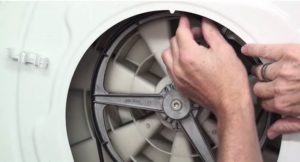
- We disconnect the machine from all communications (electricity, water supply and communications).
- We move it away from the wall, providing free access to the back wall.
- Unscrew the back cover.
- We inspect the belt for cracks or other damage.
- We remove the rubber band by pulling it towards ourselves with one hand and rotating the pulley with the other.
- We take a new belt and hang it on the engine shaft, then on the rotating pulley.
Important! A belt that comes off at high speed could damage nearby sensors and wires.
- We pay attention to the parts surrounding the pulley, replace them if necessary and tighten them.
- We put the lid back in place.
- We start the fastest wash.
If the drum doesn't move, the belt isn't the only culprit, or the installation process was improper. Recheck the rubber tension and rotate the shaft. If the result is negative, continue diagnostics to identify the secondary cause.
Removing a stuck object
If the drive belt is in good condition, it's time to check the drum itself. It's quite possible that a foreign object, such as a loose button or key, has gotten into the space between it and the drum. Continuing to operate the machine with an "uninvited guest" is extremely dangerous - the hard object will cause jamming or damage the drum wall. In any case, the repairs will be expensive, especially if you have to replace the internal tanks of the washing machine.
You can tell if something has gotten into the tank with a simple test. Open the hatch door and rotate the drum in both directions with your palm. Any resistance, ringing, or grinding sounds will clearly indicate the presence of an obstruction.
There's only one solution: remove the foreign object as quickly as possible. However, it's quite difficult to remove. You'll have to do this through the drain filter or the hole under the heating element. In the former case, the procedure is as follows:
Only soft or small objects, such as pins, buttons, coins, nuts, and socks, can enter the drain filter, hoses, and pipes.
- We find the drain hatch in the lower right corner of the body.
- We pry off the cover with a flat screwdriver.
- We cover the floor with rags.
- We unscrew the trash filter.
- We clean the body, wash the hoses and pipes.
Larger items remain at the bottom of the tank. The fastest way to get to them is to remove the back cover, disconnect the heater and remove the heating element from its seat. Next, shine a flashlight through the area, locate the object, and use long pliers, your fingers, or a wire hook to pull it out. It's important to proceed with extreme caution to avoid damaging the tank walls.
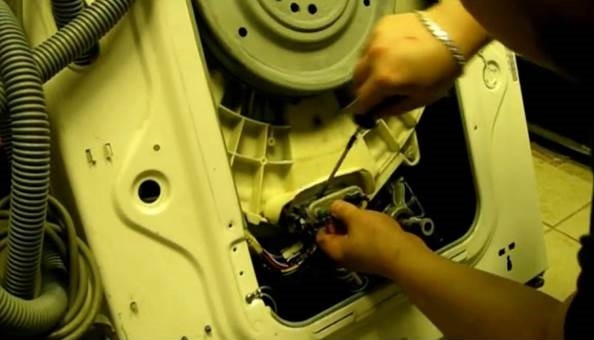
When the situation is severe and the drum has already jammed, you'll have to completely disassemble the drum. In this case, the procedure is similar to replacing the bearing assembly: remove the top and rear covers, drive, motor, dispenser, module, counterweights, shock absorbers, and all other machine components. After all these steps, remove the main tank, cut it in half, and remove any foreign material. Things are even more complicated if the drum is non-detachable. This will require four hours of cutting, which is best left to a service technician.
Problematic bearings
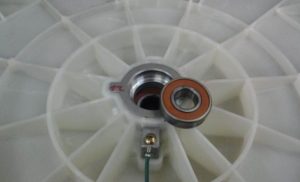 The drum also doesn't rotate due to the aforementioned bearings. More precisely, due to their wear, knocking out, or washing out all the factory grease. This can be caused by overloading the drum with laundry, improper operation, and leaking seals. In any case, the entire bearing assembly will have to be replaced. The replacement process is quite complex:
- We disassemble the entire machine.
- We take out the tank.
- We knock out the drum.
- We take out the old bearings.
- We select replacement parts.
- We change the unit and seals.
- We fix the parts with glue and treat them with sealant.
- We assemble the machine in reverse order.
It's very difficult to do all the work yourself, so it's best to seek professional help. Service center employees have more experience and specialized tools for disassembly and assembly. If you want to save even more, read the detailed bearing replacement instructions.
Engine malfunction
A static drum often indicates the motor lacks power to fully spin up. Worn carbon brushes are often to blame. Restoring the motor to its previous performance is quite simple: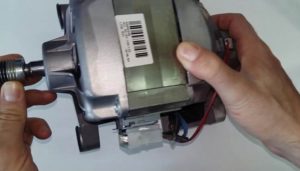
- We provide access to the engine by removing the rear cover of the machine and removing the drive belt.
- We release the wiring connected to the motor.
- We find brushes on both sides of the body. They are located in cases, have a power supply wire and a spring that presses the part against the rotating lamellas.
- Using a flat-head screwdriver, pry up the power terminal and pull out the wiring.
- We move the contact in the opposite direction.
- We press the latch, after which the spring releases and pushes the brush out.
Caution! Remember the direction the brush was installed; if installed incorrectly, the engine will spark.
- We measure the length of the carbon tip, which should be at least 0.7-1 cm.
- We take new electric brushes and place them in the engine crosspieces.
- We compress the attached spring and insert it into the brush.
- We fix the terminals.
- We connect the power wire.
It's best to mark the location of the part and its wires on the camera. You can't replace just one brush—they're removed only in pairs. Therefore, take the second part and repeat the procedure in the same way. Finally, check the secure fit and test the updated motor.
The heating element has failed.
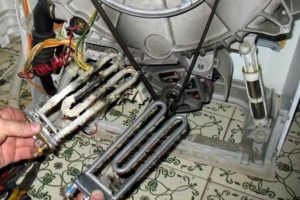 In Zanussi washing machines, a faulty heating element can also cause the drum to stall. The temperature sensor doesn't inform the control system that the water has heated up, and the module doesn't signal the motor to accelerate. Therefore, the motor rotates in test mode at a maximum speed of up to 30 rpm. In this case, DIY repair involves checking the heating element with a multimeter for functionality and, if faulty, replacing it with a new one. Let's start with testing:
- Unscrew the back cover.
- We find the heating element under the tank.
- We set up the multimeter to measure resistance.
- We disconnect all suitable conductors from the heater.
- We bring the measuring probes to the contacts and evaluate the results.
If the display shows a reading between 20-30 ohms, everything is fine. If it deviates from the norm, the heating element will need to be replaced. Loosen the retaining bolt, push its rod inward, and remove the device. Install it, reassemble the circuit breaker, and run a test cycle.
Perhaps it's an electronic issue?
Another reason for a non-spinning drum is faulty electronics. However, it's quite difficult to determine for sure whether the problem lies with the control board and whether repairs are needed. Moreover, it's not uncommon for a module to appear to be faulty, when in fact, the root cause lies in the previously discussed components of the washing machine. Therefore, it's not a good idea to immediately blame, repair, or replace the electronics: you could waste money and achieve no results.
Contacting a professional is the best course of action at this diagnostic stage. Only an experienced technician can accurately determine the source and extent of the problem, as well as repair a burnt-out triac or loose contact. Messing with the wires and chips yourself is strongly discouraged: more often than not, inexperienced experiments with the board result in permanent damage and costly replacement.
Interesting:



Readers' comments
Headings
Washing machine repair




For buyers




For users


Dishwasher




Add a comment