
How to protect your washing machine from leaks?
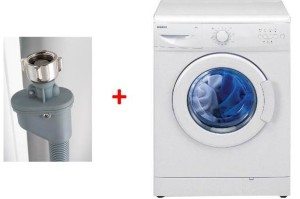 Finding a puddle of water under your washing machine is extremely unpleasant, as you'll have to not only repair the machine but also pay for the repairs to your neighbors who you've flooded. However, in case of a water leak, there are special protection systems and an Aquastop system for washing machines. It's worth examining these protection methods in more detail and understanding the drawbacks of each.
Protection options
All washing machines can be divided into three groups depending on the presence of a protection system:
- cars without protection;
- cars with partial protection;
- Machines that are completely protected from leaks.
Most low- and mid-priced washing machines are not equipped with leak protection. What does this mean? Water is supplied to the machine from the water supply through a regular flexible hose with special nuts on both ends. These machines typically have no bottom or are covered with a plastic panel. If the inlet hose ruptures, all the water in the machine will leak onto the floor. In a multi-story building, this situation can lead to flooding for the neighbors below.
So in this case It is recommended to close the water supply tap after turning off the machine. Or you can install an additional protection system yourself, such as inlet hoses with valves, which we'll discuss later. Some high-end washing machines already have protection installed. For example, complete leak protection is available in machines from the following brands:
- Asko;
- Ariston;
- AEG
- Bosch;
- Siemins;
- Miele;
- Zanussi;
- Electrolux.
Partial leak protection
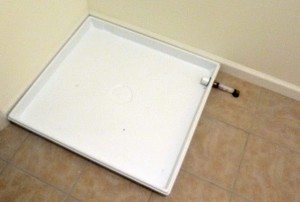 Let's look at what partial protection is and how it works. Machines with this type of leak protection are equipped with a special tray, such as the one shown in the picture.
A float equipped with an electric switch is installed inside the tray. The tray is made of plastic or metal, and the float is made of expanded polystyrene. When water leaks inside the machine, it flows into the tray. When a certain amount of water reaches the float, it rises and triggers the switch. This signal switches the machine to emergency mode, stopping the wash cycle and activating the pump, which drains the water.
Important! In this situation, an error code will appear on the machine's display. Different models have different codes. For example, an LG machine will display E1, while a Samsung machine will display E9.
If water leaks into the tray, you need to drain the water from it, and then look for the cause of the breakdown and fix it. You can learn about all the possible causes and solutions for leaks in our article on why your washing machine is leaking.
Filler hoses with valves
Washing machines with partial protection are so called because the protection is activated only when water leaks into the machine. However, if the hose breaks somewhere on the outside, flooding is inevitable. In this case, it's worth considering inlet hoses equipped with protection. There are three types:
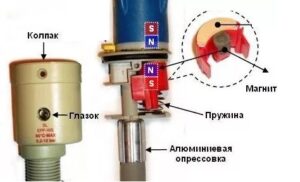
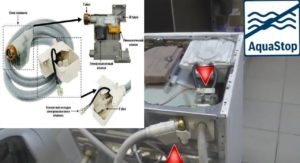
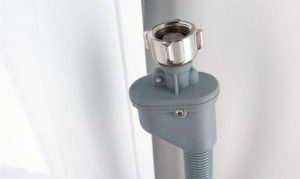
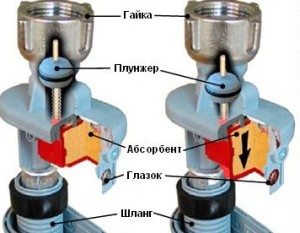 The first type of hose is a regular hose enclosed in a durable corrugated casing. At one end of the hose, which connects to the water supply, there's a built-in protective block with a viewing window. Inside the block is a plunger held in place by a spring. When the hose ruptures, water enters, the spring weakens, and the plunger closes the water supply. The viewing window then turns red.
Please note! The disadvantage of this type of hose is that once the leak protection is activated, it will have to be completely replaced.
- The second type of hose operates essentially the same as the first. The difference is that instead of a spring, the protective block contains a pair of magnets with like poles facing each other. These magnets hold the plunger in place until water enters the protective block. This hose is also replaced after a leak.
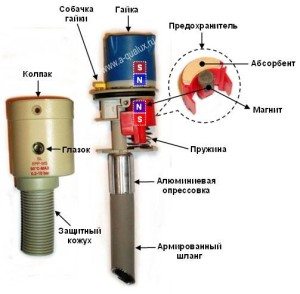
- The third type of hose has an electromagnetic valve rather than a mechanical one. While the machine is unplugged, the plunger shuts off the water supply; as soon as the machine is turned on, the valve opens. The control wires in this type of hose are hidden under a durable sheath.
Please note! The Aqua Stop inlet hose is designed for a pressure of 70 bar, which is 7 times greater than the maximum pressure in the pipeline.
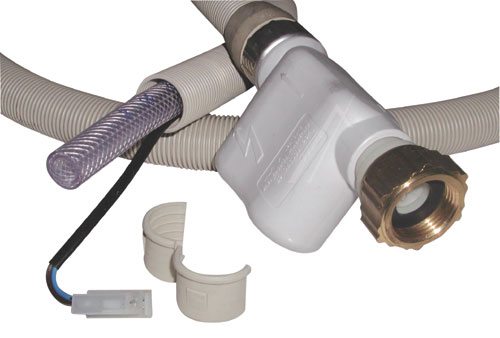
Complete protection against leaks – the Aqua Stop system
Washing machines with full leak protection not only have a tray with a built-in float, but also a hose with a solenoid valve, which we discussed above. In other words, if you connect such a hose to a machine with partial leak protection, it can be considered fully leak-proof.
This type of leak protection is considered the most reliable. Undoubtedly, machines equipped with the Aqua Stop system have an advantage over conventional machines. By paying a few hundred dollars more for it, you won't have to search for a high-quality inlet hose and figure out how to connect it properly. The entire system is already pre-configured by the manufacturer.
Please note that the Aqua Stop protection system is activated in cases of leakage in the washing machine tank, damage to the pipes, increased foam formation, and foam escaping.
Additionally, complete leak protection is complemented by an emergency water pumping system. It is activated if, for any reason, the main and safety valves fail to operate. The main valve is the machine's valve to which the inlet hose with Aqua Stop protection is directly connected. For information on how the main valve works and how to replace it, see the article "Inlet Solenoid Valve."
Thus, protecting your washing machine from water leaks can be either complete or partial. How you protect your room from flooding is up to you. However, it's best not to skimp on safety and at least install an Aqua Stop hose with a solenoid valve on your washing machine yourself. Believe me, it's worth it!
Interesting:

1 reader comment
Add a comment
Headings
Washing machine repair




For buyers




For users


Dishwasher




It's funny. If the inlet hose breaks, the water in the washing machine will jump 80 cm into the air to clear the tub? Have you ever stood next to a washing machine?