
Dishwasher leak protection
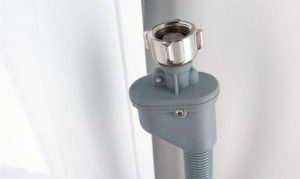 It's safe to say that leak protection in dishwashers has become a completely commonplace option, hardly surprising to modern buyers. However, when purchasing a new dishwasher, people often look for such protection, yet they almost always don't understand how it works or what it actually does. It's time to learn about the leak protection systems installed in modern dishwashers and discuss their usefulness.
What is it for?
First, let's look at what this protection is and why such protection is needed. Obviously, most users live in apartment buildings. When your upstairs neighbors flood you, it's a real disaster: a leaky pipe, a broken faucet, or, for example, a burst dishwasher hose. The result can be ruined repairs, legal proceedings, and compensation payments. This is where a system that prevents water from spilling from the dishwasher onto the floor could come to your defense. That's what it's for. A leak protection system, even if a leak does occur, can:
- turn off the water supply yourself;
- interrupt the washing program;
- turn off the power to the dishwasher, thereby preventing a flood.
In our opinion, every dishwasher and washing machine should be equipped with such a system, then there will be fewer lawsuits from dissatisfied neighbors. PMM water leak protection systems are divided into two types: complete and partial. Commercial names for these systems can vary: Aquastop, Waterstop, etc. The name doesn't change the essence or operating principle, but it's still worth mentioning. For example, Aquastop for dishwashers is most often found on Bosch units, but we'll discuss that later.
Protecting the housing from leaks
Let's start with partial leak protection, as it's twice as common on dishwashers. This protection is also called "body protection," as it doesn't prevent flooding if the hose is damaged, but it does protect against leaks in the hose inside the dishwasher. Body protection consists of the following elements:
- special pallet;
- sensor;
- float with lever;
- valve.
Some dishwashers don't have a separate valve. An additional Aquastop relay is installed on the fill valve.
This system is simple, so we'll now describe its operation using a specific example. Let's assume a crack has developed in the pipe near the pump. The damage causes a water leak. Water begins to flow into the tray, which contains a float, a lever, and a sensor. Gradually, the water level in the tray rises, pulling the float with it. The raised float changes the position of the lever, which in turn closes a contact.
The signal from the sensor is sent to the control module and the valve relay, which immediately shuts off the water. The control module activates the self-diagnostic system, displaying an error code so the user knows what's wrong. The downside of this system is obvious. If the hose located outside the housing ruptures, water will flow onto the floor instead of into the shower tray, with all the ensuing consequences.
100% protection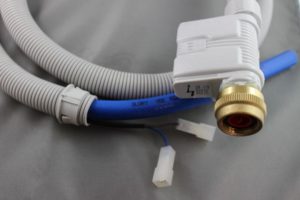
Complete leak protection, unlike partial leak protection, protects not only the housing but also the pressurized inlet hose. The Aquastop hose has double walls. When water gets between the inner walls, a sensor is triggered, located at the end of the hose near the housing. This sensor sends a signal to the valve, which in turn shuts off the water. The signal is also sent to the control board, which completely interrupts the dishwashing process and generates an error code.
The 100% protected housing has the aforementioned system in the tray, so we won't repeat it. Neither system is ideal, although option 2 is undoubtedly better. Both systems do not protect the drain hose. While damage to the drain hose is extremely rare, such leaks do occur, and water ends up on the floor unimpeded.
We hope this article sends a signal to dishwasher manufacturers to consider improving the drain hose as well, so that leak protection is truly 100%. The inlet hose protector is also disposable. If it works, you will have to throw away the inlet hose and buy a new one instead. It turns out to be a bit expensive, but there’s no other way.
Which cars have it?
100% leak protection is a common feature on almost all dishwashers from German manufacturers. Bosch dishwashers are a prime example. Models from the second, third, fourth, and other series are 100% leakproof. The same can be said for Electrolux dishwashers. Moreover, 100% leak protection doesn't depend on the price of the dishwasher; even the cheapest models feature it, as manufacturers don't skimp on safety, and that's very pleasing.
Many manufacturers produce dishwashers with leak-proof housings. Examples are not far to seek. Many Hotpoint-Ariston machines feature this type of protection. We also include "home helpers" from brands like Indesit, Candy, Gorenje, and Whirlpool.
So, we've covered the dishwasher's leak protection systems in a nutshell. Without getting too technical, we've covered everything a user needs to know. If you have any questions, please ask them in the comments or on our forum. Good luck!
Interesting:


Readers' comments
Headings
Washing machine repair




For buyers




For users


Dishwasher




Add a comment