
Grounding a washing machine yourself
 Grounding your washing machine, in accordance with all safety regulations, is the surest way to extend its life and protect yourself and your loved ones. Many people install their washing machine and, without thinking, plug it into the nearest outlet or power cord. But connecting it to the power grid is no less important than connecting the water supply and drain, so why is it only remembered when the machine burns out or starts giving you an electric shock? That's why we'll tell you how to ground it yourself.
Why ground a washing machine?
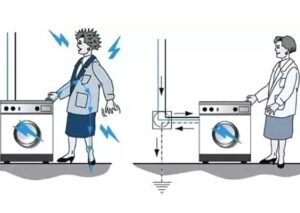
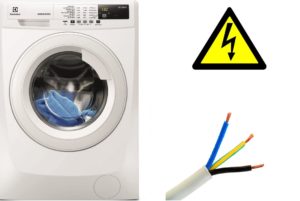
Not only washing machines but all household appliances need to be grounded. Any electrical network consists of two main wires, called the "phase" (the one carrying the power) and the "neutral" (the one carrying the power). In a grounded network, there's a third wire, called the "ground."
If the machine is equipped network filterIf you plug a washing machine into an ungrounded outlet, a residual voltage of 110 V will appear on its casing, which can be felt when touching the machine. If the insulation in the washing machine's wiring is damaged, the casing may become "live," which is 220 V, so touching it is enough to give a serious shock. And if the machine is installed in the bathroom, this poses a direct threat to health and life.
Grounding also protects the machine's electronics from power surges and lightning strikes on a building's transformer or rooftop antenna. This is why properly grounding your washing machine is so important—it ensures the safety of you and your appliance.
How to secure a washing machine in an apartment?
The wiring of a washing machine to the electrical network will depend on the age of the building. Grounding and safety issues shouldn't arise in new buildings, as grounding is already installed during construction, and the electrical wiring has a third grounding wire. Household appliances, including washing machines, already have a three-wire cord. This is sufficient to prevent the washing machine from causing an electric shock.
It's a completely different story if you live in a Soviet-era building. Here, you'll have to tackle a serious problem either yourself or hire an electrician to do it for you. There are two options for solving the grounding problem.
The first option involves setting up grounding from the electrical panel that supplies power and from which it feeds into the apartment. The process involves the following:
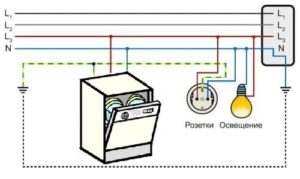
- The panel contains two busbars: neutral (N) and ground (PE). These will be used to route wiring to appliances and lighting.
- We run a three-wire copper cable from the washing machine outlet. We connect the wires as follows: the neutral wire (blue) to the N busbar, the live wire (red) through circuit breaker and RCD — to the phase wire of the meter, we connect the grounding wire (yellow-green) to the PE bus. It is prohibited to connect the grounding wire of the socket to the neutral working wire.
Important! Remember to turn off the power when working with wires.
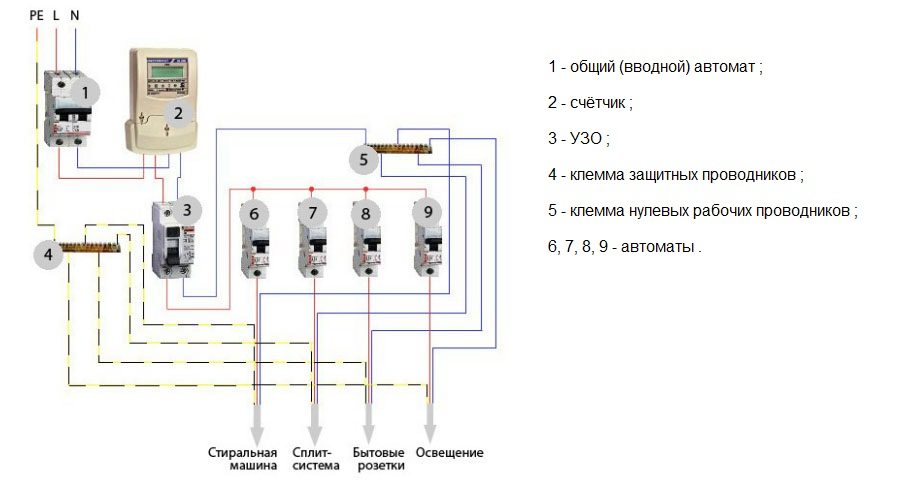
Properly installing electrical wiring requires more than just pliers, a test screwdriver, a three-wire cable, a grounded outlet, and a sharp knife—it also requires patience and precision. If this type of work seems too complicated, it's best to consult a professional.
Please note! This grounding method is legal and the most reliable.
In some older buildings, grounding may be absent altogether—that is, there's no ground wire in the electrical panel, as we discussed in the previous case. Furthermore, it's impossible to install such a ground if you live on the fifth floor. So, how can you protect your washing machine from power surges and yourself from electric shock? In this case, the solution is to install a potential equalization system. What is this?
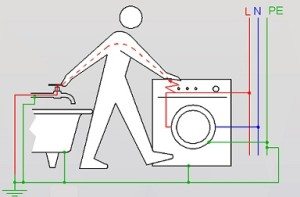 If a washing machine is installed in the bathroom, then when two conductive objects touch each other, current will flow through your body. The equipotential bonding system assumes that all conductive objects are connected by metal wires. In this case, if, for example, you touch the faucet and the washing machine, no current will flow through you.
In addition to this system, it's essential to install a residual-current device (RCD) and a circuit breaker in the electrical panel to ensure that the washing machine shuts off in the event of a power failure and prevents live power from reaching the machine body. Furthermore, when installing the washing machine in the bathroom, use a waterproof outlet; if one isn't available, avoid installing the washing machine in the bathroom altogether.
When installing electrical wiring, use solid wires. If connections are necessary, they should be made only in a dedicated conduit, carefully insulated.
An easier way to create a ground is to attach the ground wire from the washing machine body to a battery or sewer pipe. However, today it is not legal to do this. Secondly, it's unsafe, as even neighbors can "feel" the current if they touch the riser. And thirdly, cracks can form in the pipes, leading to flooding. Therefore, it's best not to use this method!
Grounding in a private home
Installing electrical wiring with grounding in a private home is similar to the process in an apartment, as described above. It's also done relative to the electrical panel. The difference is that the grounding itself also needs to be done manually. We'll describe this process in detail.
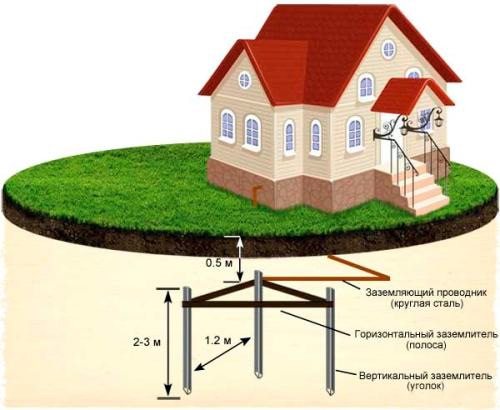
- We take 3 metal pipes with a length of 1.5 to 3 meters. The length must be no less than the depth of soil freezing.
- We sharpen the lower part of the pipes using a sledgehammer, and in the lower part (one third of the entire pipe) we make holes with a diameter of 5-10 mm.
- Now you need to dig a hole in the ground about 0.5-0.6 m deep.
- Next, we drive the pipes into the ground at a distance of 1 to 1.5 m, leaving 10-15 cm of the pipe sticking out above the ground.
- We take 3 metal plates or reinforcement bars 1-1.5 m long and connect the pipes sticking out of the ground using welding.
- A grounding wire must be welded to the fittings, which must be brought into the house to the location where the electric meter is installed.
- The grounding wire is connected to the PE busbar, and grounding wires are branched from the busbar to sockets and lighting.
Please note! In summer, when the air temperature is 350It is necessary to water the soil once a week with a saline solution prepared at the rate of 0.5 kg of salt per bucket of water. At a temperature of 300This can be done once a month, this will ensure the current is distributed in dry soil.
You can screw the ground wire to the bolt on the back of the washing machine. This bolt is designed for this purpose.
Therefore, reliable protective grounding in an apartment or private home can only be achieved by running a three-wire cable from the electrical panel to all outlets in the apartment or house. This grounded cable is then connected to an absorber circuit. All other methods are unreliable and unsafe. If you don’t have the opportunity or desire to do the grounding yourself, you will need to invite a specialist. It's better to do it once and do it right than to redo it and sigh about the fact that the washing machine burned out...
Interesting:



1 reader comment
Add a comment
Headings
Washing machine repair




For buyers




For users


Dishwasher




The Europeans did us a favor by connecting the midpoint of the surge protector to the washing machine body. In reality, the midpoint of the surge protector should be connected to the washing machine's power outlet and then connected to the protective neutral conductor in the outlet. Then we wouldn't have to disassemble the machine, remove the wire running from the midpoint of the surge protector to the machine body, and then insulate it. This also applies to other household appliances that require grounding. Well, in Europe, they frankly don't understand how a reasonable, sane, and conscious person could buy and operate household appliances that require grounding without one, because it simply doesn't exist. So, to make connecting the washing machine to the power outlet easier, they simply connected the wire from the surge protector to the machine body—these are innovators. Our people simply connect the washing machine to the water supply, lower the drain hose into the toilet during the wash cycle, plug it in, and wash. And then they complain about the machine giving them electric shocks.