
Grounding the dishwasher
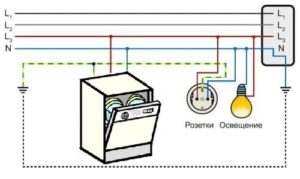 To protect your health and property, ground your dishwasher before using it for the first time. This will prevent current leakage onto the casing and minimize the risk of electric shock. Simply determine the presence of a ground wire in the electrical wiring, check its functionality, and connect the machine to the ground wire. You can either hire a professional electrician or do all the electrical work yourself. If you decide to do it yourself, our instructions will help.
Is there such a thing as "land"?
Let us immediately point out that if you do not have confidence in your abilities and the necessary knowledge and experience, you should not approach the electrical panel. Safety precautions are still important, and amateurism and the desire to experiment can lead to serious problems.If in doubt, please contact our customer service.
Now let's check if there's grounding in the house or apartment. Connecting to an existing grounding system is much easier than installing a new line. Experienced electricians can easily spot the presence of a third wire; all they need to do is: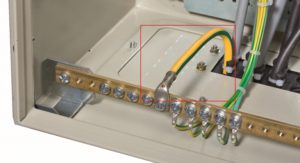
- open the main electrical panel;
- turn off the electricity supply to the apartment;
- remove the protective cover on the outlet allocated for the dishwasher;
- Assess the connected wires. If there is no grounding, only two wires, blue and brown, will be connected to the screw terminals. The ground is marked yellow and green and is connected to the bolt located between the two main phases. This means that this outlet does not have such a grounding at all.
It is worse when there is a jumper between the “zero” and the empty “ground” - this is a grounding, which poses many dangers for the residents of the house.
If all the wires in the outlet are the same color and there are no letter markings, you won't be able to fix it without outside help. You'll need to call an electrician who will use specialized equipment and tools to re-mark all the wires.
Does the "ground" work?
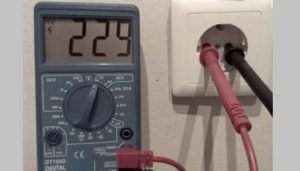 Let's say all three wires, including ground, are present. Then you need to check whether the ground in a specific outlet is working properly. You can do this yourself using a multimeter, a test lamp, or an indicator screwdriver. In the first case, proceed as follows.
- We turn on the electricity supply through the panel.
- We switch the tester to voltage measurement mode.
- Insert one multimeter probe into the intended phase and the other into neutral. Record the result.
- We move the second probe from zero to ground and carry out a similar measurement.
If the final reading is almost identical to the first, the grounding in the apartment is present and fully functional. A blank display indicates the opposite—the grounding wire is either missing or damaged.
If you don't have a multimeter handy, you can test the ground using a so-called test lamp. It's made from readily available materials: take a regular "Ilyich" light bulb, and attach two wires with current-sensitive switches to its socket. You shouldn't rely solely on the color of the insulation - there's a high probability that the electrician ignored the markings or mixed up the shades.. Next we proceed as follows:
- we touch one end of the phase, and direct the other to zero;
- remember how brightly the lamp burns;
- we move the tip from zero to ground.
Compare the light coming from the lamp with the first example. If it lights up the same, the grounding is working properly. If there's no light or it's significantly weaker, there's a problem with the ground wire.
If the RCD trips during this test, then the grounding is fine.
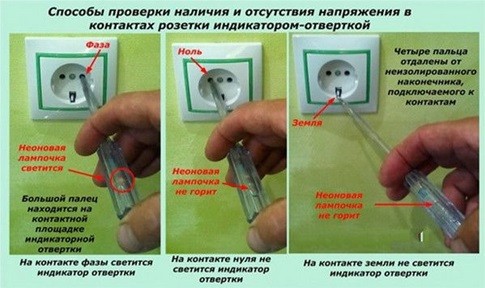
The ground is checked in a similar manner with a lamp and a test screwdriver. Don't forget about indirect evidence that the grounding is malfunctioning or missing. For example, a water heater or washing machine will periodically give off electric shocks, or you'll hear extraneous noise when listening to music on speakers.
Grounding a washing machine in an apartment building
Grounding is often not provided in older apartment buildings, known as "Khrushchev-era buildings." But don't put up with the lack of adequate protection—you can ground your dishwasher using an existing outlet. The key is to follow these steps.
- Find a suitable wire. A three-strand copper conductor of sufficient length and a cross-section of at least 3 x 1.5 mm2 or an aluminum section with a single strand area greater than 3 x 4.5 mm2 will do.
- Connect new wiring to the general apartment electrical panel.
- Fix the wire to the appropriate walls in the house along its entire length.
- Strip the ends of each wire by 2-3 cm.
- Using bolts and screws, attach the conductor to the electrical panel frame. More precisely, to the grounding point, where most of the wires are connected.
- Move the dishwasher and find a place on the back panel to connect the grounding wire.
To properly connect the ground to the washing machine, you need to look for a special sign on its body. This is a black and yellow triangle or circle with three horizontal stripes at the bottom and one vertical stripe perpendicular to them. The other end of the ground wire is located near this sign.
Grounding a washing machine in a private home
Grounding a dishwasher in a private home is a bit more challenging. The difficulty is that there's no common grounding system, so you'll need to construct a grounding loop and bury it properly. However, this can be done by following these instructions: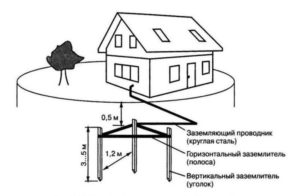
- We step back at least 1 meter from the outer wall of the house and determine the location for the future outline.
- Using a shovel, we dig a trench 0.5-1 m deep in the shape of a triangle with equal sides of 2 m.
- We insert a metal pin – a grounding rod – into each vertex of the resulting triangle. Any piece of metal at least 3 m long will do.
- We put on protective gloves and glasses and, using a welding machine, connect all the “vertices” with a metal strip.
- We fix a terminal on one of the vertices and attach a copper wire with a cross-section of 3*1.5 sq. mm or an aluminum wire with a cross-section of 3*4.5 sq. mm.
- We stretch the wire to the communal panel.
- We bury the structure with earth and compact it.
You can place the parts of the outline as a rectangle or as a single line - their location does not play a special role.
Next, we proceed similarly with the apartment grounding. Take another piece of suitable wire and connect it to the grounded panel and the dishwasher. We also use the special sign located on the back of the machine as a guide.
Some useful tips
In addition to the basic instructions, it's a good idea to know a few more secrets and rules for grounding and operating the dishwasher itself. Keeping these in mind will ensure long-lasting and trouble-free operation. Here are some tips to keep in mind:
- Do not use an extension cord in a dishwasher.
- You should not connect copper and aluminum together.
- Do not cut the ground pin from a three-wire wire.
- The machine is connected only to a power source of suitable power.
- If the dishwasher plug does not fit into the socket, the socket must be replaced with a new one.
- The use of intermediate conductors and all kinds of “tees” and adapters is prohibited.
- Once every six months, it is necessary to tighten the ground terminal in the panel, and once a year - directly on the circuit.
A dishwasher is powered by electricity and comes into contact with water, so grounding it is essential for every dishwasher owner. Whether to do it yourself or hire a professional is up to you, but neglecting safety and protection from electrical shock is definitely not a good idea. Most importantly, don't leave this job unfinished.
Interesting:



Readers' comments
Headings
Washing machine repair




For buyers




For users


Dishwasher




Add a comment