
How to find out the water hardness for your dishwasher
 For dishwashers, just like washing machines, tap water hardness is a crucial factor in achieving the best cleaning results. Manufacturers of dishwashing tablets and powders claim to soften water, but this isn't always the case. Water hardness can vary across the country, and tablets alone may not be enough to address this. This article will discuss how to determine water hardness and how to soften it for your dishwasher.
Hard Water: How It Affects Your Dishwasher
Water is called hard or soft depending on its chemical composition. A high concentration of calcium and magnesium salts indicates hard water. In chemistry, there are concepts such as "temporary" and "permanent" water hardness. The presence of calcium and magnesium salts in water is a temporary form of hardness, since when heated, these carbonates disintegrate and turn into sediment.
Permanent hardness is characterized by the presence of phosphates, nitrites, sulfates, and silicates of sodium and calcium in water. These compounds do not disintegrate when the water is heated and remain present continuously.
Important! Water hardness depends on the soil composition of the region. The more limestone in the soil, the harder the water will be.
The presence of all of the listed substances in water negatively affects the operation of water heating devices: kettles, washing machines and dishwashers. The harder the water, the more sediment forms when the water is heated, and the faster the heating element may fail. This is why modern dishwashers now use an ion exchanger as a water softener. The resin inside the exchanger attracts calcium and magnesium ions, making the water softer.
However, over time, the resin's ability to soften water diminishes, and if it isn't restored, the ion exchanger will fail, and the dishwasher will stop cleaning. Only replacing the unit will correct the situation. To prevent this, it's important to measure water hardness, which can even be done at home.
Determining water hardness
There are several ways to determine water hardness, some based on everyday experience, while others are more accurate and reliable. Here are some of them: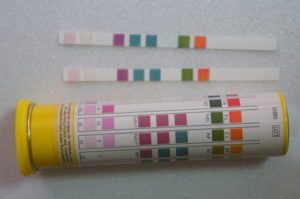
- Comparing masses. This method involves comparing the masses of water from different sources. Two containers of the same volume are filled with different amounts of water and weighed. The lower the mass of the water, the softer it is. This may help determine the water's hardness, but it's not suitable for dishwashers.
- Determine the degree of soapiness. Simply take regular laundry soap, wet it in water, and lather your hands. If it lathers easily and is difficult to rinse off, the water is soft. In hard water, soap lathers with difficulty. This method is also subjective.
- Scale formation rate. Another indicator by which people determine water hardness. If sediment and scale build up very quickly in your kettle, the water is hard.
- Water turbidity. You can tell whether water is hard by its turbidity. To do this, fill a transparent bottle and place it in a dark place for two days. If a cloudy film forms on the walls during this time, the water is hard.
- We use test strips. These strips allow us to determine water hardness more accurately. Some Bosch and Miele dishwashers come with strips included with the machine. Some strips are impregnated with a special compound; simply dip the strip in water for 1 second and then compare the color development on the strip with a table, such as the one below.
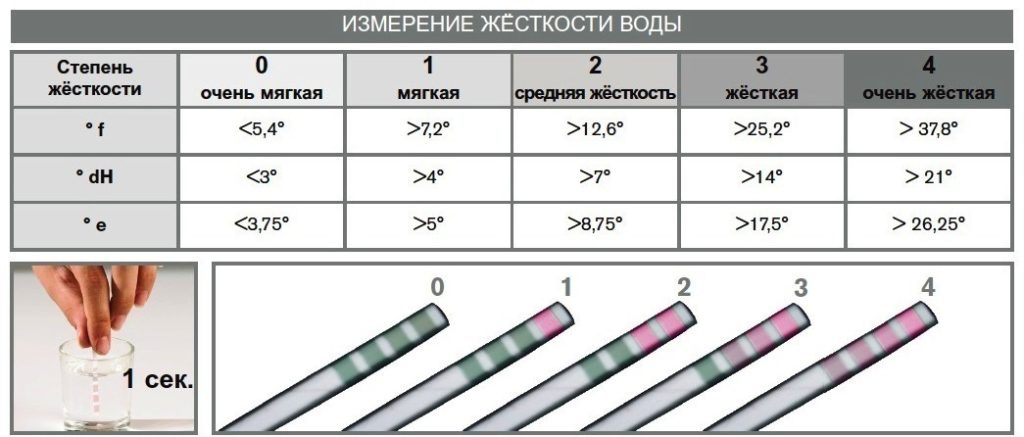
Biosensor Aqua test strips work a little differently. After soaking the strip in water for 2-3 seconds, wait 60 seconds, and then compare it to the color scale on the packaging to determine the water hardness. The scale looks like this:
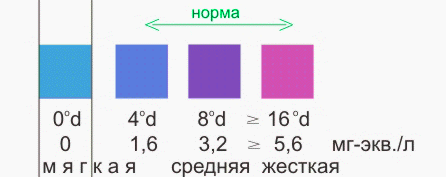
There are also strips that require special reagents. A small amount of water is poured into a glass, the strip is inserted, and then the reagent is added little by little. When the test strip turns color, the water hardness is determined using a chart. These strips come with detailed instructions for use, so be sure to read them.Please note! The test strip method is the most optimal for home use; they are inexpensive and much more accurate than the methods described above.
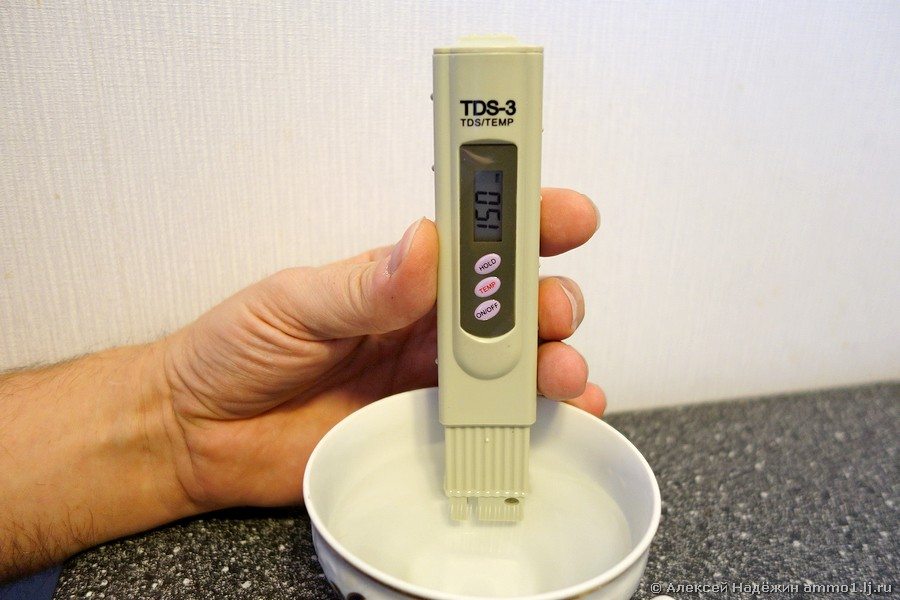
- We measure water hardness using a TDS meter. This device allows you to accurately determine the hardness level of your tap water. However, it's quite expensive. If you don't mind, you can get one.
What to do after measurements, how to soften water?
Once you've determined the water hardness in your home, you need to think about softening it. After all, you can't put water that's too hard in your dishwasher, let alone drink it. So how can you protect your dishwasher? First of all, remember to top it up regularly. regenerating salt into the dishwasher compartment at the bottom of the chamber. It's very important to adjust the salt consumption when doing this.
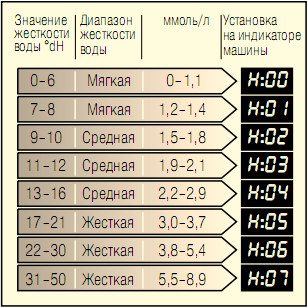
To do this, determine the flow rate using the table provided in the instructions. We offer an example water hardness table for a Bosch dishwasher.
Important! Combination tablets are not a substitute for salt in hard water, as the water passes through the ion exchanger. Without salt, it will simply fail, requiring the car to be repaired.
Another way to soften water for your dishwasher is to install a filter, such as a polyphosphate filter, on the water supply. The main thing is to remember to clean it regularly. Otherwise, the machine will eventually display error codes and stop washing.
Therefore, determining the water hardness at home is quite simple. Don't neglect this; it will help you protect your dishwasher from damage and optimize salt consumption. You'll also likely notice improvements in dishwashing performance, with streaks and deposits disappearing.
Interesting:



Readers' comments
Headings
Washing machine repair




For buyers




For users


Dishwasher




Add a comment